Customer Feedback: How to Collect, Classify, and Communicate It, with 100 Questions
Customer feedback is the information customers share, directly or indirectly, about their experience with a product, a service, or a brand: opinions, preferences, complaints, compliments, suggestions, and behavior you can learn from. This guide covers the whole system: where feedback comes from, how to ask for it through forms, interviews, and everyday interactions, how to classify it, who should receive it, and how to answer the customer. It is built on Cameron Conaway’s 3Cs method of tributaries, rivers, and lakes and on the five skills of feedback literacy, with 100 questions to ask and 20 replies to adapt.
By Professor Cameron Conaway, Penn State Smeal College of Business
Start where you are
Customer feedback is a different job for a founder, a product manager, a support lead, and an executive. Pick the row that matches yours.
| If you are | Start with |
|---|---|
| Starting out | |
| Starting from nothing | A 3Cs system in one afternoonA form, a shared channel, and a weekly 20-minute review. |
| Writing a survey this week | Forms and surveysRules for wording, timing, and length, with a five-question form. |
| Short of questions to ask | 100 questions to ask customersFor forms, interviews, and conversations. |
| Running a program | |
| Collecting plenty and using little | Classify: build the riverA tagging scheme, a weekly review, and a theme card. |
| Holding feedback that never leaves one team | Communicate: create the lakesWho should receive what, and how often. |
| Reporting a score to leadership | NPS, CSAT, and CESWhat each one measures, and what it misses. |
| Facing more requests than you can act on | How to prioritize feedbackImpact, effort, and a way to say “not now.” |
| Talking with customers | |
| Answering a negative review | Close the loop20 replies to adapt, in public and in private. |
| Preparing for customer interviews | Customer interviewsWho to invite, what to ask, and a 30-minute guide. |
| Hearing feedback on calls and chats | Everyday interactionsA three-line note that gets it out of your head. |
| Leading the organization | |
| Designing the whole system | The 3Cs: tributaries, rivers, and lakesCollect, classify, and communicate. |
| Building the habit across teams | Build the skill across your teamThe people side of a customer feedback system. |
What is customer feedback?
Customer feedback is the information customers share, directly or indirectly, about their experience with a product, a service, or a brand. It includes opinions, preferences, complaints, compliments, and suggestions. It also includes what customers do: where they stop, what they ignore, and what they come back for. Every piece of it is a data point that can inspire an improvement.
Three ways customer feedback arrives
Gartner’s research on voice of the customer programs sorts feedback into three kinds: direct, indirect, and inferred. Most organizations lean on the first and neglect the other two.
| Kind | What it is | Where it comes from | Best for |
|---|---|---|---|
| Direct | Feedback you ask for | Surveys, feedback forms, interviews, advisory groups | Answers to the questions you already have |
| Indirect | Feedback customers offer without being asked | Reviews, social posts, support conversations, sales calls, community threads | Learning what customers care about most |
| Inferred | Feedback you read from behavior | Usage, purchases, returns, renewals, cancellations | Checking what people do against what they say |
Solicited and unsolicited feedback
Solicited feedback is feedback you request, such as a survey or a rating prompt. Unsolicited feedback is offered freely, in a review, a social post, or a comment to a support agent. Innovation often hides in the unsolicited kind, because it tells you what customers care about most and not only what you thought to ask.
What useful customer feedback sounds like
Useful feedback is specific enough to act on. “Your site is confusing” gives you a mood. “It took me four clicks to find the billing page, and it felt buried” gives you a fix. When feedback arrives vague, your next question is what turns it into the second kind: “What were you trying to do when that happened?”
Customer feedback, customer service, and market research
| Activity | Purpose | Timing |
|---|---|---|
| Customer feedback | Improving the product, the service, and the experience | Ongoing |
| Customer service | Resolving one customer’s issue | After the issue arises |
| Market research | Studying a market or a segment, including people who are not customers | In planned studies |
The three feed one another. Strong organizations use service conversations to generate feedback, and they use feedback to improve the service.
What is voice of the customer?
Voice of the customer, often shortened to VoC, is the name for an organized program that gathers customer feedback from every source, analyzes it, and gets it to the people who can act. The 3Cs in this guide are one way to build such a program.
Why customer feedback matters
Customer feedback tells you what to fix, what to keep, and what to build while there is still time to act. It drives improvement, innovation, and retention, and it builds trust when customers learn that someone was listening. Four findings make the case.
- Effort decides loyalty more than delight does.
In a study of more than 75,000 customers, published in Harvard Business Review in 2010 as “Stop Trying to Delight Your Customers,” Matthew Dixon, Karen Freeman, and Nicholas Toman reported that making things easier for customers does more for loyalty than exceeding their expectations. Feedback is how you find the effort.
- Acting at the front line keeps customers.
Writing in Harvard Business Review, Rob Markey, Fred Reichheld, and Andreas Dullweber of Bain describe companies that kept their customers by asking for simple feedback and then giving frontline employees the power to act on it quickly.
- A few conversations go a long way.
In a 1993 study in Marketing Science, Abbie Griffin and John Hauser estimated that 20 to 30 one-on-one interviews bring out 90% to 95% of what a group of customers needs.
- One score is not enough.
Fred Reichheld introduced the Net Promoter Score in 2003 as “the one number you need to grow.” Later research, including a 2007 study in the Journal of Marketing, questioned whether any single number can carry that much weight. Scores tell you where to ask. The comments tell you what to do.
What it costs to skip it
Without feedback, teams build from assumptions, small problems reach customers before they reach you, and customers can leave without telling you why. A great system is not about data. It is about decisions.
The 3Cs: tributaries, rivers, and lakes
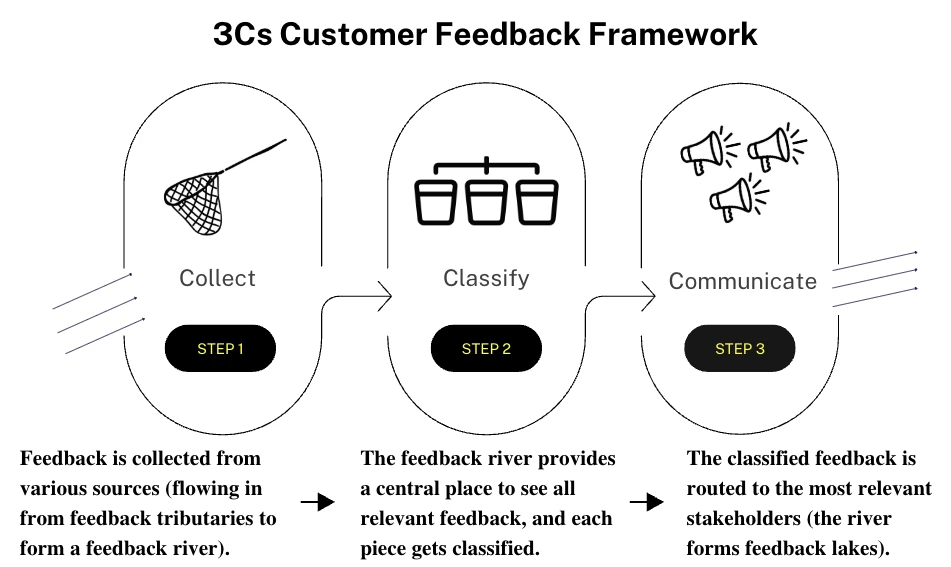
A customer feedback system has three jobs: collect feedback from every source, classify it in one place, and communicate it to the people who can act. Cameron Conaway calls these the 3Cs, and he pictures them as water: tributaries feed a river, and the river fills lakes.
- Collect: the tributaries.
Feedback starts in many small streams: a support ticket, a survey answer, a review, a remark on a sales call. Map every stream that matters, and decide how each one is monitored.
- Classify: the river.
Bring all of it into one central place where it can be read together. Then tag each piece: what it is about, who it came from, how it feels, and how urgent it is.
- Communicate: the lakes.
Route the classified feedback to the people and teams who can act on it. A lake is calmer than a river. It holds only what one team needs, where that team can study it.
Where most systems stop
Many organizations treat the river as the finish line. But the river contains everything, and it can be so overwhelming that it becomes irrelevant to the people receiving it. Three patterns are common.
- Tributaries without a river. Feedback stays where it was heard. A sales rep learns something important, and it never leaves that stream.
- A river without classification. A flood. Everyone can read everything, so nobody does.
- A river without lakes. People are left to fish for what they need.
What a working system carries
1 Collect: the tributaries
- Forms and surveys
- Interviews
- Support conversations
- Sales and success calls
- Reviews and social posts
- Product usage
2 Classify: the river
- Source
- Product area
- Theme
- Sentiment
- Customer segment
- Urgency
3 Communicate: the lakes
- Product
- Support
- Sales and success
- Marketing
- Leadership
An example
Suppose a batch of feedback arrives from your largest enterprise customers about one product. Classified in the river, it becomes three deliveries. The product team responsible receives the detail. The enterprise sales team receives the accounts to follow up with. The marketing team receives the public comments and decides whether and how to respond.
Play: Cameron explains the feedback river in three minutes.
Cameron first described the method in What is a Feedback River? Each term has its own entry: feedback tributary, feedback river, and feedback lake. The steps below follow the same order.
The five skills, applied to customers
A system moves feedback. People still have to ask for it, hear it, make sense of it, act on it, and answer it. Those are the five skills of feedback literacy in Cameron Conaway’s framework: seeking, receiving, processing, using, and giving. Each one changes shape with the way the feedback reaches you: a form, an interview, or an everyday interaction.
| Skill | In forms and surveys | In interviews | In everyday interactions |
|---|---|---|---|
| Seeking | Ask a few specific questions at the right moment, and make each one optional | Ask what the customer did, not what they might do | End the conversation with one specific question |
| Receiving | Read every comment, including the ones that sting | Listen without explaining or selling | Thank the customer before you solve anything |
| Processing | Tag each response, and count the themes | Compare notes across interviews before you conclude anything | Write down what was said, word for word, while it is fresh |
| Using | Choose one theme each cycle, and act on it | Turn each need into a decision with an owner and a date | Fix what you can on the spot, and pass on the rest |
| Giving | Tell respondents what changed because of them | Send a thank-you note that says what you learned | Answer the customer, and brief your team |
- Seeking
Customers answer the question you ask. A narrow, timely question (“How easy was it to set up your account today?”) earns a useful answer. A broad one (“Any feedback?”) earns silence. The lesson on how to ask for feedback covers the skill.
- Receiving
The first reaction to criticism of your work is to explain, and customers hear an explanation as an argument. Receive first: thank the person, restate what you heard, and ask one question. The lesson on how to receive feedback goes deeper.
- Processing
One comment is an anecdote, and a pattern is a finding. Processing means classifying, counting, weighing the source, and deciding what the feedback means before you decide what to do. Cameron Conaway’s 6 Ps of Processing Feedback and Feedback Decision Tree were built for this step.
- Using
Feedback that changes nothing teaches customers to stop giving it. Choose what to act on, act, and check whether the change worked. The Feedback GROWTH Model treats that check as part of using feedback.
- Giving
The loop closes twice: when the customer hears back, and when your colleagues hear what customers said. Both are acts of giving feedback, and the 20 replies in this guide are a place to start.
How the five skills and the 3Cs fit together
One way to connect them: seeking and receiving are how feedback enters the tributaries. Processing is the work of the river. Giving, inside the company, is what fills the lakes, and using is what the lakes are for. Giving, outside the company, closes the loop with the customer.
Collect: map your tributaries
List every place where customers talk to you or about you, name a keeper for each one, and decide how each is captured. That list is your tributary map, and making it is the first step of the 3Cs. If you aren’t monitoring the streams, the river will eventually run dry.
Private streams and public streams
- Private streams carry what customers send you directly: support tickets, survey answers, emails, calls, and meetings. Customers need easy ways to use them.
- Public streams carry what customers say where others can read it: app stores, review sites, social media, and forums. They need deliberate monitoring, or you never learn what was said.
A tributary map
Copy this table, delete the rows you don’t have, and add the ones only your business has.
| Tributary | What flows in | Who hears it first | How to capture it |
|---|---|---|---|
| Forms and surveys | Ratings and comments you asked for | The survey’s owner | Send every response to the river automatically |
| Customer interviews | Stories, needs, and workarounds | Product, research, or the founder | Tagged notes within a day |
| Support tickets, chats, and calls | Problems, confusion, and requests | The support team | A theme tag or a capture note on each one |
| Sales calls and demos | Objections, missing features, and comparisons | The sales team | A capture note after the call |
| Onboarding, renewals, and account reviews | Goals, risks, and reasons to stay | Success and account managers | A capture note, and the reason for every lost renewal |
| Cancellations and returns | Reasons for leaving | Billing or operations | One question at the moment of leaving |
| Public reviews | Praise and complaints, in public | Often nobody | A weekly check or an alert |
| Social media and communities | Reactions, questions, and comparisons | Marketing or community | Mentions forwarded to the river |
| In-person conversations | Comments at the counter, on site, and at events | Frontline staff | A shared note or a short form on a phone |
| Product usage | What people do, skip, and abandon | Product and analytics | A monthly summary in plain words |
How to run a tributary audit
- List every stream.
Ask each team one question: “Where do customers tell you things?”
- Name who hears it first.
That person or team is the stream’s keeper.
- Mark the silos.
Which streams never leave the team that hears them? Those are the ones to connect first.
- Choose a capture method for each.
The less effort it takes, the more reliably the feedback flows.
- Set a check for the public streams.
Weekly, or by alert, with a name next to it.
Feedback reaches you in three ways: through forms, through interviews, and through everyday interactions. Each one asks for a different approach.
Forms and surveys
A good feedback request is personal, specific, optional, and sent while the experience is fresh. For example: “Hi Alex, thanks for using the dashboard today. Could you take 15 seconds to tell us how it went?”
When to ask
| Moment | Ask | Why then |
|---|---|---|
| Right after a support conversation | How easy was it to get the help you needed? | The effort is still fresh |
| After a purchase or a delivery | How satisfied are you with your order? | Satisfaction is tied to one event |
| Thirty days after signing up | What nearly stopped you from getting started? | New customers still remember the obstacles |
| After a success, such as a finished project | What were you trying to get done, and did you? | You learn what success means to them |
| Once or twice a year | How likely are you to recommend us, and why? | It measures the relationship, not one event |
| At cancellation | What is the main reason you are leaving? | It is the last moment they will tell you |
Seven rules for writing questions
- Ask one thing at a time.
“How fast and helpful was our team?” is two questions with one answer box.
- Use the customer’s words.
They don’t know your internal names for features or teams.
- Keep the wording neutral.
“How was setup?” is a question. “How much did you enjoy our easy setup?” is a hint.
- Balance the scale, and label both ends.
Give as many negative choices as positive ones.
- Make every question optional.
A forced answer is a guess, or a closed tab.
- Include one open question.
Ratings tell you where to dig. Comments tell you what is there.
- Stay under two minutes.
Five questions are plenty. Say how long it will take, and keep the promise.
A five-question feedback form
- Overall, how satisfied are you with [product or service]?
A scale from 1 (very dissatisfied) to 5 (very satisfied).
- What were you trying to get done?
Open text.
- How easy was it to do that?
A scale from 1 (very hard) to 7 (very easy).
- What is one thing we could do better?
Open text.
- May we contact you about your answers?
Yes or no, with a place for an email address.
Questions 2 and 4 take the longest to read and return the most.
How to get more responses
- Ask close to the experience. Hours, not weeks.
- Put the first question in the message. One tap to start is easier than a link to a blank page.
- Send it from a person. A message from a named person reads as a request. A message from a department reads as a campaign.
- Say what happened last time. “You told us checkout was slow. Here is what we changed.” People answer when answering has worked before.
- Protect customers from too many requests. Set a limit, such as one request per customer each month.
What forms miss
A form hears only from the people who answer, and only about what you asked. Pair it with interviews and with the unsolicited streams, so that the customers who never fill in a form still reach you.
Customer interviews
An interview trades reach for depth: a few customers, in their own words, describing what they did and why. Start with five. Patterns begin to repeat quickly, and the research above suggests that 20 to 30 conversations bring out nearly everything a group of customers needs.
Who to invite
- New customers. They remember choosing you, and what nearly stopped them.
- Longtime and heavy users. They know the workarounds.
- Customers who left. They know what was missing.
- People who chose someone else. They know how you compare.
- Customers who just complained or just praised you. The details are fresh.
Mix them. Talking only with your happiest customers is a common mistake, and a comfortable one.
Rules for the conversation
- Ask about the past, not the future. “Tell me about the last time you did this” gets facts. “Would you use this?” gets politeness.
- Follow the story. “What happened next?” and “Why was that hard?” do most of the work.
- Don’t pitch, explain, or defend. You are there to learn how it works for them.
- Let silence do its work. The detail usually arrives after the pause.
- Ask what they have already tried. A workaround is a request with the proof attached.
Rob Fitzpatrick’s book The Mom Test is built on the same point: ask people about their lives and what they have done, because opinions about your idea are unreliable.
A 30-minute interview guide
- 3 minutes
Welcome. “There are no right answers. I’m here to learn how this works for you.”
- 5 minutes
Context. Their role, their week, and where your product or service fits in it.
- 10 minutes
The last time. One real occasion, from start to finish: what set it off, what they did, and how it ended.
- 7 minutes
Problems and workarounds. What was hard, what they tried, and what it cost them.
- 3 minutes
Alternatives. What else they have used or considered, and why.
- 2 minutes
Close. “What should I have asked you?” Thank them, and say what happens with what they told you.
After the interview
Write your notes within the hour. Keep quotes word for word, and keep what was said apart from what you concluded. Tag the notes, send them to the river, and send the customer a short thank-you that names one thing you learned.
Everyday interactions
A great deal of customer feedback is never typed into a form. It is said to a person: a support agent, a salesperson, a cashier, an account manager. The job is to get it out of that person’s head and into the river.
A three-line capture note
What the customer said, in their words
“I export everything to a spreadsheet on Fridays, because the report can’t group by region.”
What they were trying to do
Send a weekly regional summary to her director.
How often you have heard it
A few times this month.
Three lines take under a minute to write, and they give the next reader the quote, the goal behind it, and a sense of scale.
Where to listen
- Support conversations. Note the problem and the workaround the customer was using.
- Sales calls and demos. Note objections and missing features in the customer’s words, including the deals you lost.
- Onboarding and account reviews. Note what the customer is trying to achieve this quarter and what could stop them.
- Cancellations and returns. Always ask for the reason, with one question.
- In person. At the counter, on a site visit, or at an event, write it down the same day.
- In public. Reviews and social posts are interactions, too, and other customers are reading your reply.
Three habits for frontline teams
- Ask one question before you finish.
“Is there anything that would have made this easier?”
- Capture it before the next conversation.
Memory keeps the gist and loses the wording.
- Close your own loops.
Tell the customer what you did with what they told you, even when the answer is “not yet.”
Make it easy to pass along
Give the team one place to post, such as a shared channel or a three-field form, and thank the people who use it. When passing feedback along takes more than a minute, it tends to stay where it was heard.
100 questions to ask customers
The best customer feedback questions are short, neutral, and about something the customer has done. Choose a handful. Nobody answers 100 questions, and nobody should be asked to. Replace the words in brackets with your own, and use the customer’s names for things in place of yours.
- Satisfaction
- Loyalty
- Effort
- Product and feature
- Onboarding and first-use
- Purchase and checkout
- Support experience
- Cancellation
- Price and value
- Opening and context
- The last time
- Problems and workarounds
- Alternatives and switching
- Closing an interview
- In support conversations
- In sales and renewal conversations
- In person
Questions for forms and surveys
Satisfaction questions
Rated from 1 (very dissatisfied) to 5 (very satisfied), with one open question to follow.
- Overall, how satisfied are you with [product or service]?
- How satisfied are you with your most recent order?
- How satisfied are you with the help you received today?
- How well did [product or service] meet your expectations?
- How would you rate the quality of what you received?
- What is the main reason for your rating?
Loyalty questions
The first is scored from 0 to 10. The others are open.
- How likely are you to recommend [company] to a friend or a colleague?
- What is the main reason for your score?
- What is one thing that would raise your score by a point?
- What would you tell a friend who was considering us?
- What would you miss most if you could no longer use [product or service]?
Effort questions
Rated from 1 (very hard) to 7 (very easy).
- How easy was it to get the help you needed today?
- How easy was it to find what you needed?
- How easy was it to complete your purchase?
- How easy was it to get started?
- What, if anything, took more effort than it should have?
Product and feature questions
For a product you can change. Send them to people who used the feature recently.
- What is the main thing you use [product] for?
- Which feature do you use most, and why?
- Which feature have you stopped using, and why?
- What is the hardest part of using [product]?
- What do you still do by hand that you wish [product] did for you?
- If you could change one thing about [product], what would it be?
- What nearly stopped you from using this feature?
- How would you describe [product] to a colleague?
Onboarding and first-use questions
For the first 30 days, while the obstacles are still remembered.
- What were you hoping to do when you signed up?
- How easy was it to get set up?
- What was confusing in your first week?
- What nearly made you give up?
- What did you expect to find that you didn’t?
- Which instructions or guides did you use, and how useful were they?
Purchase and checkout questions
For the confirmation page or the first message after an order.
- What nearly stopped you from buying today?
- What other options did you consider?
- What information was missing when you were deciding?
- How easy was it to check out?
- How did you first hear about us?
- What convinced you to choose us?
Support experience questions
For the message that follows a closed ticket, chat, or call.
- Did we resolve your issue today?
- How many times did you have to contact us about this issue?
- How well did we understand your problem?
- Was anything unclear in our reply?
- What could we have done to solve this faster?
- Is there anything else we can help with while you are here?
Cancellation questions
For the moment a customer leaves. Ask one or two, never all six.
- What is the main reason you are leaving?
- What were you hoping for that we didn’t deliver?
- What will you use instead?
- What is one thing that would have kept you?
- What did we do well that we should keep doing?
- May we contact you if we fix this?
Price and value questions
For a relationship survey or a renewal conversation.
- How would you rate the value for what you pay?
- Which parts of [product or service] are worth the most to you?
- Which parts would you not miss?
- What would make [product or service] worth more to you?
- How does our price compare with the alternatives you considered?
Questions for interviews
Opening and context
To learn where you fit in the customer’s work before you ask about yourself.
- Tell me about your role and what a normal week involves.
- Where does [product or service] fit into your work?
- How did you handle this before you used us?
- What prompted you to start searching for something new?
- Who else is involved when you use it, or when you decide about it?
- What does success with [product or service] mean for you?
The last time
One real occasion, from start to finish. These eight do most of the work in an interview.
- Tell me about the last time you used [product]. What set it off?
- What were you trying to get done?
- Take me through what you did, step by step.
- Where did you get stuck?
- What did you do when that happened?
- How long did the whole thing take?
- Who else did you need to involve?
- How did it turn out?
Problems and workarounds
To size a problem before anyone proposes a solution.
- What is the hardest part of [the task]?
- Why is that hard?
- How often does it happen?
- What does it cost you when it does?
- What have you tried in order to solve it?
- What do you like and dislike about that workaround?
- If this problem disappeared tomorrow, what would change for you?
Alternatives and switching
To learn what you are compared with, which is often not a competitor.
- What else have you used for this?
- What made you switch, or stay?
- What nearly stopped you from choosing us?
- What do the alternatives do better?
- What would make you leave?
- If we disappeared tomorrow, what would you do instead?
Closing an interview
The last two minutes often hold the best material.
- What should I have asked you that I didn’t?
- Is there anything you expected me to ask about?
- Who else should I talk with?
- May I follow up when we have something for you to try?
Questions for everyday interactions
In support conversations
Ask one before the conversation ends.
- Before we finish, is there anything that would have made this easier?
- What were you trying to do when this happened?
- Has this happened before?
- How are you getting around it for now?
- Is there anything else about [product] that has been bothering you?
In sales and renewal conversations
To hear the objection behind the objection.
- What made you decide to talk with us now?
- What would have to be true for this to be an easy yes?
- What is missing for you?
- What worries you about switching?
- What has worked well for you this year, and what hasn’t?
- What do you need from us in the next six months?
In person
At the counter, at the table, or on a site visit. Then write the answer down.
- How was everything today?
- Did you find everything you came in for?
- What brought you in today?
- Is there anything you wish we carried or offered?
- What is one thing we could do better next time?
How to choose
- Start from a decision. Ask only what could change what you do next.
- Pair one rating with one open question. The rating tells you where you stand, and the comment tells you why.
- Test the wording on three people. If they hesitate, rewrite it.
- Keep the same questions over time. A score means more next to last quarter’s.
Classify: build the river
Bring every piece of feedback into one place, and tag it so that it can be sorted, counted, and found. Collecting feedback without classifying it is collecting a pile of data. It doesn’t matter until you make it matter.
Choose the river
The river is one central place where all feedback can be read together. What matters is that there is only one, that every tributary reaches it, and that someone tends it.
- A shared channel. Fast and low effort, in a tool the team already opens. Harder to count.
- A spreadsheet. Easy to sort, count, and search. Someone has to add the rows.
- A dedicated feedback tool. Captures and tags automatically. Costs money and setup time.
Start with what your team already uses every day. In his post on feedback rivers, Cameron describes how Patagonia kept customer feedback in large spreadsheets organized by month and searchable for years, because a product revision could take two years to reach the shelf.
A tagging scheme
| Tag | The question it answers | Example values |
|---|---|---|
| Source | Which tributary did it come from? | Survey, interview, support, sales, review, social, usage |
| Product area | What is it about? | Checkout, onboarding, billing, reporting, delivery |
| Theme | What is the customer saying? | Too slow, hard to find, missing feature, unclear price |
| Sentiment | How does it feel? | Positive, neutral, negative |
| Customer segment | Who said it? | New or longtime, free trial or enterprise, region, industry |
| Urgency | How soon does it matter? | Blocking, painful, minor |
Six tags are enough to begin, and you can add detail wherever it helps. A comment from an enterprise customer with a large contract and a comment from someone on a free trial may both matter, and they should not be mistaken for each other. Keep the scheme short enough that people use it.
A classified entry
The feedback
“I export everything to a spreadsheet on Fridays, because the report can’t group by region.”
The tags
Source: support call. Product area: reporting. Theme: missing feature. Sentiment: negative. Segment: enterprise, three years. Urgency: painful. Heard four times this month.
Tend the river every week
- Read everything new.
One person owns the review, and a different colleague joins each week.
- Tag what is untagged.
Use the customer’s words for themes, not your internal ones.
- Count the themes.
What rose this week, and what is new?
- Pull three quotes.
Choose the ones that say it best. A quote travels further inside a company than a chart does.
- Decide what goes to which lake.
The next section covers the routing.
From comments to themes
Open-text answers are where the specifics are, and they take a method to read.
- Read a sample first.
Fifty comments, without tagging anything.
- Name the themes.
Write each one as a customer would say it: “I can’t find my invoice.”
- Tag every comment.
One comment can carry two themes.
- Count, and split by segment.
A theme that is rare overall can be the main problem for one group.
- Ask a second reader.
The 1993 study by Griffin and Hauser also examined how many analysts it takes, since one reader can miss what another catches.
Where AI helps, and where it doesn’t
AI speeds up processing through sentiment analysis, topic detection, and automatic tagging. It helps with scale, and it works best as an assistant to human judgment, not a replacement for it. Let it propose tags and summaries. Have a person check a sample every week, keep reading real quotes, and follow your privacy rules before customer data goes into any tool.
Check the river for bias
- Who is missing? Customers who never answer surveys, small accounts, and other regions and languages.
- Who is loudest? One large account or one frequent poster can sound like a crowd.
- What is most recent? Last week’s complaint feels bigger than last quarter’s pattern.
- What did the question suggest? A leading question upstream produces agreeable data downstream.
- What were you hoping to hear? Read the feedback that argues against your plan twice.
A theme card
When a theme is ready to leave the river, put it on one card. The card is what travels to the lake.
- Theme
Reports can’t be grouped by region.
- Evidence
Fourteen mentions in six weeks, nine of them from enterprise accounts.
- In their words
“I export everything to a spreadsheet on Fridays.”
- What it costs them
About an hour a week for each regional manager.
- Owner
The reporting team.
- Next step
Decide by March 15 whether to build grouping, and tell the customers who asked.
NPS, CSAT, and CES
Three scores cover most needs: CSAT for one experience, CES for effort, and NPS for the relationship as a whole. None of them explains itself, so each one needs an open question beside it.
| Score | The question | How it is calculated | Best for |
|---|---|---|---|
| CSAT Customer Satisfaction Score | “How satisfied are you with your order?” on a scale of 1 to 5 | Commonly, the percentage of answers that are 4 or 5 | One experience: an order, a ticket, a visit |
| CES Customer Effort Score | “How easy was it to get the help you needed?” on a scale of 1 to 7 | Commonly, the average score, or the percentage of answers at 5 or above | One task: getting help, checking out, setting up |
| NPS Net Promoter Score | “How likely are you to recommend us to a friend or a colleague?” on a scale of 0 to 10 | The percentage who answer 9 or 10, minus the percentage who answer 0 to 6 | The whole relationship, once or twice a year |
How to calculate NPS
People who answer 9 or 10 are called promoters, 7 or 8 passives, and 0 to 6 detractors, as Bain describes the method. Suppose 200 customers answer: 90 promoters, 70 passives, and 40 detractors. Promoters are 45% and detractors are 20%, so the score is 45 minus 20, or 25. The score can run from −100 to 100.
Where the effort score came from
The Customer Effort Score comes from the 2010 Harvard Business Review article described above. Its original question was “How much effort did you personally have to put forth to handle your request?” Many teams now ask the easier-to-answer version in the table.
How to use a score well
- Compare with yourself. Your trend over time means more than another industry’s average.
- Mind the sample. With 30 answers, two unhappy customers can move the number a long way.
- Read the comments. The score tells you that something changed. The comments tell you what.
- Be careful with rewards. When pay depends on a score, people learn to manage the score.
- Remember who didn’t answer. Silence is not satisfaction.
Three numbers for the system itself
Scores measure customers. These measure whether your 3Cs are working.
- Share of feedback classified within a week. Is the river being tended?
- Days from feedback to the right team. Are the lakes filling?
- Share of customers who heard back. Is the loop closing?
Communicate: create the lakes
Route classified feedback to the people who can act on it, in an amount they can use, on a rhythm they expect. A lake is a place where one team’s feedback can be studied and acted on without the constant rush of the river.
Who needs what
| Lake | What flows in | In what form | How often |
|---|---|---|---|
| Product and engineering | Themes by product area, with counts, quotes, and workarounds | Theme cards | Weekly, before planning |
| Support | Recurring issues, unclear replies, and effort scores | A short list of the top issues | Weekly |
| Sales and success | Objections, reasons for wins and losses, and accounts at risk | Account notes and a monthly summary | As it happens, and monthly |
| Marketing | The words customers use, public praise, and public complaints | Quotes, and reviews that need a reply | Weekly |
| Leadership | The few themes that affect retention and growth, and what changed because of feedback | One page | Monthly |
| Everyone | One customer quote, and one thing that changed | A minute in the all-hands meeting | Every meeting |
A weekly digest
- Three themes that rose this week
Each with a count.
- One quote for each theme
In the customer’s words.
- What we did about last week’s themes
One line each.
- One decision we need
And the name of the person who can make it.
- Where to read the rest
A link to the river.
Five lines. If the digest takes more than two minutes to read, it has become the river again.
Habits that keep the lakes full
- Model it from the top. When leaders quote customers, teams start reading them.
- Give every theme an owner. Alignment is not only access. It is accountability.
- Build it into meetings you already have. Open planning and sprint reviews with what customers said.
- Celebrate action. Name the change, the customer who prompted it, and the colleague who passed it along.
- Put it in team goals. What gets a line in the plan gets time in the week.
Keep a feedback changelog
A changelog is a running list of what you changed because of customer feedback, with the date and the theme. Inside the company it proves that passing feedback along is worth the minute. Shared with customers, it builds trust. Play: “Don’t Just Use Customer Feedback, Share That You Used It.”
How to prioritize feedback
Weigh each theme by its impact and by the effort to address it, check it against your strategy, and then decide: do it now, plan it, or say no and explain why.
Impact and effort
- Impact. How many customers it affects, how badly, in which segments, and what it does to retention or revenue.
- Effort. The time, the cost, and the risk of addressing it.
| Theme | Low effort | High effort |
|---|---|---|
| High impact | Do it now, and tell the customers who asked | Plan it, give it an owner and a date, and say so |
| Low impact | Batch it with similar fixes | Decline, and explain why |
Two tools worth knowing
- RICE. A scoring method from Intercom that rates each idea on reach, impact, confidence, and effort.
- The Kano model. Noriaki Kano’s 1984 model separates the basics customers expect from the features that satisfy them more as they improve and the extras that delight them.
Listen for the problem behind the request
Customers are experts on their problems and only sometimes designers of the solution. “Add an export button” may mean “I can’t get a regional summary to my director.” Solve the second, and the first may not be needed. Then check every choice against your strategy, because a popular request that pulls you off course is still off course.
Close the loop: how to respond to customer feedback
Closing the loop means answering the customer: acknowledge what they said, share context, act, and follow up. It is the step that turns a comment into a relationship, and it is easy to skip.
- Acknowledge.
Quickly, by name, and in their words, so that they know a person read it.
- Share context.
Say what you know, what you don’t, and what happens next.
- Act.
Fix it, route it, or decide. The theme card is how it reaches the right team.
- Follow up.
Tell them what changed, even when it is months later.
When negative feedback is public
Acknowledge it quickly, stay calm, move the details to a private channel if needed, and follow up in public once it is resolved. Other customers are reading, and a complaint that is handled well can become an asset.
Play: how one restaurant handled a negative Google review.
When feedback is anonymous
Treat it seriously, and track the trends. You can’t reply directly, so acknowledge it in the open, in a newsletter or a changelog, and say what you did.
20 replies to adapt
Change the names and the details, and keep the shape: thanks, the specific point, the honest answer, and the next step.
When the feedback is positive
- A positive review“Thank you, Maya. I’ve passed your note about the quick setup to the team who built it. If there is ever something we could do better, I’d like to hear that, too.”
- Praise for an employee“Thank you for telling us about Daniel. I’ve shared your message with him and with his manager, and he will be glad to read it.”
- A high score with no comment“Thanks for the 9. If you have a minute, what is the one thing we should make sure we never change?”
When a customer asks for something
- A request you will build“You asked for reports grouped by region. We are building it, and we expect to release it this spring. I’ll write to you the day it is ready.”
- A request you might build“Thank you for this. Grouping by region is on our list, and we haven’t scheduled it yet. I’ve added your account to the request, so you will hear from us if that changes. In the meantime, here is the workaround other customers use.”
- A request you won’t build“I want to give you a straight answer: we are not planning to build this. Our priority this year is the mobile app, and this would pull us away from it. Here are two tools that customers use alongside ours for that job.”
- A request you don’t understand yet“Thank you. I’d like to understand this better. What were you trying to do when you ran into it?”
When something went wrong
- A bug report“Thank you for the detail. I’ve reproduced the problem and sent it to our engineers. You shouldn’t have to work around this, and I’ll update you by Friday.”
- A complaint about slow service“You waited four days for an answer, and that is too long. I’m sorry. Here is the answer to your question, and here is what we are changing so that it doesn’t happen again.”
- A mistake you made“We sent the wrong item, and that is our error. A replacement ships today at no cost, and you don’t need to return the first one.”
- A complaint about price“Thank you for being direct about the price. Here is what the increase pays for, and here are two ways to lower your cost if those things don’t matter to you.”
- A complaint you can’t fully resolve“I can’t offer a refund outside the 30-day window, and I know that is not the answer you wanted. What I can do is extend your subscription by two months. Would that help?”
When the feedback is public
- A negative review that is fair“Thank you for telling us, and I’m sorry the installation ran late. That is not the standard we promise. I’ve sent you a message so that we can make it right.”
- The public follow-up, once it is resolved“An update for anyone reading: we finished the work last week, and we have changed how we schedule installations so that crews are not double-booked.”
- A negative review you disagree with“Thank you for the feedback. This isn’t how we want anyone to feel after a visit. I’d like to learn more about what happened. Could you write to me at the address below?”
- A review with a factual error“Thank you for the review. One correction for other readers: we are open on Sundays from 10 to 4. I’m sorry we missed you, and I hope you’ll give us another chance.”
When it arrives by survey, or without a name
- A low survey score“You gave us a 4, and you named the reports as the reason. I’d like to understand what you needed that they didn’t do. Do you have 15 minutes this week?”
- A customer who is leaving“I’m sorry to lose you, and thank you for saying why. I’ve passed your reason to our product team. If we fix it, may I let you know?”
- Anonymous feedback, answered in the open“Several of you told us, without leaving a name, that checkout was confusing on a phone. You were right. Here is what we changed this month.”
- The note that says “you asked, and we did it”“Six months ago you asked for reports grouped by region. They are live today, and your request is one of the reasons. Thank you for telling us.”
What every good reply has
- Their words. Repeat the specific thing they told you.
- An honest answer. Yes, not yet, or no, with the reason.
- A next step with a date. Even when the step is small.
- A name. Signed by a person who can be reached.
A 3Cs system in one afternoon
A small team can set up all three Cs with tools it already has: one form, one shared place, and one weekly meeting. The whole thing takes about two and a half hours.
- Map your tributaries (30 minutes).
List where customers reach you. A small business often has five or six: email, a contact form, reviews, social messages, the phone or the counter, and the places you sell through.
- Open one easy private stream (30 minutes).
Build the five-question form, and link it from receipts, emails, and your site.
- Create the river (15 minutes).
One shared channel, one inbox label, or one spreadsheet, named “Customer feedback.”
- Point every tributary at it (45 minutes).
Forward form answers automatically, set an alert for new reviews, and agree that anything said in person or by phone gets a three-line capture note.
- Agree on six tags (15 minutes).
Use the tagging scheme as a starting point.
- Book the weekly review (5 minutes).
Twenty minutes at the same time each week to read, tag, count, and decide who needs to know.
- Close one loop this week.
Write to one customer about one thing you changed because of them.
What to add later
A handful of interviews each quarter, a relationship survey once or twice a year, a public changelog, and one page a month for whoever leads the business.
Mistakes to avoid
| Mistake | What it costs | What to do instead |
|---|---|---|
| Asking and not acting | Customers stop answering | Close one loop for every round of asking |
| Asking too much, too often | Thin answers and tired customers | Five questions, and a limit on requests per customer |
| Leading the answer | Agreeable data you can’t trust | Neutral wording, tested on three people |
| Listening only to the loudest | The quiet majority goes unheard | Check who is missing from the river |
| Collecting without classifying | A pile that nobody reads | Six tags and a weekly review |
| Stopping at the river | Feedback that never reaches a decision | Route each theme to an owner |
| Relying on one score | A number without a reason | Pair every score with an open question |
| Leaving feedback in silos | Each team solves a different problem | One river for every tributary |
| Arguing with the customer | A second complaint, often in public | Receive first, and then answer |
| Letting AI summarize unchecked | Confident errors | A person reads a sample every week |
Build the skill across your team
A customer feedback system is only as good as the people who feed it and act on it. The skill underneath is feedback literacy: seeking, receiving, processing, using, and giving feedback well.
What to practice
- Start with mindset. A complaint is information about the product. It is not a verdict on the person who hears it.
- Rehearse the challenging conversations. The angry call, the unfair review, and the request you have to decline.
- Teach one structure for passing feedback along. The SBI model keeps handoffs between teams specific: the situation, what the customer did or said, and the impact.
- Tell the stories. Describe a decision that changed because of something a customer said, and name the colleague who passed it along.
Ways to build it
- Five minutes, free. The feedback practice covers fifteen real situations.
- In team meetings. The Feedback Deck for teams turns one skill into a 15-minute round.
- For individuals. The Feedback Literacy Certification covers all five skills, with an exam.
- For the whole organization. Keynotes and workshops with Professor Cameron Conaway.
When you want the system designed with you
Cameron’s Feedback Architecture Audit is an audit of the systems that carry feedback through your organization. He reviews your real documents, data, and practices against the latest research and the five components of feedback literacy, and then maps where your feedback architecture is strong, thin, and absent. It ends in a blueprint your team owns.
Play: 14 short videos on customer feedback
Cameron has recorded short lessons and case studies on how organizations collect and use customer feedback. Each one opens on YouTube.
- Customer Feedback 101: What is a Feedback River?
- Customer Feedback-Led Innovation: How Slack Became a $1 Billion Company In 2 Years
- 1 Unique Way Microsoft Captures Customer Feedback
- Customer Feedback Excellence: How ServiceNow Leverages Qualtrics
- A Customer Feedback Success Story With AWS and Alida
- Honda’s Customer Feedback Program: Insights From Their Published Report
- Don’t Just Use Customer Feedback, Share That You Used It (Insights From Red Hat)
- Getting Customer Feedback to Guide Your Digital Marketing Efforts (From Qualaroo + Hootsuite)
- Are Your Customer Feedback Surveys Biased? 3 Tips From Typeform
- Customer Feedback: 11% Goes Unseen! [Research]
- How to Handle Negative Feedback Posted Publicly: In This Case, a Google Review
- Customer Feedback Strategy: Tips For Success
- How to Ask For Feedback | Module 5, Constructive Feedback Course
- How to Build an Effective Feedback Culture | Module 6, Constructive Feedback Course
Questions and answers
What is customer feedback?
Customer feedback is the information customers share, directly or indirectly, about their experience with a product, a service, or a brand. It includes opinions, preferences, complaints, compliments, and suggestions, and it includes what customers do, such as renewing, returning, or leaving.
Why is customer feedback important?
Customer feedback tells you what to fix, what to keep, and what to build while there is still time to act. It drives improvement, innovation, and retention, and it builds trust when customers learn that someone listened and something changed.
What are the types of customer feedback?
Feedback can be direct (you asked for it), indirect (customers offered it without being asked), or inferred (you read it from behavior). It can also be sorted as solicited or unsolicited, and as structured ratings or unstructured comments.
What is a customer feedback system?
A customer feedback system is the end-to-end process for collecting feedback from every source, classifying it in one place, and communicating it to the people who can act. Cameron Conaway calls these steps the 3Cs: collect, classify, and communicate.
What are feedback tributaries, rivers, and lakes?
They are Cameron Conaway’s metaphor for a feedback system. Tributaries are the many sources where feedback begins. The river is the one central place where all of it is gathered and classified. Lakes are the classified feedback routed to the specific teams who can act on it.
What is the best way to ask for customer feedback?
Make the request personal, specific, optional, and timely. Ask right after the experience, say how long it will take, and ask about one thing: “Thanks for using the dashboard today. Could you take 15 seconds to tell us how it went?”
What is the best way to collect customer feedback?
Combine three methods. Use short forms and surveys for reach, interviews for depth, and everyday interactions, such as support and sales conversations, for what customers offer without being asked. Then send all of it to one place.
How many customers should you interview?
Start with five, and continue until you stop hearing new things. A 1993 study by Abbie Griffin and John Hauser estimated that 20 to 30 one-on-one interviews bring out 90% to 95% of what a group of customers needs.
What is the difference between NPS, CSAT, and CES?
CSAT measures satisfaction with one experience. CES measures how much effort a task took. NPS measures the overall relationship by asking how likely a customer is to recommend you. Each one needs an open question beside it to explain the number.
What does it mean to close the feedback loop?
Closing the feedback loop means answering the customer who gave the feedback. Acknowledge what they said, share context, act on it, and follow up to tell them what changed. Customers who hear back have a reason to give feedback again.
How do you respond to negative customer feedback?
Acknowledge it quickly, stay calm, and thank the customer. Name the specific problem, say what you will do and by when, and move the details to a private channel if needed. When it is resolved, follow up, in public if the complaint was public.
How do you prioritize customer feedback?
Weigh each theme by its impact, meaning how many customers it affects and how badly, and by the effort to address it. Check the result against your strategy. Then decide to do it now, plan it, or decline, and tell the customers who asked.
How can AI help with customer feedback?
AI can speed up the classifying step through sentiment analysis, topic detection, and automatic tagging. It works best as an assistant to human judgment. Have a person check a sample of its work each week, and keep reading real customer quotes.
How often should you collect customer feedback?
Continuously. Capture what customers say in everyday interactions as it happens, send short surveys after key moments such as a purchase or a support conversation, and run a relationship survey once or twice a year. Review all of it weekly.
Practice the skills behind the system
A customer feedback system runs on five human skills. They are easier to build before the next complaint arrives than during it.
The five-minute feedback practice
FreeFifteen real situations. One page of feedback that is yours to keep and share.
The Feedback Deck
$2950 evidence-based cards across the five skills of feedback literacy, each with a three-minute companion video.
Feedback Literacy Certification
$199Establishes your competency across all five feedback literacy skills. Self-paced, with an exam and a LinkedIn credential upon completion.
Feedback training and audits
By quoteKeynotes, workshops, and audits with Professor Cameron Conaway, including the Feedback Architecture Audit.