Feedback Models: 36 Frameworks, Explained with Examples
A feedback model is a repeatable structure for giving, seeking, or working with feedback: what to say or do, and in what order. This page explains 36 of them, puts the best-known scripts to work on the same workplace moment, and sorts them by the five skills of feedback literacy.
By Professor Cameron Conaway, Penn State Smeal College of Business
What is a feedback model?
A feedback model, also called a feedback framework, is a named structure that tells you what to include when you give, ask for, or work through feedback, and in what order. Most are acronyms. SBI stands for Situation, Behavior, Impact, and each letter is a step.
Models exist because feedback goes wrong in predictable ways. Without a structure, people drift into judgments about the person (“you’re careless”), leave out the effect the behavior had, or never reach what happens next. A model works like a checklist for the parts that are easy to skip.
The models on this page come in four kinds:
- Scripts set out the parts of one piece of feedback, in order. SBI, STAR, and COIN are scripts.
- Conversation structures set out the stages of a longer, two-way discussion. Pendleton, CEDAR, and FUEL are conversation structures.
- Standards and stances describe the qualities feedback should have, or the posture to hold while giving it, with no fixed order. BOOST and Radical Candor belong here.
- Research models explain how feedback works, and they are built from studies. Hattie and Timperley’s model and feedback intervention theory are two examples.
Feedback model or feedback framework?
In practice the two terms are used interchangeably, and this page treats them the same way.
One caution before the list
Almost every well-known model is a script for the person giving feedback. Giving is one of five feedback skills. The other four are seeking, receiving, processing, and using, and they decide whether feedback changes anything. That is why this page includes models for all five, organized the way the Employee Feedback Literacy Model organizes them.
How to choose a feedback model
Start from the job you need done, not from the acronym. Each row names one place to begin.
| When you need to | Start with |
|---|---|
| Giving | |
| Give one clear piece of feedback today | SBIThree steps, no preparation, and it works for praise and for problems. |
| Find out why someone did what they did | SBIIIt adds a question about intent, which turns the feedback into a conversation. |
| Give feedback that may land hard | R-SBI-RIt opens with why you care and closes with room to respond. |
| Recognize strong work so it gets repeated | STARIt ties the action to its result, so the person knows what to repeat. |
| Correct something and point to the alternative | STAR/AR or EECBoth end with what to do differently. |
| Raise a concern firmly | DESCIt was built for assertive conversations where the stakes are high. |
| Run a two-way review conversation | Pendleton or CEDARThe other person does much of the talking and owns the next steps. |
| Coach someone toward a goal | FUELIt ends with a plan the other person owns. |
| Seeking | |
| Ask for feedback on yourself | SKSThree questions that anyone can answer in a few minutes. |
| Get feedback on work in progress | I like, I wish, what ifThree sentence stems that keep a room constructive. |
| Get a rounded picture from many people | 360-degree feedbackRatings and comments from every direction, with modest expectations. |
| Receiving, processing, and using | |
| Stay steady when feedback stings | The three triggersName the reaction, and it loosens its grip. |
| Decide whether to act on feedback | Feedback Decision TreeA short run of questions about trust and fit. |
| Turn feedback into lasting change | Feedback GROWTH ModelA loop for adopting feedback and checking that it took. |
| Across a team | |
| Build all of the above into how a team works | Employee Feedback Literacy ModelFive skills, taught and practiced together. |
Scripts for giving feedback
A script sets out the parts of one piece of feedback, in order. Every example in this section responds to the same moment, so the wording can be compared from model to model. Each step gives the instruction first and then the words.
The moment used in every example
On Tuesday, Maya presented the third-quarter results to a client. She opened with the client’s own customer data, and it got the room’s full attention. She then spent 25 of the 30 minutes on methodology and ran out of time before the recommendations. The client left without making a decision.
SBI™ feedback model
Situation, Behavior, Impact
SBI is one of the most widely taught scripts for a single piece of feedback, and several models below are variations on it. It was developed by the Center for Creative Leadership, which holds the trademark. It keeps the giver on what was observed and away from assumptions about the person.
- Situation
Name when and where it happened, so the other person knows exactly which moment you mean.
“In Tuesday’s client presentation,”
- Behavior
Describe what you observed and heard, without assumptions or judgment.
“the methodology took about 25 of the 30 minutes, and we ran out of time before the recommendations.”
- Impact
Explain the effect on you, on others, or on the work. Use facts, and include your honest reaction when it is relevant.
“The client left without making a decision, and I came away unsure where the account stands.”
Use it when you need a fast, fair way to give praise or raise a problem. Limits: SBI stops at impact. It doesn’t ask for the other person’s side or say what happens next, which is what SBII, COIN, and SAID add.

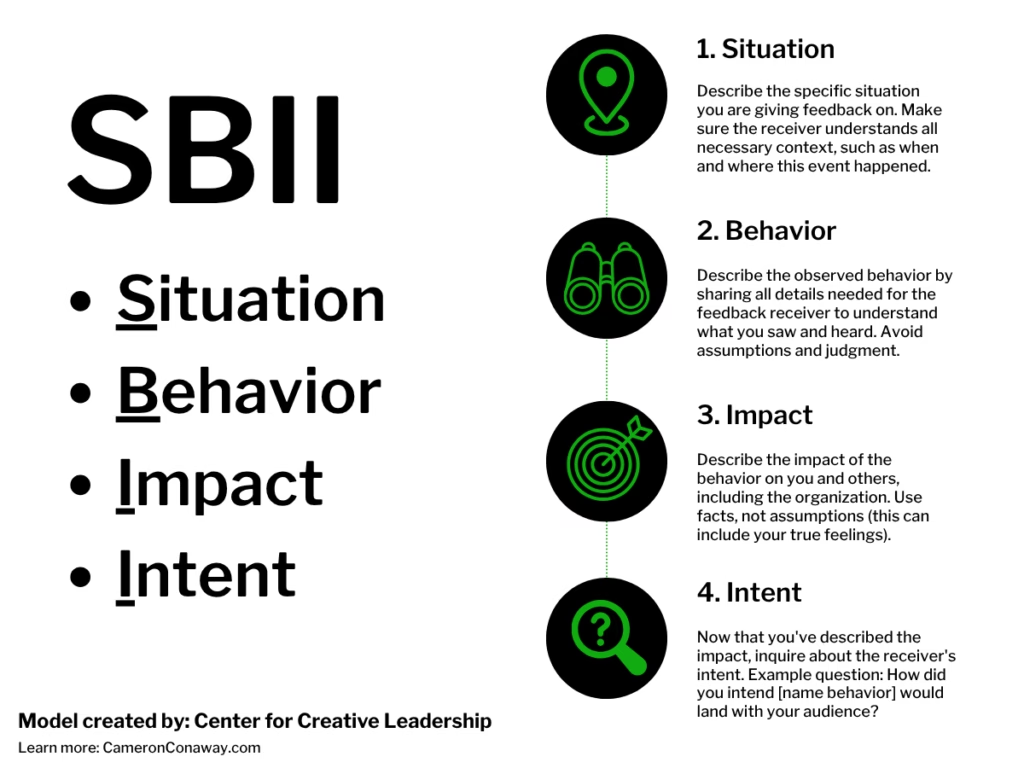
SBII feedback model
Situation, Behavior, Impact, Intent
SBII is the Center for Creative Leadership’s own extension of SBI. After describing the impact, you ask what the person intended. The reasoning is simple: you can’t know what someone meant to do unless you ask. The question turns one-way feedback into a two-way conversation, and it can reveal a gap between what the person intended and how it landed.
- Situation, Behavior, Impact
Give the first three steps exactly as in SBI.
- Intent
Ask what the person was aiming for. Ask it as a real question, not as a trap.
“What were you hoping the client would take from the methodology section?”
Use it when the behavior surprised you, or you don’t know the person’s reasoning. Limits: the question only works if you are ready to hear the answer and adjust.
R-SBI-R feedback framework
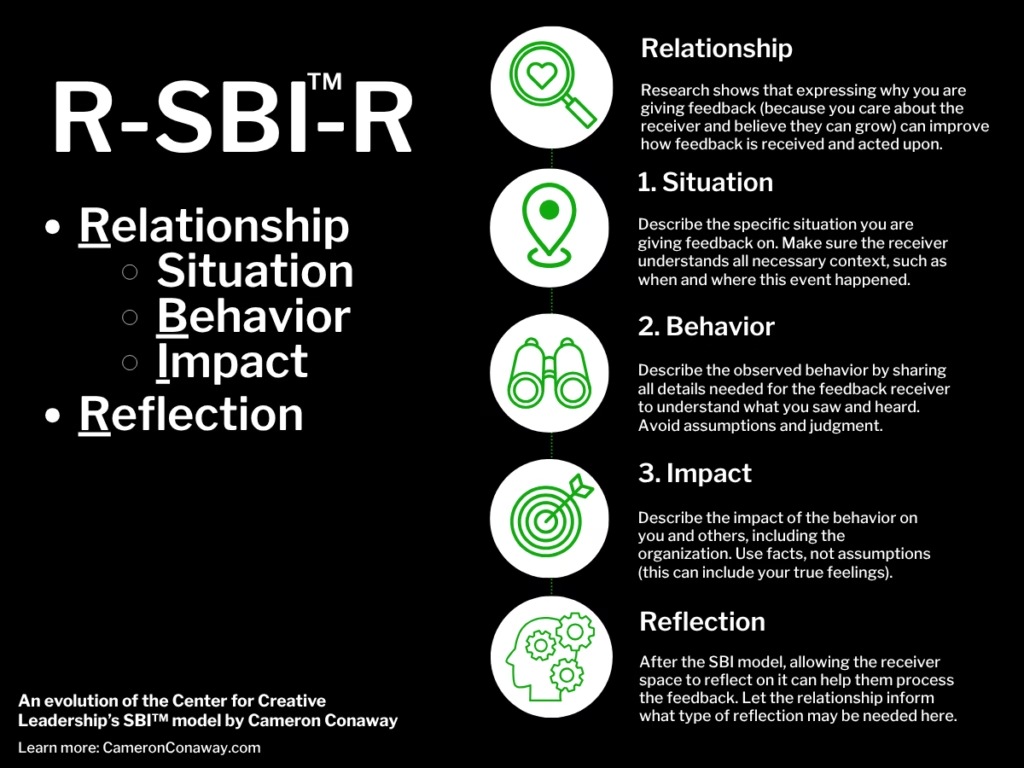
Relationship, Situation, Behavior, Impact, Reflection
R-SBI-R is Cameron Conaway’s evolution of SBI. It adds two bookends. Relationship comes first: say why you are giving the feedback, which is that you care about the person and believe they can grow. Reflection comes last: leave room for the person to process and respond. In Cameron’s words, relationships shape how feedback lands, and reflection helps it take root.
Research on “wise feedback” points the same way. In a 2014 study led by David Yeager, students whose essay comments came with a note saying the teacher held high expectations and knew they could reach them were more likely to revise their work.
- Relationship
Begin by affirming the relationship, or by saying why you care.
“I’m raising this because your analysis is the strongest on the team, and I want clients to act on it.”
- Situation, Behavior, Impact
Give the feedback as in SBI.
“On Tuesday, the methodology took 25 of our 30 minutes, and the client left before hearing your recommendations.”
- Reflection
Stop, and give the person room to think and respond. Let the relationship guide how much room they need.
“I’d like to hear how it went from where you stood. Take your time, today or later this week.”
Use it when the feedback is emotionally charged, or trust is still being built. Limits: the opening has to be true. If you can’t say why you care, work that out before you give the feedback.
STAR feedback model
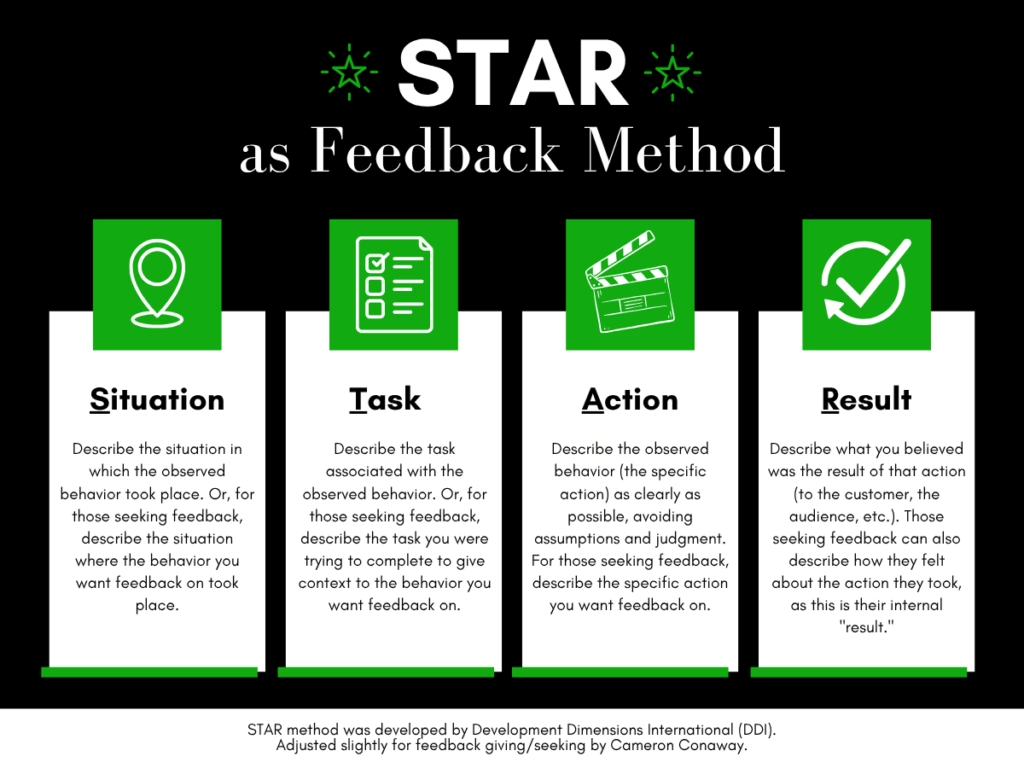
Situation, Task, Action, Result
STAR began as an interviewing format. Development Dimensions International (DDI) says it invented the method, which has been in use since the 1970s, and teaches it for feedback as well. For feedback that calls for a change, DDI adds two parts to make STAR/AR: an Alternative action, and the Alternative result it would have produced.
Cameron also uses STAR for seeking feedback. Describe your own situation, task, and action, give the result as you experienced it, and then ask for the other person’s response.
- Situation
Describe the setting in which the behavior took place.
“In Tuesday’s presentation to the client,”
- Task
Name what needed to be done.
“you had 30 minutes to bring them to a decision on next quarter’s plan.”
- Action
Describe the specific action the person took.
“You opened with their own customer data,”
- Result
Describe what the action led to.
“and it got the room’s full attention. Two people started taking notes.”
- Alternative action
For STAR/AR, describe what could have been done differently.
“If the methodology had taken five minutes and not 25,”
- Alternative result
Describe what that would have made possible.
“there would have been time for the recommendations, and the client could have decided in the room.”
Use it when you are recognizing strong work, or writing performance reviews where results matter. Limits: four parts can feel long for a quick comment, and SBI covers similar ground in three.
EEC feedback model
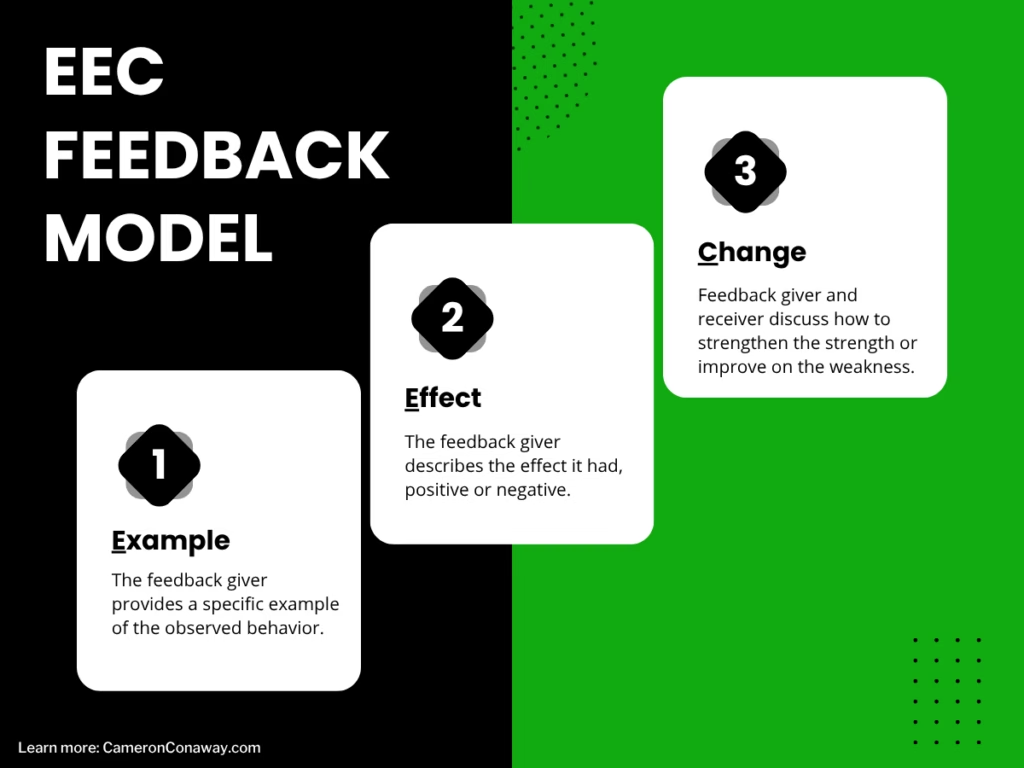
Example, Effect, Change
EEC is a three-step script from management training. Its origin isn’t clear, and it is taught under a few names: the first E is sometimes Evidence or Event, and the C becomes Continue or Congratulate when the feedback is positive.
- Example
Give one specific example of the behavior you observed.
“On Tuesday, the methodology section ran 25 minutes.”
- Effect
Describe the effect it had, positive or negative.
“We never reached the recommendations, and the client left without deciding.”
- Change
Discuss together how to improve on the weakness, or how to build on the strength.
“What would you cut to reach the recommendations by minute ten?”
Use it when you want quick, developmental feedback close to the event. Limits: with only one example, it suits a single incident better than a pattern.
COIN feedback model
Context, Observation, Impact, Next steps
COIN was developed by executive coach Anna Carroll and is described in her 2014 book The Feedback Imperative. It follows the shape of SBI and adds an agreed next step. Some versions replace Context with Connection, to stress empathy at the start.
- Context
Name the event or issue you want to discuss.
“I’d like to talk about Tuesday’s client presentation.”
- Observation
Give a specific, factual description of what happened.
“The methodology took 25 of the 30 minutes.”
- Impact
Explain how it affected others, the team, or the work.
“The client didn’t hear the recommendations and left without a decision.”
- Next steps
Agree on what will change, and invite the other person’s ideas.
“For the follow-up call, I’d lead with the three recommendations and keep the method to one slide. How does that sit with you?”
Use it when a concern is ongoing and you need agreement on what changes. Limits: if the giver writes the next steps alone, the receiver may comply without committing.
SAID feedback model (and AID)
Situation, Action, Impact, Do
SAID is taught with several endings: the D appears as Do, Desired outcome, or Development. In each version, the last step turns the feedback toward the future. AID is the three-letter version (Action, Impact, Desired outcome), which the Open University teaches in its free course on giving and receiving feedback.
- Situation
Name the specific moment.
“In Tuesday’s presentation,”
- Action
Describe the observable behavior.
“you walked through the full methodology before the findings.”
- Impact
Explain the effect on others or on the work.
“We ran out of time, and the client left without a decision.”
- Do
Say what to do next, or what to keep doing.
“Next time, give the recommendations first and offer the method as backup.”
Use it when the person needs a clear direction to act on. Limits: the last step can turn into an instruction. Asking for the other person’s idea first keeps it a conversation.
IDEA feedback model
Identify, Describe, Encourage, Action
IDEA is most often taught as Identify, Describe, Encourage, Action. Other versions use Explore or Exchange for the E and Agree for the A, and it has no clear single origin. What sets it apart is the third step, which is saying out loud that you are giving the feedback to help.
- Identify
Name the topic you want to give feedback on.
“I want to talk about the pacing of Tuesday’s presentation.”
- Describe
Describe the behavior in detail, and be clear about its impact.
“The methodology ran 25 minutes, so the recommendations never came up and the client left undecided.”
- Encourage
Make it plain that you are sharing this to help the person do their best work.
“Your analysis is strong, and I’m telling you this because I want clients to act on it.”
- Action
Close with a clear next step, for the person and for you.
“Let’s rebuild the deck so the recommendations come first. I’ll go through a draft with you on Thursday.”
Use it when you are giving corrective feedback to someone who may doubt your motives. Limits: the encouragement has to be specific, or it reads as padding.
DESC script
Describe, Express, Specify, Consequences
The DESC script comes from Sharon Anthony Bower and Gordon Bower’s 1976 book Asserting Yourself. It was designed for assertiveness: saying what you need without attacking and without backing down. The U.S. Agency for Healthcare Research and Quality teaches a version of DESC in TeamSTEPPS, its teamwork program for healthcare, as a tool for resolving conflict.
- Describe
Describe the behavior or situation objectively. Give only the facts.
“In Tuesday’s presentation, the methodology took 25 of our 30 minutes.”
- Express
Say how you feel or what concerns you, using “I” and not “you.”
“I felt frustrated, because I had told the client they would leave with recommendations.”
- Specify
State the change you want.
“For the follow-up, I need the recommendations in the first five minutes.”
- Consequences
Name what follows, ideally the benefit of the change.
“If we do that, we can still get a decision this month.”
Use it when you need to raise a concern firmly, including with someone senior to you. Limits: it is a script for stating your position, so add a real question if you want the other person’s side.
McKinsey feedback model
Action, Feeling, Feedback
This three-part script is widely attributed to McKinsey & Company, though the descriptions that circulate are mostly secondhand. Its distinctive move is the middle step: you say how the action made you feel. A feeling is hard to argue with, because it is yours.
- Action
Name the specific action, event, or behavior.
“When the methodology took 25 minutes on Tuesday,”
- Feeling
Say how it made you feel.
“I felt anxious, because I could tell we were losing the room.”
- Feedback
Recommend what to do differently next time.
“Next time, I’d recommend opening with the recommendations.”
Use it when the effect on you is the point, and you can state it plainly. Limits: the feeling has to be real and in proportion. An overstated feeling turns feedback into pressure.
Renninger’s four-part feedback formula
Micro-yes, Data point, Impact statement, Question
Cognitive psychologist LeeAnn Renninger set out this formula in a 2020 TED talk, The secret to giving great feedback. It opens with a short yes-or-no question, which signals that feedback is coming and gives the other person a moment of choice. It ends with a question, so the exchange becomes joint problem-solving. Renninger adds advice for the other side of the conversation: ask for feedback regularly, and don’t wait for it to arrive.
- Micro-yes
Ask a short question that invites a yes.
“Do you have five minutes to talk about Tuesday’s presentation?”
- Data point
Name exactly what you observed or heard, and cut any word that isn’t objective.
“The methodology section ran 25 of the 30 minutes.”
- Impact statement
Say how that data point affected you or the work.
“Because of that, the client didn’t hear the recommendations and couldn’t make a decision.”
- Question
End by asking for the other person’s take.
“How did it go from your side?”
Use it when you want feedback to start and end as a conversation. Limits: a micro-yes asked every time can start to sound like a formula, so vary the wording.
RISE model for peer feedback
Reflect, Inquire, Suggest, Elevate
Educator Emily Wray created the RISE Model for Meaningful Feedback in the early 2010s to help students give each other better comments. Its four prompts are aligned with Bloom’s taxonomy, and they climb from recalling the work to raising it to a higher purpose. It suits feedback on a piece of work, such as a draft, a design, or a deck.
- Reflect
Recall and restate what the work does.
“Your deck makes the case that churn is concentrated in two customer segments.”
- Inquire
Ask questions to understand the choices behind it.
“What led you to put the full methodology before the findings?”
- Suggest
Offer ideas to improve this version.
“You might move the three recommendations to the second slide.”
- Elevate
Offer ideas that raise the next version to a higher purpose.
“Perhaps this becomes the template for every quarterly client session.”
Use it when peers are commenting on each other’s work, in a class or on a team. Limits: it is built for work products more than for behavior.
The feedback sandwich
Praise, Criticism, Praise
The feedback sandwich places criticism between two pieces of praise. It is widely used and widely criticized. Receivers may hear only the praise and miss the point, or recognize the structure and stop trusting the praise.
The research is mixed, and it does not favor the sandwich. A 2013 study by Parkes, Abercrombie, and McCarty found that sandwiched feedback changed how students felt about the feedback and did not improve their performance. In a 2015 experiment by Henley and DiGennaro Reed, giving the corrective comment first and the positive comments after it worked better than the sandwich.
A better approach, from Cameron’s post on the feedback sandwich: give enough specific positive feedback all year that challenging feedback doesn’t need bread around it.
Structures for a feedback conversation
A script covers one message. These four models cover a whole conversation, and in all of them the other person does much of the talking. A review of feedback models in clinical education describes a range that runs from simple and educator-centered, with the feedback sandwich at that end, to more involved and learner-centered. The structures below belong toward the learner-centered end.
Pendleton feedback model
Pendleton’s rules
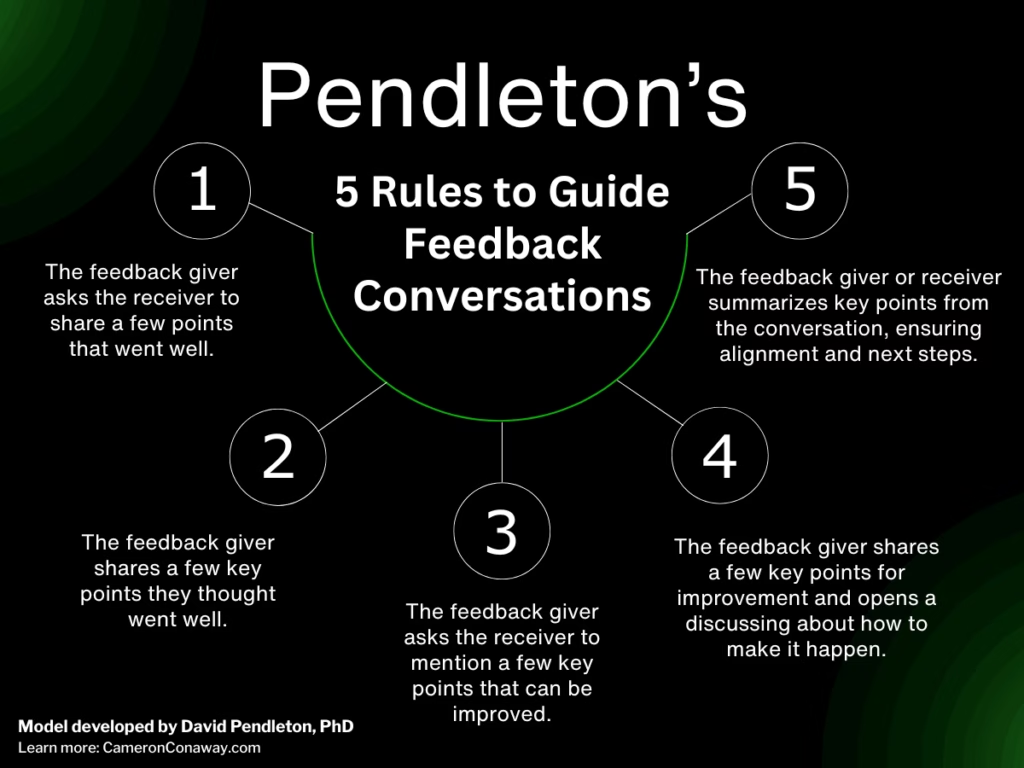
David Pendleton and colleagues set out these rules in 1984 for training family doctors, in the book The Consultation: An Approach to Learning and Teaching. The person receiving feedback speaks first at each stage, and strengths come before improvements. Sources count the steps differently, and this is the five-step version. The model has since spread well beyond medicine.
- Ask
Ask the receiver to share a few things that went well.
“What do you think went well on Tuesday?”
- Add
Share a few things you thought went well.
“I agree about the opening. Their own data had everyone’s attention.”
- Ask
Ask the receiver what could be improved.
“What would you change if you gave it again?”
- Add
Share your own points for improvement, and discuss how to make them happen.
“I’d bring the recommendations forward. How could the method fit into five minutes?”
- Agree
Summarize the key points and agree on next steps.
“So: recommendations first, method in an appendix, and a dry run with me on Thursday.”
Use it when you are debriefing a piece of work with someone who was there. Limits: followed to the letter, it can feel like a ritual, and critics in medical education have said so. Treat the order as a guide.
CEDAR™ feedback model
Context, Examples, Diagnosis, Action, Review
Leadership consultant Anna Wildman designed CEDAR in 2003, and the name is her trademark. It is a collaborative structure for performance conversations. The manager sets the context, and the team member is encouraged to supply the examples, work out the causes, and choose the actions.
- Context
Explain the topic and why it matters.
“Client presentations are where our analysis turns into decisions, so I’d like us to go through Tuesday’s together.”
- Examples
Explore one or two specific examples, ideally ones the other person brings.
“Which moments on Tuesday went as you planned, and which didn’t?”
- Diagnosis
Ask why it happened before moving on.
“What made the methodology section run long?”
- Action
Ask what the person wants to do next.
“What will you change for the follow-up call?”
- Review
Agree on when you will check progress.
“Let’s meet after the follow-up call and compare notes.”
Use it when you have time for a real performance conversation and want the other person to own the outcome. Limits: it takes time and some trust, so it is not for a comment in the hallway.
R2C2 feedback model
Relationship, Reactions, Content, Coaching
R2C2 was developed by Joan Sargeant and colleagues and published in the journal Academic Medicine in 2015. It was built through research with physicians, and its authors describe it as evidence-based and theory-informed. It is designed for talking through feedback that already exists on paper, such as assessment results or a review report. The University of Calgary’s human resources team presents it as a fit for formal workplace conversations such as annual reviews.
- Relationship
Build rapport and explain the purpose of the conversation.
“Thanks for making time. I want this to be useful to you, so tell me what you most want from it.”
- Reactions
Explore the person’s reactions to the feedback.
“You’ve read the client’s comments on Tuesday’s session. What is your reaction?”
- Content
Explore how the person understands the content.
“Is there anything in their comments that surprised you, or that doesn’t make sense yet?”
- Coaching
Coach for change, and build the plan together.
“What is one change you want to make, and what would help you make it?”
Use it when you are discussing written feedback, survey results, or a performance review. Limits: it assumes there is a report to discuss, so it is more than a quick comment needs.
FUEL coaching model
Frame, Understand, Explore, Lay out
FUEL is a coaching conversation from John Zenger and Kathleen Stinnett’s 2010 book The Extraordinary Coach. It belongs on this page because many feedback conversations are really coaching conversations, where the aim is a plan the other person owns.
- Frame
Frame the conversation. Agree on the purpose, the process, and the outcome you both want.
“I’d like 20 minutes on client presentations: what’s working, what isn’t, and one thing to try. Does that work?”
- Understand
Understand the current state. Explore the other person’s perspective before you share your own.
“How do you think Tuesday went?”
- Explore
Explore the desired state. Define the target, and generate more than one way to reach it.
“What would a great client session be like, and what are a few ways to get there?”
- Lay out
Lay out a success plan. Agree on specific, time-bound steps and a follow-up.
“So you’ll restructure the deck by Thursday, and we’ll debrief after the follow-up call.”
Use it when the goal is growth over weeks, not a fix by Friday. Limits: if you already know what must change, say so plainly. A coaching structure can hide a message that should be direct.
Standards and stances for givers
These three don’t give you an order of words. They give you a standard to check feedback against, or a stance to hold while you give it.
BOOST feedback model
Balanced, Objective, Observed, Specific, Timely
BOOST is a checklist of five qualities. It appears in university and human resources training materials, and its origin isn’t clear. Because it has no sequence, it works best as a check on feedback you have already drafted with a script such as SBI.
- Balanced
Does it cover strengths and areas to develop, and not only one of them?
- Objective
Is it about actions and behavior, and not about personality?
- Observed
Did you witness it yourself, or are you passing on someone else’s report?
- Specific
Does it include concrete, behavioral detail?
- Timely
Are you giving it at the first good opportunity?
Applied to Maya: the opening worked and the pacing didn’t (balanced). You were in the room (observed). Tell her this week, before the follow-up call (timely).
Radical Candor
Care personally, Challenge directly
Radical Candor is Kim Scott’s framework from her 2017 book of the same name. It has two dimensions: how much you care personally about the person, and how directly you challenge them. Doing both at once is radical candor. The other three combinations are named failures, and Scott calls ruinous empathy the most common one.
Use it when you want to check your stance before you speak, or give a team shared words for what went wrong. Limits: it names the stance and leaves the wording to you, so pair it with a script.
Netflix 4A feedback guidelines
Aim to assist, Actionable, Appreciate, Accept or discard
Reed Hastings and Erin Meyer describe these guidelines in their 2020 book No Rules Rules. Two are for the giver and two are for the receiver, which makes 4A one of the few popular models that covers both sides of the conversation. For work across cultures, the authors add a fifth A: Adapt.
- Aim to assist
For the giver. Give feedback to help the person or the company, never to vent.
- Actionable
For the giver. Focus on what the person can do differently.
“Leading with the recommendations would have given the client time to decide.”
- Appreciate
For the receiver. Listen, and resist the urge to defend or explain.
“Thank you for telling me.”
- Accept or discard
For the receiver. Consider all of it, and then decide. You are not required to follow it.
“I’ll think about how to shorten the method section.”
Use it when a team wants shared norms for both giving and receiving. Limits: it is a set of norms, so it depends on a culture where people can speak up safely.
Models for seeking feedback
Seeking is asking for feedback on purpose. It turns feedback from something pushed at you into something you pull toward you, and it is the skill most lists of feedback models leave out. These four make the ask easy to answer. The lesson How to Ask for Feedback goes further.
SKS feedback model
Stop, Keep, Start
SKS is three questions. Thomas DeLong described it in a 2011 Harvard Business Review article, “Three Questions for Effective Feedback,” and credited it to Phil Daniels, a psychology professor at Brigham Young University. It was devised as a way of asking for feedback, with no more than three points under each heading, and it works for giving feedback too. Agile teams run retrospectives on a close relative: start, stop, continue.
- Stop
“What should I stop doing in client presentations?”
A useful answer: walking through the full method live.
- Keep
“What should I keep doing?”
A useful answer: opening with the client’s own data.
- Start
“What should I start doing?”
A useful answer: putting the recommendations on the second slide.
Use it when you want honest feedback from people who are busy or hesitant. Limits: short answers need a follow-up question, such as “Can you give me an example?”
I like, I wish, what if
The Stanford method
This method comes from the Stanford d.school, where it sits among the tools in the school’s Design Thinking Bootleg. Every piece of feedback begins with one of three stems. It was built for groups responding to work in progress, and it doubles as a way to ask for feedback: invite people to finish the three sentences. A common variant ends with “I wonder.”
- I like
Name what works.
“I like that you opened with the client’s own data.”
- I wish
Name what you would change.
“I wish we had reached the recommendations.”
- What if
Offer a possibility.
“What if the method moved to an appendix?”
Use it when a group is responding to a draft, a prototype, or a plan. Limits: the stems keep the tone kind, and they can also keep the feedback vague. Ask for specifics.
Feedforward
Ask, Listen, Thank
Executive coach Marshall Goldsmith developed feedforward from a conversation with Jon Katzenbach in the early 1990s. You ask for suggestions about the future and leave comments on the past aside. Pick one behavior you want to change, ask someone for two ideas, listen without judging or debating them, and say thank you.
- Ask
Name the one thing you want to get better at, and ask for two suggestions.
“I want to get to the point faster in client presentations. What are two things I could try next time?”
- Listen
Take notes. Don’t rebut, explain, or grade the ideas.
- Thank
Say thank you, and decide later what to use.
“Thank you. That’s useful.”
Use it when you want ideas from many people quickly, or when talk about the past would only produce defensiveness. Limits: feedforward skips the past on purpose. When someone needs to know the effect of what they did, they still need feedback.
360-degree feedback
Manager, peers, direct reports, and sometimes customers
360-degree feedback, also called multisource feedback, collects ratings and comments on one person from the people around them. It is a system more than a conversation model, and its value depends on what happens after the report arrives.
The evidence calls for modest expectations. A 2005 meta-analysis of 24 longitudinal studies by James Smither, Manuel London, and Richard Reilly, published in Personnel Psychology, found that improvement after multisource feedback is generally small. Improvement was most likely when recipients had a positive orientation toward feedback, believed change was possible, set goals, and took action. Those are receiving, processing, and using skills, which is where this page goes next.
Use it when one manager’s perspective is not enough, and the organization will support people in working through the results. Limits: a report without a conversation rarely changes much. Pair it with R2C2 or the 6 Ps.
Models for receiving, processing, and using feedback
Most lists of feedback models end with the giver. Most of the work of feedback happens after that, with the person who receives it. These four models belong to the receiver.
The three feedback triggers
Truth, Relationship, Identity
In Thanks for the Feedback (2014), Douglas Stone and Sheila Heen of Harvard Law School name three reactions that keep people from taking feedback in. Naming the trigger is the first move, because a reaction you can label is easier to put down while you listen. They also sort feedback into three kinds, which are appreciation, coaching, and evaluation, and trouble starts when the giver means one and the receiver hears another.
- Truth
The content seems wrong or unfair. Before you decide, ask what the giver observed.
“That’s not right. The client asked for rigor.”
- Relationship
The reaction is to the person giving it. Separate the message from the messenger, and treat the relationship as its own conversation.
“He wasn’t in any of the prep meetings. Who is he to say?”
- Identity
The feedback threatens your sense of who you are. Keep it the size it is: one presentation is one presentation.
“Maybe I’m just not good with clients.”
Use it when feedback stings and you notice yourself arguing with it. The lesson How to Receive Feedback covers what to do in the moment.
The 6 Ps of Processing Feedback
Poise, Process, Positionality, Percolate, Proceed, Perspective
Cameron Conaway first published the 6 Ps in Harvard Business Review as a way to work through challenging feedback. They move the receiver from a first emotional reaction to a deliberate decision.
- Poise
Quiet the mind, and feel what comes up without letting it dictate your response.
- Process
Sort the feedback with a logical filter, such as the Feedback Decision Tree.
- Positionality
Consider the power dynamics and the relationship between you and the giver.
- Percolate
Give the feedback time to sit.
- Proceed
Choose to act on the feedback, or to set it aside on purpose.
- Perspective
Step back, and place this one piece of feedback within your longer path.
Use it when feedback has shaken you and you are tempted to react at once. The lesson How to Process Feedback walks through each step.
The Feedback Decision Tree
Trust, alignment, decision
The Feedback Decision Tree, which Cameron also first published in Harvard Business Review, is a logical filter for constructive feedback. It guides the receiver through a sequence of checks, mainly trust and alignment, to decide whether to act on an insight or set it aside.
- Trust
“Do I trust the motives of the person who gave me this?”
- Alignment
“Does this feedback align with my values and my goals?”
- Decision
If it aligns, proceed. If it doesn’t, seek another opinion before you act.
Use it when you have received constructive feedback and can’t tell yet whether it deserves a change. It is the Process step of the 6 Ps.
The Feedback GROWTH Model
Game plan, Reflect, Ownership, Wonder, Test, Habit
The Feedback GROWTH Model is Cameron’s framework for the step most models skip, which is what happens after “thank you.” It treats using feedback as a loop, and the receiver stays the owner of the change from start to finish.
- Game plan
Decide who you will ask to check your progress on the change.
- Reflect
Notice how the new behavior feels. Exhaustion and flow are both information.
- Ownership
Keep the direction of your growth in your own hands, with a small group of trusted advisors.
- Wonder
Meet challenging feedback with curiosity, so that you can hold it long enough to use it.
- Test
Try the new skill somewhere with higher stakes.
- Habit
Make asking for feedback on the change a routine, and then begin the loop again.
Use it when you have decided to act on feedback and want the change to last. The lesson How to Use Feedback goes deeper.
Style frameworks applied to feedback
The four names in this section are often listed as feedback models. Two are frameworks about people that get borrowed for feedback, and two are acronyms with thin documentation. All four deserve more caution than they usually get.
DISC and feedback
Dominance, Influence, Steadiness, Conscientiousness
DISC began as a theory of emotional behavior in William Moulton Marston’s 1928 book Emotions of Normal People. Marston never built an assessment, and the questionnaires in use today came later, from others. In feedback, DISC is used to adapt delivery to a person’s profile: more direct with one person, more time to think for another.
Use with care. Adapting your delivery to the person is sound. A four-letter profile is only a starting guess at how to do it, and asking people how they like to get feedback will tell you more.
VARK and feedback
Visual, Aural, Read/write, Kinesthetic
Neil Fleming introduced VARK in 1987 as a questionnaire about how people prefer to take in information. It is sometimes recommended for tailoring feedback to a person’s learning style, and the research does not support that use. A 2008 review by Harold Pashler and colleagues found that people will state preferences when asked, and found virtually no evidence that matching instruction to a preferred style improves learning.
A safer practice: give important feedback in more than one form, such as a conversation followed by a written summary, and ask the person what helps.
4C feedback model
Clarity, Context, Compassion, Commitment
The 4C model is usually given as Clarity, Context, Compassion, and Commitment, and it turns up in leadership training in more than one version. It doesn’t appear to have a documented origin or published research behind it. Treat it as a memory aid for four reasonable qualities, and use a script for the words.
3Ps feedback model
Praise, Problem, Potential
The 3Ps are usually given as Praise, Problem, and Potential: name what worked, name the issue, and point to what the person could do next. Like 4C, the model doesn’t appear to have a documented origin. It opens the same way the feedback sandwich does, so make sure the praise is specific and true.
Research models of feedback
Researchers use “feedback model” in a second sense: an explanation of how feedback works, tested against data. A 2021 review in Frontiers in Education by Anastasiya Lipnevich and Ernesto Panadero examined 14 such models. Three are worth knowing before you choose a script, because they explain when feedback helps and when it doesn’t.
Hattie and Timperley’s model of feedback
Three questions, four levels
In “The Power of Feedback” (2007), John Hattie and Helen Timperley describe feedback as information that closes the gap between where a person is and where they are trying to go. Effective feedback answers three questions. It can be aimed at four levels: the task, the process, self-regulation, and the self. Feedback aimed at the self as a person, such as general praise, is the least effective of the four.
- Where am I going?
Feed up: the goal.
“The goal of a client session is a decision.”
- How am I going?
Feed back: progress toward the goal.
“On Tuesday we won the room’s attention and didn’t get a decision.”
- Where to next?
Feed forward: the next step.
“Lead with the recommendations on the follow-up call.”
What it means for scripts: most scripts answer the second question well. Add the first and the third.
Feedback intervention theory
Kluger and DeNisi
Avraham Kluger and Angelo DeNisi’s 1996 meta-analysis in Psychological Bulletin covered 607 effect sizes and more than 23,000 observations. Feedback improved performance on average, and in more than a third of cases it made performance worse. Their explanation, feedback intervention theory, is that feedback works less well as it pulls attention away from the task and toward the self. Cameron’s post What is Feedback Intervention? goes through the paper.
What it means for scripts: this is the strongest argument for models that keep feedback on the behavior and the task, and away from the person.
Student feedback literacy
Carless and Boud
In 2018, David Carless and David Boud turned attention from the giver to the learner. Their framework names four features of a feedback-literate student: appreciating feedback, making judgments, managing affect, and taking action. In their definition, feedback is a process in which learners make sense of information and use it to improve their work.
What it means for scripts: a script can improve what is said. Whether anything changes depends on the receiver’s skills, and that idea is what the Employee Feedback Literacy Model carries into the workplace.
The Employee Feedback Literacy Model
Employee feedback literacy is the capacity for employees to effectively seek, give, receive, process, and use feedback. Cameron Conaway coined the term in 2022, carrying the research on feedback literacy from students into the world of work.
The model treats feedback as five skills. It also explains why a script alone rarely changes a culture: a script covers one skill, for one person, in one moment. Every model on this page serves at least one of the five.
- Seeking
Proactively pursuing insights to grow.
SKS, I like, I wish, what if, feedforward, and 360-degree feedback.
- Giving
Offering constructive and actionable input.
The scripts, the conversation structures, and the standards and stances.
- Receiving
Listening openly and understanding feedback.
The three triggers, and the receiving half of Netflix 4A.
- Processing
Reflecting on and evaluating feedback.
The 6 Ps of Processing Feedback and the Feedback Decision Tree.
- Using
Applying feedback to improve performance.
Most training programs teach only giving. Feedback training with Cameron builds all five skills across a team.
All 36 models at a glance
Every model on this page, with its parts, the feedback skill it serves, and the job it does best.
| Model | Parts | Skill | Best for |
|---|---|---|---|
| SBI | Situation, Behavior, Impact | Giving | One clear piece of feedback, positive or corrective |
| SBII | SBI plus Intent | Giving | Understanding why someone acted as they did |
| R-SBI-R | Relationship, SBI, Reflection | Giving | Feedback that may land hard |
| STAR | Situation, Task, Action, Result | Giving, seeking | Recognition, and correction with STAR/AR |
| EEC | Example, Effect, Change | Giving | Quick developmental feedback |
| COIN | Context, Observation, Impact, Next steps | Giving | Agreeing on what will change |
| SAID and AID | Situation, Action, Impact, Do | Giving | Feedback that ends with a clear next step |
| IDEA | Identify, Describe, Encourage, Action | Giving | Corrective feedback with stated support |
| DESC | Describe, Express, Specify, Consequences | Giving | Raising a concern firmly |
| McKinsey model | Action, Feeling, Feedback | Giving | Naming the personal effect of a behavior |
| Renninger’s formula | Micro-yes, Data point, Impact statement, Question | Giving | Starting and ending feedback with a question |
| RISE | Reflect, Inquire, Suggest, Elevate | Giving | Peer feedback on a piece of work |
| Feedback sandwich | Praise, Criticism, Praise | Giving | Rarely. The research does not favor it |
| Pendleton | Ask, add, ask, add, agree | Giving, receiving | Debriefs where the receiver speaks first |
| CEDAR | Context, Examples, Diagnosis, Action, Review | Giving | Collaborative performance conversations |
| R2C2 | Relationship, Reactions, Content, Coaching | Giving, processing | Talking through reports and review results |
| FUEL | Frame, Understand, Explore, Lay out | Giving | Coaching toward a plan the person owns |
| BOOST | Balanced, Objective, Observed, Specific, Timely | Giving | Checking drafted feedback for quality |
| Radical Candor | Care personally, Challenge directly | Giving | Checking your stance before you speak |
| Netflix 4A | Aim to assist, Actionable, Appreciate, Accept or discard | Giving, receiving | Team norms for both sides of feedback |
| SKS | Stop, Keep, Start | Seeking | Asking for feedback in three questions |
| I like, I wish, what if | Three sentence stems | Seeking, giving | Group feedback on work in progress |
| Feedforward | Ask, Listen, Thank | Seeking | Ideas for the future, with no judgment of the past |
| 360-degree feedback | Manager, peers, direct reports, customers | Seeking | A rounded picture from many people |
| Three triggers | Truth, Relationship, Identity | Receiving | Staying steady when feedback stings |
| 6 Ps of Processing Feedback | Poise, Process, Positionality, Percolate, Proceed, Perspective | Processing | Working through challenging feedback |
| Feedback Decision Tree | Trust, alignment, decision | Processing | Deciding whether to act on feedback |
| Feedback GROWTH Model | Game plan, Reflect, Ownership, Wonder, Test, Habit | Using | Turning feedback into lasting change |
| DISC | Dominance, Influence, Steadiness, Conscientiousness | Giving | Adapting delivery, with care |
| VARK | Visual, Aural, Read/write, Kinesthetic | Giving | Not recommended for tailoring feedback |
| 4C | Clarity, Context, Compassion, Commitment | Giving | A memory aid with no documented source |
| 3Ps | Praise, Problem, Potential | Giving | A memory aid with no documented source |
| Hattie and Timperley | Three questions, four levels | All five | Understanding what feedback is for |
| Feedback intervention theory | Attention to the task or to the self | All five | Knowing why feedback sometimes backfires |
| Student feedback literacy | Appreciating, judging, managing affect, acting | Receiving, processing, using | The research behind the receiver’s side |
| Employee Feedback Literacy Model | Seeking, giving, receiving, processing, using | All five | Building feedback skill across a team |
Questions and answers
What is a feedback model?
A feedback model is a named, repeatable structure for giving, seeking, or working with feedback. It tells you what to include and in what order. SBI, for example, has three steps: describe the situation, the behavior, and the impact.
What is the difference between a feedback model and a feedback framework?
The terms are used interchangeably. Both mean a named structure for a feedback conversation or for part of the feedback process.
What are the most common feedback models?
The models that appear most often in workplace training include SBI, STAR, COIN, EEC, DESC, the Pendleton model, CEDAR, BOOST, and 360-degree feedback. This page explains each of them and 27 more.
What is the best feedback model?
There is no single best model. Choose by the job: SBI for one clear piece of feedback, SBII when you need to understand intent, STAR to recognize strong work, DESC to raise a concern firmly, and Pendleton or CEDAR for a two-way review. The chooser above matches needs to models.
What is the simplest feedback model?
SBI and EEC are the simplest, with three steps each. SBI describes the situation, the behavior, and the impact. EEC gives an example, its effect, and the change to discuss.
What is the difference between SBI and STAR?
Both describe a specific moment. SBI ends with the impact of the behavior on people or on the work. STAR adds the task the person was responsible for and ends with the result, which suits recognition and performance reviews. STAR/AR adds an alternative action and result for corrective feedback.
What is the difference between SBI, SBII, and COIN?
All three start the same way: the setting, what was observed, and its impact. SBII adds a question about the other person’s intent. COIN adds next steps, where the giver and the receiver agree on what will change.
Is the feedback sandwich effective?
The evidence does not favor it. One study found that it changed how people felt about the feedback without improving their performance, and another found that giving the corrective comment first worked better. Specific positive feedback given regularly is a stronger foundation than praise used as packaging.
Which feedback model is best for positive feedback?
STAR and SBI both work well, because they name the specific action and what it led to, which tells the person what to repeat. In EEC, the last step becomes “continue” when the feedback is positive.
Are there models for receiving feedback?
Yes, though they are less well known. Stone and Heen’s three triggers help you notice why feedback stings. The 6 Ps of Processing Feedback and the Feedback Decision Tree help you decide what to do with it, and the Feedback GROWTH Model helps you turn it into a lasting change.
Which feedback models are used in education and healthcare?
Pendleton’s rules and R2C2 come from medical education. RISE was built for peer feedback among students, and Hattie and Timperley’s three questions come from education research. The DESC script is taught to healthcare teams through TeamSTEPPS.
Do feedback models work?
A model improves the clarity of what is said, and the research on feedback explains why that matters. Feedback helps most when it keeps attention on the task and the behavior, and it can backfire when it turns attention to the person. A model can’t do the rest. Whether feedback leads to change depends on how it is sought, received, processed, and used.
Practice the skills behind the models
Knowing 36 models won’t make feedback easier to give or to hear. Practicing the five skills will.
The five-minute feedback practice
FreeFifteen real situations. One page of feedback that is yours to keep and share.
The Feedback Deck
$2950 evidence-based cards across the five skills of feedback literacy, each with a three-minute companion video.
Feedback Literacy Certification
$199Establishes your competency across all five feedback literacy skills. Self-paced, with an exam and a LinkedIn credential upon completion.
Feedback training for teams
By quoteKeynotes, workshops, and audits with Professor Cameron Conaway.