Feedback Definition & Meaning: The Complete 2026 How-To Guide
Feedback is a response to a person’s activity with the purpose of helping them adjust to become more effective.
Feedback Definition, Types and Examples
Best practices for the modern workplace — and life outside it.
The Feedback Definition Guide.
Get the complete breakdown of feedback definitions, types, and examples in one easy-to-navigate PDF. Perfect for printing, sharing with your team, or keeping as a quick reference.
What is Feedback?
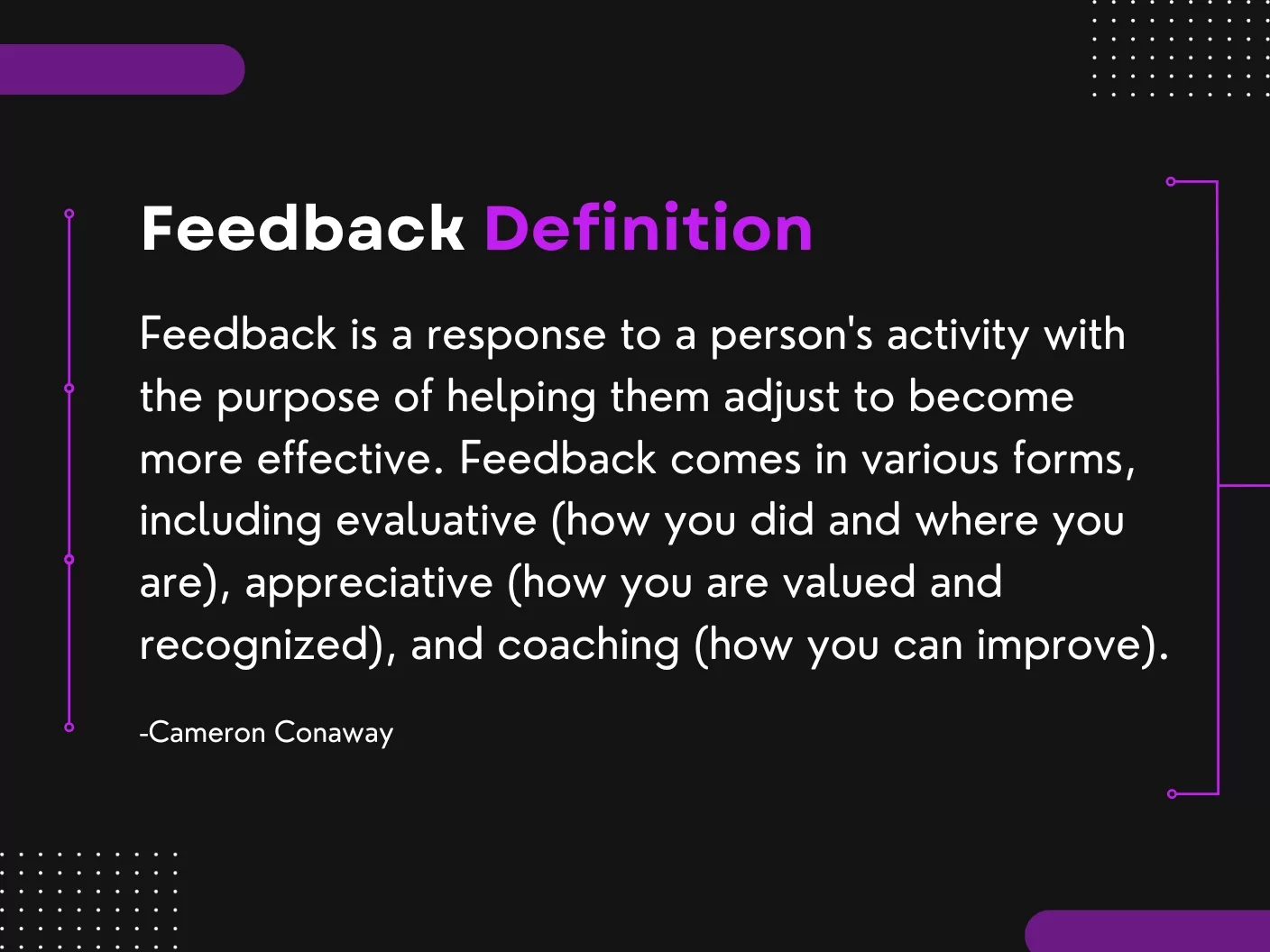
Feedback is a response to a person’s activity with the purpose of helping them adjust to become more effective. Feedback comes in various forms, including evaluative (how you did and where you are), appreciative (how you are valued and recognized), and coaching (how you can improve).
Evaluative
How you did and where you are.
Appreciative
How you are valued and recognized.
Coaching
How you can improve.
 10:04
10:04
#1 Video Result on Google for “Feedback”
Video Transcripts
Feedback Diagram
 Feedback Definition — English


Why a definition matters
Because feedback is everywhere in our lives, many of us assume we all know what it is — and we assume others see it the same way we do. These are big assumptions that lead to a host of communication challenges. In the corporate world, some leaders speak beautifully about the importance of leveraging feedback throughout their organization, but offer no definition and no training — leaving everyone without a shared foundation for what’s actually being talked about.
Consider John Hattie’s landmark finding, after 15 years synthesizing 800 meta-analyses on achievement:
“The most powerful single influence on achievement is feedback but impacts are highly variable, which indicates the complexity of maximising benefits from feedback.”
— Carless & Boud, summarizing Hattie’s synthesis
And for those who want a more academic framing: Professor Ramaprasad’s 1983 paper in Behavioral Science defines it as “information about the gap between the actual level and the reference level of a system parameter which is used to alter the gap in some way.” The focus on the gap is valuable — feedback is meant to address some kind of perceived gap. But the language can feel impenetrable for a general audience. A shared, accessible definition is where all of this has to begin.
Unpacking the definition
There are three parts of our definition worth exploring closely.
1. “Is a response to a person’s activity.” This centers that something happened — a person acted — and there was a corresponding response. “Response” is intentionally broad because feedback can range from an audience’s standing ovation (letting a performer know they did something exceptionally well) all the way to an in-depth conversation where a junior colleague provides upward feedback to their manager about being micro-managed.
2. “With the purpose of helping them adjust.” The purpose of feedback is to be helpful. But having the best intentions doesn’t mean things will go smoothly — you can have great intentions and still deliver terrible feedback, or deliver feedback terribly. Note also that “adjust” refers to a future activity. You can’t go back and change a thing in the past. Effective feedback allows someone to adjust a future performance. Even appreciative feedback like “great job driving that project to the finish line” can plant seeds for how someone approaches their next project.
3. “Various forms.” Is it the compliment from your yoga instructor in the morning? The performance review score tied to your bonus in the afternoon? Your daughter’s delight when you read her a story before bed? Yes — all of those can be feedback. “Various forms” leaves space for the many types we’ll cover, while specifically naming three of the most foundational.
Evaluative feedback
Evaluative feedback helps you see how you did and where you are. It is evaluative because it compares how you did to how you could have done it — similar to Professor Ramaprasad’s “the gap between the actual level and the reference level.” Here are five examples:
- At the end of the quarter, you drove 10% fewer marketing leads than you forecasted. The feedback — perhaps from an automated dashboard — tells you how you did in relation to how you thought you would do.
- A direct report tells you: “You are the best leader I’ve ever worked with.”
- You did not meet the qualifying standards to participate in the Boston Marathon.
- You moved to #4 on a Duolingo leaderboard.
- Your formal bid in response to a Request for Proposal (RFP) was selected.
Notice the variation. A positive but rather vague comment from a direct report sits next to an example of missing your quarterly number. Both are evaluative because they contain, directly or indirectly, a comparative data point. The feedback types can blur into each other — at times, they exist on a spectrum.
Appreciative feedback
Appreciative feedback helps you know you are valued and recognized. Here are five examples:
- Your basketball team’s center points to you in gratitude after a great pass.
- Your grandparent says, “I am so grateful for all you’ve done for us.”
- Your teacher praises you in class for always asking great questions.
- Upon returning from a dangerous military mission, one sergeant hugs another.
- A patron at the restaurant where you work leaves you a great tip.
Appreciation can be spoken or nonverbal. Unlike evaluative and coaching feedback, which can touch on negative areas, appreciation is positive — it motivates. Keep in mind that everyone wants different types of appreciation. Some love to be appreciated in front of peers. For others, quietly renewing their contract for another quarter may be all they want or need.
Appreciative positive feedback is vital. Studies suggest that providing specific positive feedback — going beyond “great job” — improves both employee satisfaction and development.
Coaching feedback
Coaching feedback helps point the way to how you can improve. Here are five examples:
- A colleague tells you they loved your flyer and graphics, but to please use the company’s proprietary font — and recommends a course they just completed on omnichannel branding.
- “Here’s what worked for me when I was in a similar position,” a colleague begins.
- Your ballet teacher offers advice on how to improve your grand plié.
- Through active listening and asking questions, one teammate guides another to finding their own solution to a challenge.
- A teammate says: “I noticed each time you looked down at your notes it took away some of the great energy that kept your audience engaged. Are you open to working together so we can both improve?”
Coaching can be as direct as “here’s how to point your toes” or, as in the active listening example, more like a torch that helps light the way for another person to discover the answer for themselves. It doesn’t have to come from a more senior colleague — we all have things to learn from each other, and we can all be coaches for each other.
Feedback shows up everywhere. These 60 images capture its many forms — in sport, education, conversation, and daily life.


On the definition of feedback
Those who go deeper or want a more authoritative source may land on Professor Ramaprasad’s 1983 paper in Behavioral Science. His focus on recognizing and altering “the gap” has shaped how feedback practitioners and researchers think about the relationship between where someone is and where they could be.
While the language can feel technical for a general audience, the underlying insight — that feedback is information that bridges an actual level and a desired one — is foundational to everything that follows on this page.
“Feedback is information about the gap between the actual level and the reference level of a system parameter which is used to alter the gap in some way.”
Professor A. Ramaprasad
On the Definition of Feedback, Behavioral Science, 1983
18 Examples of Feedback
Evaluative
Where you stand.
- At the end of the quarter, you drove 10% fewer marketing leads than forecasted.
- A direct report tells you: “You are the best leader I’ve ever worked with.”
- You did not meet the qualifying standards to participate in the Boston Marathon.
- You moved to #5 on a Duolingo leaderboard.
- Your formal bid in response to a Request for Proposal (RFP) was selected.
- Your manager says you are in the top 5% of all performers.
Notice the variation. A vague “best leader” comment is still evaluative because it implies a comparison. Evaluative feedback always contains a data point.
Appreciative
Value & recognition.
- Your basketball team’s center points to you in gratitude after that great pass.
- Your grandparent says, “I am so grateful for all you’ve done for us.”
- Your teacher praises you in class for always asking great questions.
- Upon returning from a dangerous military mission, one sergeant hugs another.
- A patron at the restaurant where you work leaves you a great tip.
- A colleague recognizes you in a Slack channel for going above and beyond.
Appreciation can be spoken or unspoken. While often viewed as “fluffy,” specific appreciation improves satisfaction more than negative feedback.
Coaching
How to improve.
- A colleague suggests taking a course on “Omnichannel Branding” to improve your visuals.
- “Here’s what worked for me when I was in a similar position,” a colleague begins.
- An experienced ballet teacher offers advice on how to improve your grand plié.
- Through active listening, a teammate helps another discover the true cause of failure.
- “I noticed each time you looked down, it took energy away. Are you open to working together?”
- “The last two projects went over budget. Here are principles I use to ensure this doesn’t happen.”
Coaching is the “helping them adjust” part. It can be directive (“do this”) or supportive (“let’s find the answer”), and doesn’t require a boss-employee relationship.
The 33 Types of Feedback
Planned feedback refers to any feedback communication session that is scheduled in advance. Often referred to as formal feedback, this type may occur at regular intervals — quarterly or annual performance reviews, or even within a day’s notice. The benefit is that giver(s) and receiver(s) have a chance to prepare.
Example: A CX team leader schedules a 90-minute quarterly review with each direct report. The invite includes an agenda with a topic: “Growth Opportunities — areas where you can grow + your thoughts on how I can grow.”
Informal feedback is often considered the most common form of workplace feedback because it can occur anytime and come from anywhere in the organization. Although often thought of as differing from formal feedback in that it is not scheduled, it can include planning elements. The benefit of good informal feedback is its timeliness.
Example: A design lead quickly calls a junior designer after seeing their draft: “Your use of white space is spectacular. Might you be able to incorporate a similar design aesthetic in the footer? Otherwise, it feels like two different brands are colliding.”
Unplanned feedback is not scheduled in advance and occurs in real-time. Although often referred to as informal feedback, unplanned feedback differs in that it is truly spontaneous and in-the-moment.
Example: On a team call, a colleague senses the conversation is going too deep in the weeds. They say: “I’m wondering if we should first get alignment on the overall direction?” The manager agrees: “Great point. Thank you for having the awareness to bring us back.”
Professor’s Note: The manager may even leverage this unplanned feedback to reinforce it in front of the team and create a teachable moment.
Real-time feedback occurs as the activity is happening. It can be planned (as in a collaborative working session) or unplanned (as in feedback received from an audience during a presentation).
Example: The design lead schedules a 30-minute call with the junior designer so they can work in real-time to improve the brochure.
Self-feedback refers to the feedback in our minds as we critique, praise, and compare our performance. Self-feedback can happen consciously (self-appraisal) or unconsciously (a hypercritical thought process related to trauma).
Professor’s Note: Space for self-reflection is a key part of developing conscious self-feedback and helping to bring subconscious self-feedback to the surface so it can be worked with rather than reacted to.
In the workplace, peer-to-peer feedback typically refers to constructive feedback given and received by peers at an equal seniority level. Effective peer-to-peer feedback is built on several key pillars, including psychological safety and a general baseline of feedback literacy.
Professor’s Note: Research suggests that getting feedback from a few peers can be just as helpful or even better than getting feedback from a single expert.
Customer feedback is feedback given by customers. It can occur in various forms, including customer satisfaction surveys, public customer reviews, and beta testing whereby a product or service is rolled out to a select group to provide feedback before a general release.
Employee feedback is a broad term used in multiple ways. It commonly refers to feedback given by a manager to a direct report, but can also refer to any feedback given and received between colleagues regardless of org chart position. An organization’s leaders may also request “employee feedback” about, for example, how a new procurement process is working.
360-degree feedback is a process for employees to give and receive feedback to each other in an anonymous way. The purpose is to improve employee performance by helping them receive feedback from 360 degrees. Though the potential downsides are many, this method became popular because it can allow employees to get a broader range of feedback perspectives.
Upward feedback is constructive feedback given by a direct report to their manager. It can also refer to any feedback given by a more junior employee to a more senior employee — including skip-level feedback.
Downward feedback is feedback given by a manager to their direct report. It can also refer to any feedback given by a more senior employee to a junior employee.
Positive feedback is how we know we are doing well. This can come in various forms, ranging from a colleague’s praise to an automated dashboard that turns numbers green when you’ve met or exceeded your goal.
Example: “I’m not sure if you know this, but you are a riveting public speaker. Your slides are clear and engaging, and your passion for the topic shines through. I especially appreciate how you engage your audience with questions.”
Negative feedback is how we see our gaps — those areas where we can improve. In this sense, negative feedback can be beneficial. However, people often fear giving and receiving it.
Example: “Upon review of the copy, I think we missed the mark in addressing the primary pain point of our targeted audience. Can you try again, this time working to empathize with their current struggle to do X and positioning our product as the solution?”
This term seems to exist due to confusion or misconceptions around what the “negative” in negative feedback refers to. “Constructive” here implies helpfulness or usefulness — which, based on our primary definition, is the general purpose of feedback.
Example: “The call went well because the engineering team provided constructive feedback that I will include in our next release.”
The term feedforward arose to ensure feedback takes a future-oriented approach. Effective feedback, however, does precisely that — it points to a past performance with the intention of improving future performance. In this sense, it’s problematic to position feedforward as the “reverse” of feedback. Still, like the term constructive feedback, feedforward has its place depending on the audience.
Positive feedforward is positive feedback with a phrase that attaches it to the future.
Example: “In your report last week, you did an excellent job of steering our focus to the highlights of your research. Great work. You might want to try that in your client presentation next week.”
Negative feedforward is negative feedback with a phrase that attaches it to the future.
Example: “Next time, I think it will be helpful to spend more time researching your audience. Before you present next week, let’s spend some time discussing the backgrounds of who will be in attendance so we can really nail the opening.”
Destructive feedback goes against our primary definition in that it is ultimately either not helpful or not given with the intent to be helpful. It comes in the form of harsh critique that may include ridiculing, which breaks confidence and makes adoption nearly impossible. There are long-term negative consequences to destructive feedback.
Oral feedback, often called verbal feedback, is delivered via synchronous or asynchronous talking. One potential benefit is that participants can pick up on verbal and non-verbal gestures, which helps ensure ideas are conveyed clearly.
Written feedback is delivered in writing and can serve as a way to document feedback. Unlike oral feedback, where verbal and nonverbal gestures can be experienced, these elements are missing in written feedback.
Academic Note: When delivering written feedback, make sure to include clear and unmissable signposts of warmth, encouragement, or gratitude to avoid sounding harsh.
In a corporate work context, visual feedback can refer to various types of visual indicators — such as numbers turning green to represent an achieved goal or a designer’s visual changes to a web design mockup.
Grammatical issues caught by Grammarly. A financial dashboard that adjusts based on parameters met. An online exam that provides insight as to why an answer is wrong. Even the feeling of pain when we touch a hot stove. These represent just a few of the many automatic/automated types of feedback that we experience throughout any given day.
Encouragement is a type of motivational feedback communication that can help the receiver move into a stronger place of empowerment.
Example: “I see you as a shining star in this organization. You didn’t land this particular deal, but with your skillset and passion you have so much potential.”
Formative feedback is typically given in a low-stakes environment where the feedback receiver has a chance to redo or re-submit their work. It refers to the type of feedback given over time to assess how a learner or worker is developing. Formative feedback differs from summative in that summative comes near the end and typically quantifies development.
Summative feedback is how we know how we did on an exam or a project — something that has reached an end. In the classroom, for example, a summative assessment typically measures all course material. This type of feedback is critical to help learners and workers understand how they did on a final or otherwise completed project.
Criticism can be considered a type of feedback communication that points only to the areas to be improved. It addresses and “critiques” a past performance without providing guidance or a future-oriented lens.
Technical feedback is feedback communication about how to perform or improve in specific job-related tasks.
Example: “When saving your PowerPoint file, do X, Y, and Z.”
Referent feedback is feedback about what is expected of you in your role.
Example: “We expect you to hit 3% regional growth this year.”
Normative feedback is feedback about the type of attitudes and behaviors you are expected to display.
Example: “We do not send emails on the weekends. If you work on them, that’s fine, but please schedule them to send during the work week.”
Performance feedback is constructive feedback specific to how others are evaluating your job performance.
Example: “You missed your numbers this quarter. There’s a perception that it’s because you aren’t committed to our model. What do you make of this and how can I help?”
Social feedback is feedback communication about what’s acceptable for work-related behavior that doesn’t involve tasks or projects.
Example: “I love the numbers you drove, but I’m concerned because you haven’t attended a single company event.”
Job/career progression feedback is feedback about how to advance, get promoted, or otherwise progress in one’s role or career.
Example: “Based on your performance and increased scope, I’m recommending your promotion to Vice President.”
This type of feedback refers to when feedback is delivered in a group setting but targeted to one person in particular. Delivering negative feedback in this manner is typically not advised, particularly if it attempts to leverage the group’s presence to further pressure or drive the point home to the individual receiver.
3 Important Feedback Terms
Three phrases you’ll see often in my work on feedback literacy — each pointing to a slightly different but deeply connected piece of the feedback puzzle.
-
Feedback literacy Your overall feedback capacity
-
Feedback-seeking behavior How you look for feedback
-
Feedback orientation How receptive you are to feedback
Feedback literacy is a term I use to refer to an individual’s understanding of and capacity to effectively give, receive, and process feedback. The term has research roots in the world of education, where it is primarily used to describe students’ ability to receive feedback. I’ve expanded its use, pulling it into the business world so we have a broad term to describe the overall feedback capacities.
Note: For additional reading about feedback literacy, see the following:
Suggested ReadingsFeedback-seeking behavior refers to how individuals seek feedback either by reading the actions of others to infer what it means or by explicitly asking others for feedback. Since 1983, Dr. Susan Ashford and others have been researching feedback-seeking behavior. In organizations, feedback-seeking behavior generally leads to positive improvements in performance and the conversational feedback process.
Note: You may also come across “indirect feedback seeking behavior.” This separates asking others (direct feedback seeking) from “reading the actions” (indirect feedback seeking) — highlighting one’s efforts to intentionally observe the behavior of others for the sake of improving in a particular area.
Related ReadingsA classic concept from academic HR literature, feedback orientation “…refers to an individual’s overall receptivity to feedback, including comfort with feedback, tendency to seek feedback and process it mindfully, and the likelihood of acting on the feedback to guide behavior change and performance improvement.”
Note: Are you a freelancer? See how freelancers can develop their feedback orientation.
Feedback Myths & Research

Feedback Myths — Debunking 5 Common Misconceptions
Myth number one – positive feedback is a waste of time. This one’s connected to the myth that only negative feedback is real feedback. There is often a type – particularly in certain corporate cultures – who tends to look down on positive feedback because they see it as soft or fluffy or unnecessary. Some of them may even be proud to call themselves “brutally honest.” This person often operates under the faulty assumption that there are enough environmental or behavioral signals that everyone around them should already know they’re doing a great job – so why should they need to say it? Yikes. Here we begin to see the ignorance around just how impactful positive feedback can be.
So coupled with this – that person often also usually holds kind of an erroneous notion that positive feedback is nothing but empty fluff, you may have even heard them say that. Again, our root here is the ignorance around just how impactful positive feedback can be, and maybe even what it is. Yes it can be meaningless and insincere fluff if it’s simply a comment like good job, right. But truly effective positive feedback is specific; it’s something like this: Hey I appreciated the way you steered our team discussion out of the weeds and back to gaining a better understanding of our customers primary pain point – without that we may have come up with a solution to a problem that wasn’t even the problem. So, you know, when you said hey team can we pause here for a moment and come back to our purpose, that allowed everybody time to regroup and get back to our primary intentions. So well done and thank you so much.
Myth number two – receiving negative feedback is a bad thing. Okay, so let’s be real here. Losing your job is a bad thing. Being expected to fulfill the expectations of your role plus that of a colleague who left the company, yes, likely a bad thing. Being ridiculed in front of your peers – definitely a bad thing. But receiving feedback as we are defining it here — “a response to a person’s activity with the purpose of helping them adjust to become more effective” — probably is not a bad thing.
Now before we dive in, I want to validate how you may have felt about feedback in the past – including how your body may have experienced it – sinking feeling in the stomach, tight jaw, sweaty palms, and more. Many variables come into play when we receive feedback. We know from the work of Professor Carol Dweck that those of us with a fixed mindset tend to experience receiving feedback as if they failed a critical test. Those with a growth mindset tend to experience receiving feedback as a valuable and even exciting opportunity to grow.
Another variable has to do with the narratives we create. Many years ago, I received feedback from my manager about how I needed to get more disciplined with how I was managing projects. It was good and helpful feedback, but because my manager had missed our last few one-to-ones and had promoted a colleague I considered my co-lead, I couldn’t see the feedback through the narrative fog I had created. I was convinced this feedback about project management was me being put on notice, and so I operated for weeks in total terror. And then one day my manager told me I was a high performer being promoted. I share this story because the next time you’re on the receiving end of feedback – just try to take steady breaths to center yourself.
Myth number three – you should wait until quarterly reviews to give feedback. This myth has proved remarkably resilient even with the pace of technological change and increased adoption of agile methodologies. But it must be said – delaying feedback can negatively impact a person’s growth and future performance. Still, many managers wait until the quarterly development discussion to provide detailed feedback. These managers take notes throughout the quarter and then kind of dump all of them out during the quarterly review in a way that, number one, can be overwhelming for the receiver and, number two, is usually so removed from the incident that the feedback receiver finds it hard to see the feedback as actionable.
On this topic, I often think about my long ago days as an MMA fighter and one of the first lessons from my boxing coach who taught me that to slip a punch and be in a great position to land a counter punch I had to actually move toward my opponent’s punch, not away from it. As we see again from this survey at Harvard Business Review: “One of the most difficult parts of a manager’s job is giving feedback. In a survey of 7,631 people, we asked whether they believed that giving negative feedback was stressful or difficult, and 44 percent agreed.” Delaying until a quarterly review allows managers to kick the can down the road a bit. My advice: try to give feedback as close to the behavior or performance you will be commenting on as possible.
Myth number four – the feedback giver has all the power. If you’ve ever spent time reading popular articles on how to effectively receive feedback, you’ve likely noticed a condescending tone. Some entire articles can basically be summed up as: make eye contact, smile, say thank you. This tone is apparent even throughout decades of academic research on feedback — an underlying assumption that the giver is an all-knowing keeper of wisdom and the receiver is desperately in need of help.
I see the receiver-giver relationship as far more balanced, with the receiver in many cases holding more power in the relationship. Part of why managers are stressed about giving negative feedback is they are quite scared of what the receiver’s response will be. And we’ve known since 1983 about Feedback Seeking Behavior — where the receiver makes the first move by literally asking for feedback. In some ways, this puts even more power into the receiver’s hands.
Myth number five – feedback isn’t future focused. Here again is our definition of feedback. Notice that the purpose is helping someone adjust to become more effective — that in itself means more effective in the future. Notice also that one of the three feedback forms is referred to as coaching, which is about helping someone improve in the future. Additionally nearly all of the research on what makes feedback effective points to its capacity to improve future performance. And yet, the term feedforward has entered the scene, with some folks so passionate about it that they no longer use the word feedback. Effective feedback is already future-focused. May you and those you love be well.
Here’s a look at some of the feedback research that has shaped my thinking. Many of these are behind paywalls (institutional access required). If you’re curious but stuck, please email me at feedback@cameronconaway.com.
Consequences of individual feedback on behavior in organizations
Journal of Applied Psychology
The effects of feedback on task group behavior: A review of the experimental research
Organizational Behavior & Human Performance
Feedback as an individual resource: Personal strategies of creating information
Organizational Behavior & Human Performance
The performance feedback process: A preliminary model
Organizational Behavior & Human Performance
The effects of feedback interventions on performance: A historical review, a meta-analysis, and a preliminary feedback intervention theory
Psychological Bulletin
Feedback orientation, feedback culture, and the longitudinal performance management process
Human Resource Management Review
The Role Of Gender In The Construction And Evaluation Of Feedback Effectiveness
Management Communication Quarterly
The Development and Validation of the Feedback Orientation Scale (FOS)
Journal of Management
Why receiving feedback collides with self determination
Advances in Health Sciences Education
Beyond individualism: professional culture and its influence on feedback
Medical Education
Age differences in feedback reactions: The roles of employee feedback orientation on social awareness and utility
Journal of Applied Psychology
How empathic concern helps leaders in providing negative feedback: A two‐study examination
Journal of Occupational and Organizational Psychology
What feedback literate teachers do: an empirically-derived competency framework
Assessment & Evaluation in Higher Education
Performance feedback interviews as affective events: An exploration of the impact of emotion regulation
Human Resource Management Review
Honest feedback: Barriers to receptivity and discerning the truth in feedback
Current Opinion in Psychology
The Feedback Blog
Performative Feedback
Read →The Feedback Second Arrow
Read →Nurturing Healthy Self-Feedback
Read →The Great Feedback Inhibitor
Read →What is a Feedback River?
Read →Beyond the Feedback Bubble
Read →Feedback and Gender Research
Read →Reflect on Positive Feedback
Read →The Feedback Giver’s Mindset
Read →Narrative Fallacy in Feedback
Read →Team Feedback Literacy
Read →Lane Blurring in Feedback
Read →Common Barriers to Feedback
Common Barriers — Why Feedback Breaks Down
Hi there, Team. Cameron Conaway here. Today, let’s cover three foundational but rarely-discussed barriers that prevent us and our organizations from leveraging the power of effective feedback at work. We’ll approach these three barriers from two interrelated angles. The first will be from an individual level, because we know from mountains of research that feedback is vital for our personal growth and for the growth of our teammates. And the second angle will be organizational, because if an organization isn’t successful at seeking and receiving feedback, it likely won’t be around very long.
So here are the three common feedback barriers we will be addressing, starting at the individual level where we all have agency and building towards the larger organization where our agency, when we propel it into action, can create impact:
Number 1: Underdeveloped Feedback Literacy
Number 2: A Neglected Feedback Culture
Number 3: The Lack of an Organizational Feedback System
So let’s dive into Barrier Number 1: Underdeveloped Feedback Literacy. If you watched What is Feedback?, you may recall our definition of feedback literacy. We talked about it as referring to an individual’s understanding of and capacity to effectively give, receive, and process feedback.
But we didn’t address how it’s not only possible, but actually vital to create a feedback literacy development plan for ourselves. Because although developing all aspects of our feedback literacy takes being in relationship with others, we have individual agency, we have the ability to chart our own course for developing in this way.
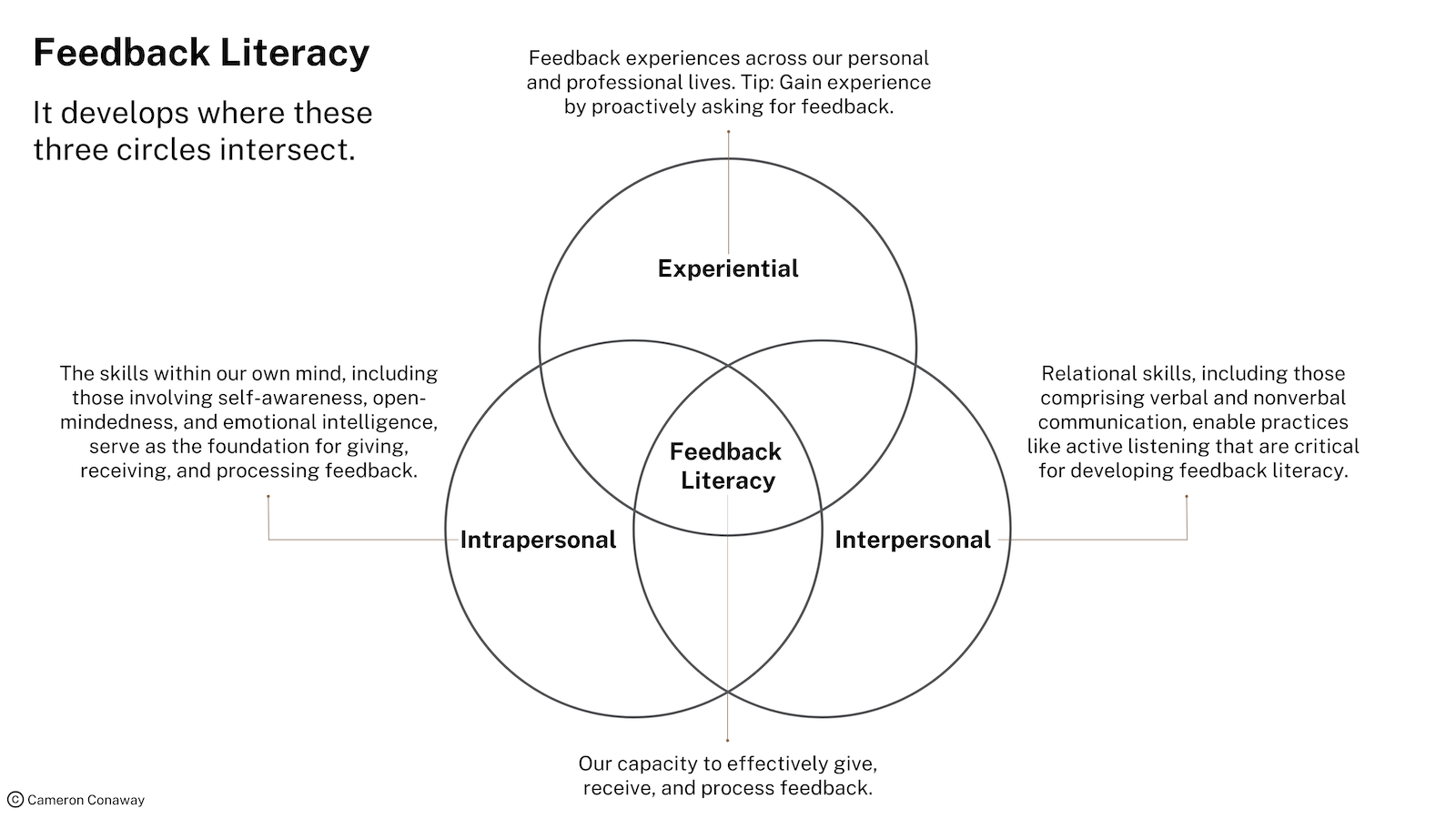
Let’s explore this Feedback Literacy venn diagram to see how it all works.
As we see here, our feedback literacy is at the core and develops where these three circles intersect. Let’s take a look at each, starting with Intrapersonal. Intrapersonal refers to those skills within our self, or within our own mind. This includes all of those qualities that make up self-awareness, open-mindedness, and emotional intelligence – that ability to skillfully experience and manage our emotional states. As you may also recall from our What is Feedback? video, Intrapersonal would also include the way we talk to ourselves, which would include Self-Feedback… “the feedback in our minds as we critique, praise, and compare our performance.” As you can likely see here, these internal skills and states serve as the foundation for effectively giving, receiving, and processing feedback. For example, if we are overwhelmed with anger… and perhaps especially if we are filled with anger but not aware that we are, there’s a good chance that we will struggle to both receive negative feedback and process how it feels and what it means.
For a deeper exploration of what I mean by processing feedback, see my article in Harvard Business Review on that topic.
Similarly, if your mind is flooded with harsh inner chatter about a mistake you made earlier in the day, you will likely struggle to provide your teammate with the clear and empathy-led feedback they deserve. Improving your ability to recognize, be with, breathe through, and understand the roots of a felt emotion will help keep you receptive and grounded during challenging feedback conversations. The great part with intrapersonal skills development is that there’s no shortage of ways to improve. From practicing meditation and journaling to working with a licensed therapist and a career coach – all can help us gain new perspectives, develop self-awareness, and build the skills we need to effectively navigate and leverage what’s going on in our inner world.
As a point of comparison, let’s now jump over to Interpersonal. If Intrapersonal is within, we can think of inter-personal as meaning between… that is, between yourself and others. So this includes all of the many skills that account for being in relationship with others – including all elements of verbal and nonverbal communication. Not all feedback at work happens while in relationship with other humans (for example, we also receive automated feedback from machines), but much of it does, so these interpersonal qualities are vital for being an effective communicator whether you are giving feedback or receiving feedback. As with intra-personal skills development, you can develop your interpersonal skills. One way is by setting specific goals for the aspects you want to improve and then consciously observing and learning from others. You can also request feedback specifically about your interpersonal interactions. And it’s also possible to improve your skills in this regard by watching and learning from recordings of your performance. As you can likely tell, there are plenty of intersections between intra and inter-personal development. For example, in a communications class I took as part of an Executive MBA program, we were tasked with recording one of our performances. Phew. The first few times I watched my performance, it was actually hard to look at the screen. I was judging myself so harshly – everything from the color of my teeth to the sound of my voice. But we had a self-reflective writing exercise that was attached to this assignment, and this exercise allowed me to slow down enough so that I was able to bring awareness to my harsh inner chatter and realize how it was actually a significant barrier standing in the way of my goal of improving. In this sense, I had to slow down before I could wake up. I wasn’t able to tease out ways I could improve interpersonally until I brought that intrapersonal self-awareness to the monologue going on inside me, and then calmed it down. After that, I was in a better position to view the recording as purely an opportunity to grow.
Lastly, let’s head over to Experiential. This one is simply about the feedback experiences we have across our personal and professional lives. This intersects with intra-personal because experience is what we reflect on and learn from, and it intersects with interpersonal because many of these experiences happen in relation with others. One tip I call out here is that we need not be passive recipients in the feedback process. I’ve met with many folks at various stages of their career who felt that they didn’t have effective feedback relationships modeled for them and therefore weren’t able to get the feedback experiences they deserved. While this modeling is vital – and we’ll briefly cover this in Barrier #2 – getting disciplined about seeking feedback from others can ensure you are at least getting opportunities to flex this Experiential muscle. And, you may find, that the more you ask others for feedback, the more others begin to feel comfortable asking you for feedback… so by you making the first move you create a type of feedback loop for your feedback literacy development. This is one incredible way you can take your individual agency and begin to change the feedback culture.
And with that as a transition, let’s move to Barrier Number 2: A Neglected Feedback Culture.
So one way to think about a culture at work, and in our focus here, a feedback culture, is as the soil upon which effective feedback is either neglected or cultivated. Like the soil of our earth, the culture exists whether or not we intentionally try to shape it, right? So a neglected feedback culture, then, is one that is not intentionally cultivated. To continue with the soil metaphor, in such a culture, weeds and other invasive qualities may sprout. This can include toxic cultural elements, such as managers belittling colleagues rather than providing helpful feedback. In many cases, neglected feedback cultures are actually feedback-averse cultures. By this I mean cultures where feedback is generally avoided, which means employees aren’t receiving comprehensive feedback training and new employees aren’t seeing healthy feedback relationships modeled for them. And if this culture is neglected at the people-level, there’s a good chance there’s neglect at the organizational level, where the organization itself is not effective at seeking and receiving feedback. A healthy and effective feedback culture, however, is built with intention. It’s a garden that is pruned and nurtured and generally cared for – with the result being colleagues at all levels who are number one, working to build their own feedback literacy and number two, feel psychological safe enough to give and receive feedback regardless of where they sit in the organization’s hierarchy. So what barriers get in the way of cultivating an effective feedback culture and, more importantly, what can we do about them?
One barrier, and it may seem like a refrain here, but it’s awareness around the importance of feedback. In my previous videos, I highlighted the overwhelming evidence on the importance of feedback, so I’ll hold on that for now and encourage you to go check out the links I provided in the descriptions of those YouTube videos. One other element has to do with lack of awareness on the categories of feedback, especially because many who are new to learning about feedback often tend to think of it as purely an exchange of information, usually from a manager to a more junior colleague. So let’s address this barrier with a quick tour of the Workplace Feedback Categories diagram which can be a helpful tool because it allows us to step back to see a fuller picture of the various feedback dynamics.
Let’s begin at the top. Internal refers to both the feedback happening internally in our minds and the feedback kept internally in our organization. So if we work down the left side, this covers the self-feedback in our minds, the individual feedback we receive from our colleagues at work, the customer feedback we receive directly from our customers, and market feedback. Market feedback in the internal sense is about the effects on our business that we experience based on what’s happening in the market. For example, even before it’s a major topic of public discussion, we may begin seeing signals of labor market strength as employees seem to be asking for raises at a higher rate than usual. If we move to External at the top right, we begin with Sought. This is feedback outside of our organization that we intentionally seek. So at the Individual level, this could be feedback you seek by asking an industry leader if they are open to serving as a mentor for you. At the Customer level, this could be feedback about some part of your organization that you see posted on public sites like LinkedIn, G2, Yelp, Reddit forums, or elsewhere. Similarly, external market signals could be a result of publicly-known market shifts that maybe haven’t impacted your business yet – such as the Federal Reserve changing interest rates or a tense geopolitical situation that may have an impact on your supply chain strategy.
As you see, there can be barriers at every level here. For example, a company may be one of those rare few who offer their employees training on feedback communications, but they may be missing the boat when it comes to having a strategy for listening to the external market signals that could seriously disrupt their business model. Based on my experience and review of the decades of feedback literature, one way to move from feedback category awareness to real action is to pair our category diagram with a Feedback Growth Pyramid – something like this. Approaching each category through the lens of Culture, Training, and Event can ensure we are addressing each barrier holistically. Culture and Training we’ve touched on, but by Feedback Event I mean real opportunities to engage in various feedback dynamics. In this sense, an event would align with the Experiential section of our Feedback Literacy diagram. For example, a feedback event could be receiving feedback from a manager – this would be an event for both the manager giving and the employee receiving. Here’s an example of one way to pair the diagram with the pyramid. Let’s consider individual feedback at both the Internal and External level. You might come at this with questions informed by the pyramid, such as:
“How might we improve our culture so that employees are getting the effective feedback they need?” Or… “Are we training employees across our organization how to seek feedback from those outside of our organization so that they are staying at the top of their field?” Or “What feedback training are we providing our new people managers?”
And, last but not least, we could ask: “What feedback events do our employees have a chance to participate in?”
If the answer to that question is none, or not many, or even I have no idea… one potential solution could be to roll out weekly feedback-oriented check-ins between managers and employees and a quarterly performance review framework to ensure all parties have a chance to give and receive feedback. Another solution could be creating feedback workshops whereby more junior colleagues who have been identified as future people managers could get an opportunity to practice how they give feedback – and to get feedback on how they give feedback.
At this point, if you’re hungry to be more intentional about changing your organization’s feedback culture, I’d recommend reading up on a few change management principles. I’ve included a link in the description to an in-depth page on change management – and, if you’re new to this field and in a hurry, I’d recommend jumping right to the John Kotter framework on that page.
Speaking of change at the organizational level, that leads us to our third feedback barrier: Number 3: Lack of an Organizational Feedback System.
We’ve highlighted the importance of building feedback literacy, and the importance of understanding the feedback categories, but even with all the awareness in the world – it can be a tremendous challenge for an organization to figure out how to collect, classify, and effectively communicate received feedback to the most relevant stakeholders. This is where the 3Cs of Organizational Feedback Systems come into play. Let’s briefly work through this visual.
Step 1 here is about collecting feedback from various sources. One metaphor that may be helpful here is to think about all the tributaries that feed into a river. The goal here is to map out all the most important feedback tributaries and to create a process for how they are being monitored. For example, if we think about collecting customer feedback – those tributaries would include the internal feedback our customers send us privately (and ensuring they have easy ways to do so) and it would include monitoring the most important areas where they are providing public feedback.
From there, we can move to step 2 – which is to ensure all that feedback flows into a central place where it can be seen in aggregate. This could be a Slack channel, for example. Once there, it’s helpful to Classify it. For example, is this External feedback about a particular product or service? Is it positive or negative feedback? You can get as detailed as is helpful here. For example, it may be helpful to note if it’s coming from a Fortune 100 customer who you have a significant deal with as opposed to a customer from a small business who is simply on a free trial. We then move to Step 3, Communicating. Some organizations end at Step 2, thinking that the feedback river is enough, but the river contains everything and can be an overwhelming source of information to the point where it’s irrelevant for many people who are receiving it.
The river metaphor continues here, as Step 3 is about creating feedback lakes from the river, that is, ensuring that the classified feedback is routed to the most appropriate people or teams. As in our example, a batch of feedback from Fortune 100 customers on a particular product could be routed to the product team responsible for that product, to the enterprise technical sales team who can follow up directly with their customer points of contact, and perhaps to the marketing team who can determine if and how to respond to the public feedback.
So, team, that’s a wrap on addressing three foundational barriers to effective feedback at work. We covered a lot of ground here and I hope it was helpful in getting you to step back and see a fuller picture than most of the feedback articles out there provide. I’m always open to your questions and to your feedback and I’m happy to go deeper into particular areas you want me to address in future videos. Thank you, and may you and yours be well.

Workplace Feedback Categories

Feedback Growth Pyramid
Feedback Literacy Diagram

3Cs Organizational System
Why feedback breaks down
Feedback is everywhere. And yet most of us regularly experience feedback that misses its mark — that lands wrong, arrives too late, or never arrives at all. Understanding why feedback breaks down is the first step toward building environments where it flows freely and does what it’s designed to do.
There are barriers on the giving side and the receiving side. Some are structural — organizational hierarchies, performance review timelines, and cultures that conflate criticism with weakness. Others are deeply personal — the fear of damaging a relationship, the anxiety of being seen as inadequate, or the narrative we’ve built around our own identity that makes certain feedback nearly impossible to hear.
The diagrams above represent frameworks I’ve developed and taught in organizational settings to help make these barriers visible. Visible barriers can be addressed. Invisible ones quietly undermine even the most well-intentioned feedback cultures.
Research consistently shows that psychological safety — the belief that one won’t be punished or humiliated for speaking up — is the single most important condition for feedback to function well. Amy Edmondson’s work at Harvard has demonstrated this across industries and team configurations. Without it, even technically skilled feedback givers find their efforts returned flat.
How to Give Feedback

How to Give Feedback Effectively
Hi there and welcome to Module 4 in our Constructive Feedback course.
In this module, we’ll look at how we can give feedback more effectively. If you’ve made it this far in the course, you’ve already improved your ability to give feedback. As mentioned throughout our time together, there’s significant overlap across the various feedback dimensions. For example, by understanding what feedback is, why it’s important, where we get challenged by it, how to receive it, how to process it, and how to use it – all areas we’ve covered so far – you’ll be in a far better position to give great feedback to others.
If you recall, we kicked off our modules with receiving feedback for precisely this reason. In many ways, learning how to receive serves as the foundation for how we can give. We will now build on that foundation, occasionally circling back to a few topics we’ve covered to ensure we understand them.
Let’s remind ourselves of the feedback definition now: “Feedback is a response to a person’s activity with the purpose of helping them adjust to become more effective. Feedback comes in various forms, including evaluative (how you did and where you are), appreciative (how you are valued and recognized), and coaching (how you can improve).
And let’s recall just how challenging giving feedback can be. The Harvard Business Review article highlights that 44% of managers say feedback was stressful or difficult, 21% avoid giving constructive feedback altogether, and a whopping 37% even avoid giving positive feedback – which research has proven is often more effective than negative feedback.
And let’s also recall the two-year study published in Fortune which found three insights.
Number one: employees who don’t get clear feedback quit. Let me repeat this one: Employees who do not get clear feedback quit. So keep in mind here that despite what you may think, studies point to employees actually wanting your feedback so long as it is clear, comes from a good place, and they respect where you are coming from with it. For example, I am in no position to give feedback to Steph Curry on how to shoot a basketball. So it’s critical here to check your ego at the door. You don’t need to give feedback to someone just because you think it’s your role to do so. You should only give it when you think you have a gift to offer.
Number two: not all feedback is equally effective. For example, as a giver to a far more junior direct report, you may be providing task-specific feedback but not feedback that may be helpful for helping them navigate their career. Similarly, you may be providing plenty of negative feedback but the primary challenge holding your direct report back is that they don’t have a sense of their strengths – which you can help change by delivering highly specific positive feedback. Lastly, I’d argue here that the most effective feedback comes from a giver who both cares a great deal about the receiver’s development and has had enough deep one-to-one conversations with the receiver to have a sense of what they want.
And number three: high-quality feedback isn’t distributed equally. We covered this in earlier modules, but it’s important to keep positionality in mind here. The research shows that women tend to get far less helpful constructive feedback than men, and black women in particular get even less. This impacts their professional development, their ability to receive promotions, and generally their overall career, so as a feedback giver you have a responsibility to understand both systemic biases and your individual biases.
We don’t have time to cover this massive topic here, but a good start is to begin learning about both social identities and biases that humans in general contain, and doing the inner work of excavating your own biases.
Lastly, let’s also remind ourselves of when feedback is effective – it’s effective when the setting it takes place in feels psychologically safe, and we know that psychological safety takes time to build. This is is about ensuring each party feels heard, feels valued, and feels safe enough to share their thoughts, their ideas, and even their disagreements and mistakes without fear of negative consequences. So perhaps your number one job as a feedback giver, if possible, is to put the work in to build this kind of relationship – or at the least to try to objectively see if this description of psychological safety applies to your team. In my experience, this type of culture doesn’t just arise; it’s built intentionally by mindful leaders.
If you haven’t started yet, begin now. If you don’t know where to begin, get Amy Edmondson’s book immediately. The link is in the description.
We know that the feedback relationship can also be effective when the mindsets of the giver and the receiver are positive and aligned – which means the foundation here is built on trust and a shared goal of improvement. Lastly, we know that feedback can be effective when it goes beyond calling out a past behavior. In fact, based on our definition, that actually isn’t even feedback. So the kind of feedback we’re talking about is by its nature constructive. That is, it’s pointing to a past behavior but also lighting a torch to help point towards future improvement. As we highlighted earlier, telling people they are missing the mark is not the same as helping them hit the mark.
And, lastly, we know feedback has a chance to be effective when the feedback giver grants the receiver time to process it – and even helps them integrate it into their workflow. If you are a giver who has just delivered what may be very challenging feedback for the receiver to hear – and it takes empathy to recognize this – a great next move will be to ensure you and the receiver are on the same page about what it means. And then grant them some space to make sense of it. Additionally, while the actual feedback conversation is important, perhaps just as important is how the feedback giver checks in or otherwise follows up to see if they can do anything to help the receiver make progress on it.
And, as we covered, we know feedback is most effective when it falls within the Learning Zone of our matrix here. Remember to consider the axis. If the feedback is delivered with true empathy for the receiver and with a high degree of helpfulness, there’s a far better chance it will land well for the receiver and therefore have a chance to positively impact their professional development.
One way to build or at least center this sense of empathy and recognize the important role you play as a feedback giver is to think about an Employee Hierarchy of Needs. There are many variations out there, but here’s how I often think of it. At the bottom, the base for most of us, is the need for survival, for a paycheck. After that it may be a sense of security, security that the paycheck will be there next week, but also a sense of security by way of the culture – of how the employee feels and is treated within it. Next is a sense of belonging – again belonging to that workplace culture, a culture that in many ways can be shaped by the way feedback is given. Next is a sense of growth and importance. Again, two elements that can be impacted by the feedback relationship. And lastly at the top of the pyramid we have growth and a sense of fulfillment, yet another area that can be impacted by feedback experiences. Feedback givers can certainly have an impact on the top four parts of this employee hierarchy of needs pyramid, which makes sense considering that Fortune article which highlighted the role feedback plays in whether employees stay or leave their organization.
Okay do you have a grasp of all that?
If so, here’s a big picture way to think about giving constructive feedback that has impact. This tip is about giving feedback that has an ongoing impact on someone’s life or professional development. Giving feedback is a gift. Yes, I know that is a phrase often about receiving feedback, but think about it. As a feedback giver you have the immense honor of shaping the direction of a person’s improvement, even their entire career. As that last part should have suggested, giving feedback is also an immense responsibility. As such, it can be helpful, especially when preparing to give feedback in a planned feedback session, to think into the future about not only how you hope this feedback will land but also what the feedback receiver may be able to do with it.
I’ll repeat: feedback receiver.
So I think about this as Impact After Receipt (IAR). It’s a concept I came up with that is inspired by the National Football League metric of Yards After Catch, or (YAC). As it sounds, this metric is about how many yards a football receiver gets after they’ve caught the pass. While it can be easy to think about this as purely the receiver’s speed or skill in outmaneuvering those trying to make a tackle, many other elements are at work here. One element involves the quarterback who had to throw a pass in such a way that the receiver has a chance to do something with it. Often, this means the pass was thrown not to where the receiver is but to some combination of where they are going and where they might be able to go.
Think about it. Which receiver is likely to get more yards after the catch? This receiver that needs to dive towards the ground just to make the catch or this one who is able to make the catch in stride and with an open field ahead of them?
So think about that the next time you step into an important feedback conversation. Ask yourself: What might the Impact After Receipt be of this one?
Depending on context and many other factors, not all feedback you give needs to have a high IAR, but as a feedback giver you should try to bring awareness to those moments when you have the chance for IAR. You might think to yourself: If, years from now, the feedback receiver were to take some kind of Likert Scale based on what I’m about to share, how might they respond to the following question? The feedback I received today positively shaped my professional development. Ultimately, thinking about Impact After Receipt is an act of care – it helps us bring greater thoughtfulness to how we give. After all, for feedback to be a great gift for the receiver it should be a gift that provides ongoing value.
Next, let’s talk about the profound role of positive feedback. As mentioned earlier, a whopping 37% of managers studied in one survey do not give positive feedback despite the the rather overwhelming amount of research on how doing so not only improves employee morale and performance but helps point out their strengths so they can double down on them. In my video on taking an evidence-based approach to debunking five feedback myths, I opened by debunking the myth that positive feedback is not helpful.
To reiterate what I said over there: Positive feedback positively impacts so many lives and entire work cultures could immediately and dramatically improve if leaders started giving more of it.
Okay, so this myth has kind of a single root with several branches coming off it. The root is some ignorance around positive feedback’s ability to highlight a gap. One branch, as mentioned in that Harvard Business Review article, is that many managers believe positive feedback is optional. As the authors put it: “We can only conclude that managers feel that it’s their job to tell their direct reports bad news and correct them when they make a mistake, but that taking time to provide positive feedback is optional.” They continue on to say: “We think this is a mistake. Our research suggests that colleagues place a great deal of emphasis on receiving positive feedback, and that it colors their relationship with one another even more than does negative feedback.” In my own article at HBR, I wrote about how I’d spent years as an undergraduate writing student getting my papers filled with negative feedback in red pen. The feedback taught me plenty about my weaknesses – it highlighted those gaps – but I rarely received specific feedback that showed me my strengths.
And, if you think about it, not knowing your strengths is also a vital gap to address. In many cases, it’s actually far more important than shoring up your weaknesses. So when one professor gave me specific positive feedback by showing me an example of something I did exceptionally well – and then he actually compared it to what authors that I admire had done – it not only highlighted a gap, it also improved my confidence to the point that I pursued writing as a career.
The academic research on positive feedback is vast. This 2020 piece here in Frontiers in Psychology opens with a description about how “Positive feedback has been found not only to enhance performance” and here they cite the classic 1996 work from Kluger and Denisi, “but also to be an efficient intervention to manipulate self-efficacy.” So, team, what that last part essentially means is that when someone receives positive feedback it has longer term downstream impact – such as protecting that person from stress and also improving their self-confidence. The paper then goes on to highlight its own study with a sample of 102 participants in which the results suggest something I find completely fascinating. Positive impact may even increase flow state – the ability of people to be fully focused on a single activity. This could be because, as positive feedback can both improve confidence and alleviate stress, it allows the receiver of it to generally feel good about their work and to less frequently be pulled out of flow state due to their inner critic or other self-doubting mechanisms. Put all that together and the case to give feedback, particularly specific positive feedback, becomes quite strong. It really can do everything from helping improve employee satisfaction and development to promoting a culture of appreciation, which many employees, arguably most, are looking for.
Speaking of showing appreciation, I’d like to pause here for a moment because this is kind of another branch off the root. So you may have seen this: a person puts their tough card on the table. And by that I mean they’ve equated positive feedback, even appreciation, with weakness – and they want you to know that they can take whatever harsh feedback you can serve up. So coupled with this, that person often also usually holds kind of an erroneous notion that positive feedback is nothing but empty fluff. You may have even heard someone say that. Again our root here is the ignorance around just how impactful positive feedback can be, and maybe even what it is. Yes, it can be meaningless and insincere fluff if it’s simply a comment like “good job” right? But truly effective positive feedback is specific; it’s something like: “Hey I appreciated the way you steered our team discussion out of the weeds and back to gaining a better understanding of our customer’s primary pain point. Without that we may have come up with a solution to a problem that wasn’t even the problem. So, you know, when you said Hey team, can we pause here for a moment and come back to our purpose – that allowed everybody time to regroup and get back to our primary intention. So well done and thank you so much.” Let’s now talk to the role of time as it relates to giving feedback.
By that I mean it’s important, particularly if you are a people manager, to provide a mix of planned feedback and unplanned feedback. Why? Because sometimes having a planned feedback session – whether you give a few days notice or it comes during a quarterly performance review – provides a sense of structure and long-term commitment. While unplanned feedback can provide the ongoing in-the-moment feedback we all need to stay on the growth path. Keep in mind that feedback delivered during a quarterly performance review should never shock the receiver. There should be feedback touchpoints between you with enough frequency that the quarterly review can be seen as a chance to go deep rather than surface something new.
Lastly, and although these are generalities, I found these DOs and DONT’s about giving feedback helpful as a manager, as have many of the people leaders I’ve worked with.
First up: do give feedback as close to the observed behavior as feels reasonable. Use your discretion here. Obviously you wouldn’t want to give negative feedback immediately after an incredible performance, nor would you want to wait too long – delivering it so far into the future that the receiver missed many opportunities where they could have used it. And our don’t here, of course, is don’t hold the feedback until an arbitrary date like a quarterly review. As I tell here in this feedback failure story, I’ve made the mistake of delaying feedback to the point where it seriously impacted the career of my colleague. Don’t make that same mistake.
Next up: as a feedback giver, do encourage feedback from your direct reports. As a giver, particularly if you’re a manager, you have a great opportunity to model what asking for and receiving feedback looks like. In doing so, you’ll also let your colleagues, who may be more accustomed to receiving feedback, have a chance to practice how they give it. However, as you encourage your direct reports to give you feedback, don’t pressure them to give it in the moment. Again, this comes down to your empathy. If we continue with the people manager role, recognize that there might be differences in power between you and the receiver. It may be exceptionally scary for them to provide feedback to you, as they may think whatever they say could jeopardize their relationship with you or even cost them their job. So provide them space to think about it and work to create the safest possible relationship. At the time of the conversation, you might open by saying something like: “I am so grateful for your time here. I’m always looking to improve and I’m excited to hear any thoughts you may have about how I can.” Another do: do create a safe, empowering environment where your direct reports can ask for feedback. Again, in my experience, two great ways to set the stage here. First, to ensure you have real and heartfelt one-to-ones with your direct reports. Get to know them. Share a glimpse into your life outside of work, and try to make some space to talk about things other than work. Second, you can model this behavior where it makes sense – asking them for their feedback.
On the don’t side: if your direct report does ask you for feedback, don’t feel the need to talk just to talk. If you don’t have any feedback in that moment, ask for more time. Similarly, if they are asking for feedback on something that is wildly outside of your domain, state that and try to refer them to an expert you know on that topic.
Another do: and this one should be obvious by now but, wherever possible in the feedback relationship, lead with empathy, helpfulness, and kindness. If you feel agitation or even anger leading the way, it may not be a great time for you to deliver constructive feedback. That said, the don’t here is don’t use kindness to mask direct feedback. Feedback that dances around the topic is not likely to be helpful and is not likely to be clear. As Brené Brown puts it: Clear is kind. Unclear is unkind. And, often when it comes to giving constructive feedback, direct is often the best path to being clear.
Next up: an obvious one if you’ve watched the previous modules, is do create time for your direct reports to process the challenging feedback. On the other side, don’t expect their immediate acceptance and smiles. Many of us in the privileged position of being able to frequently give feedback have been conditioned by countless articles and even academic papers that receivers should be immensely grateful and immediately accept everything we just said. Hold those expectations lightly. In fact, it’s often best to leave your expectations behind entirely and show up to the feedback conversation with an open heart and the courage to work with whatever unfolds.
Next up: and this is one we often forget – do promote self-feedback for your direct reports. Encouraging and again modeling what it means to be a self-reflective manager can help them lean into doing the same. On the don’t side, don’t, in your attempt to encourage them to be self-reflective, don’t force them into demoralizing comparisons. If there’s a colleague or person in the world who you think they could learn from, rather than framing it harshly like “You really need to learn from Everett. He’s your same pay grade and he never messes it up like this.” You can shift it to something like “I see your audience engaged when you shift attention from what’s on your slides to more extemporaneous sharing your story. It makes me think you and Everett could partner up to improve each other’s presentations as I know he could use some help on the slides and I think he may have some great tips for you on how he goes off script.” Our final do here is do continue being a student of communications. That’s the game we’re in as feedback givers. You are doing this by taking this course, you can do this by continuing to put your feedback reps in at work, and you can do it by reading many of the great books out there – including Nonviolent Communications, Dare to Lead, Thanks for the Feedback, and The Fearless Organization. All of which I’ll link to in the description. And our final don’t – don’t think you’re all good and that you’re the feedback guru just because you read a few good books. I learn something new every day about feedback and I invite you to stay on the same journey.
One final tip about giving feedback: it’s important to consider feelings. Yes, by that I mean: how do you want the feedback receiver to feel after you’ve delivered the feedback? Check out this wheel to be reminded of our complexity of human emotions. Do you think constructive feedback is more likely to be adopted and set the recipient on a growth path if after they receive it they feel, say, inspired and respected or if they feel exposed and frustrated? Not all, not nearly all, of what they may feel in a feedback session is under your control, but you do play a role here and it’s important to keep that in mind. For more information about the fascinating and complex landscape of our emotions, check out the Atlas of Emotions (atlasofemotions.org), a collaboration between the Dalai Lama and emotion scientist Dr. Paul Ekman.
Well team, that’s a wrap on Module Number Four: Giving Feedback. I’ll see you over in the next module.
Upon reviewing both the academic literature and informal surveys and studies, a few concepts stand tall as it relates to giving constructive feedback.
While “how to give feedback” depends on the unique variables present in any situation, below we provide universal principles you can apply to just about every situation.
Some have claimed that feedback is the favorite word of India’s Prime Minister, Narendra Modi, who views meeting people on the ground as not only a political act but a way to get honest feedback. For Reed Hastings, co-founder of Netflix, candid feedback is one of the top three ingredients of an innovative organization.
For music superstar Taylor Swift, meaningfully responding to the feedback her fans give is one reason why those fans adore her. For former U.S. President Barack Obama, listening and remaining open to feedback from multiple perspectives helped him make better decisions in the most challenging moments.
It can have a tremendous impact on someone’s life and workplace performance.
Those giving negative feedback often experience tremendous anxiety.
It is often mired in unhelpful hierarchical and/or power dynamics.
Not giving it can be a primary reason why employees leave.
It’s widely regarded as a vital element of organizational success.
Most employees understand its importance and want more of it.
Influential leaders unanimously agree that constructive feedback is critical.
Frameworks & Models
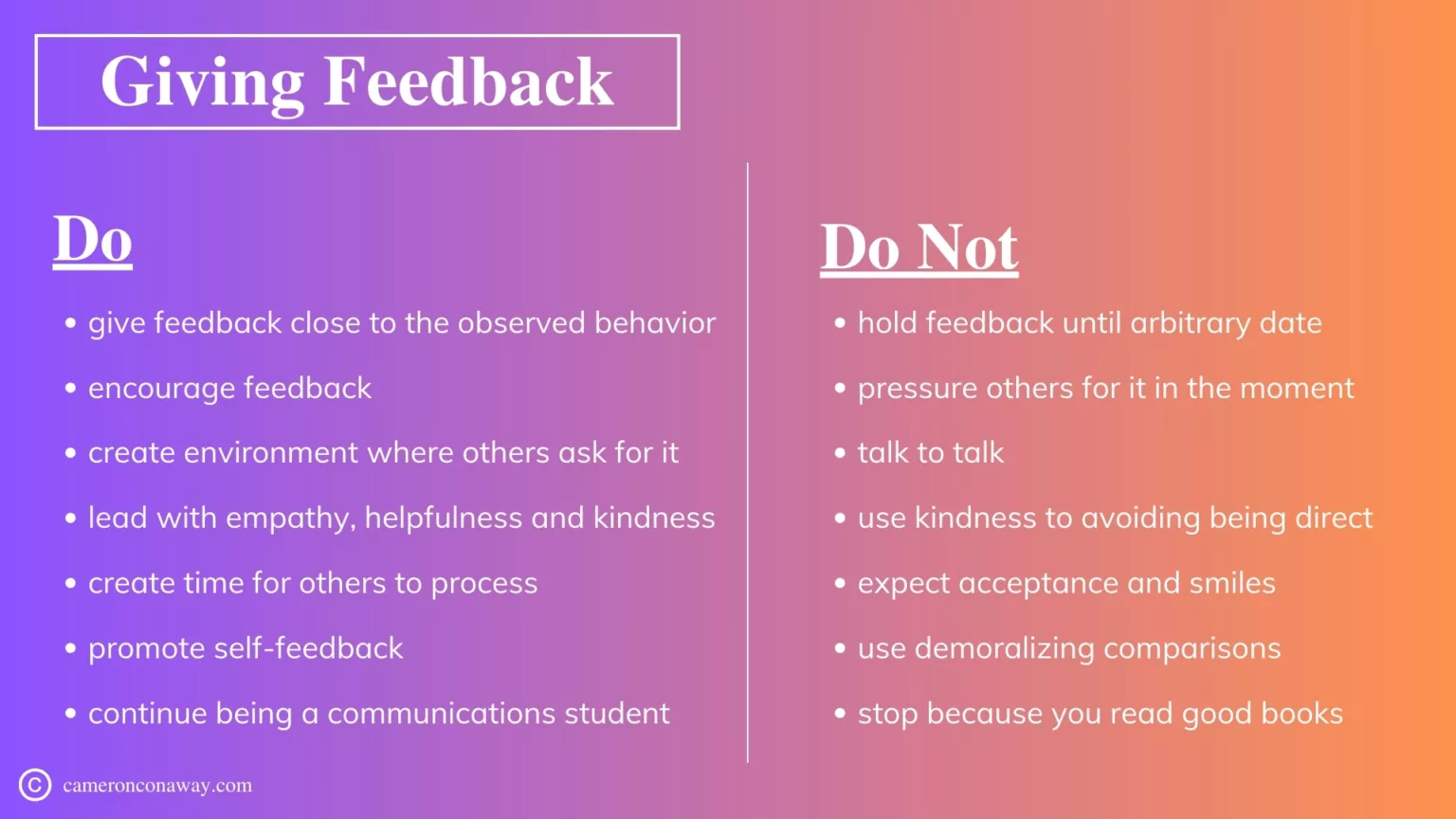
Giving Feedback Tips
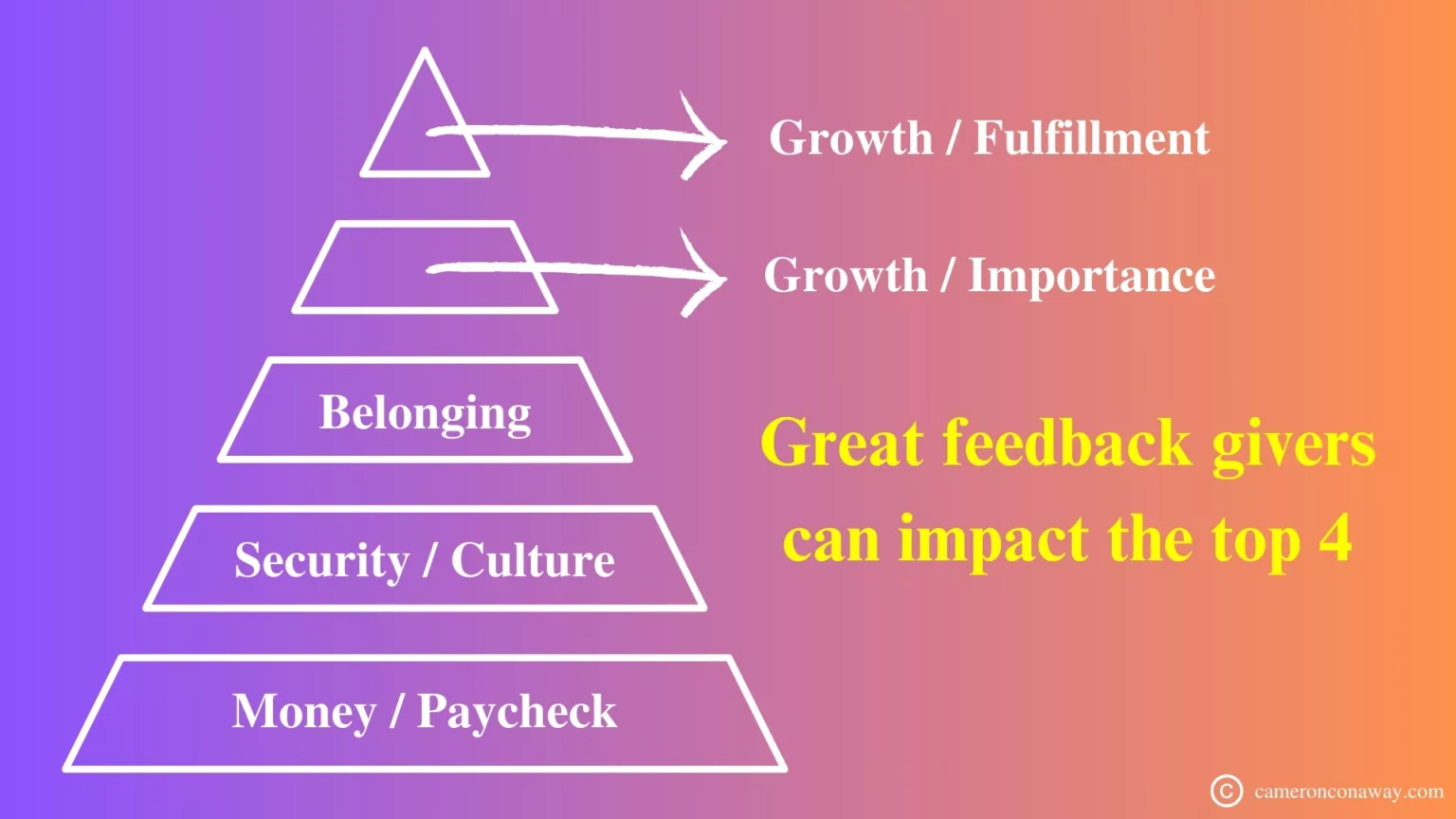
Employee Hierarchy
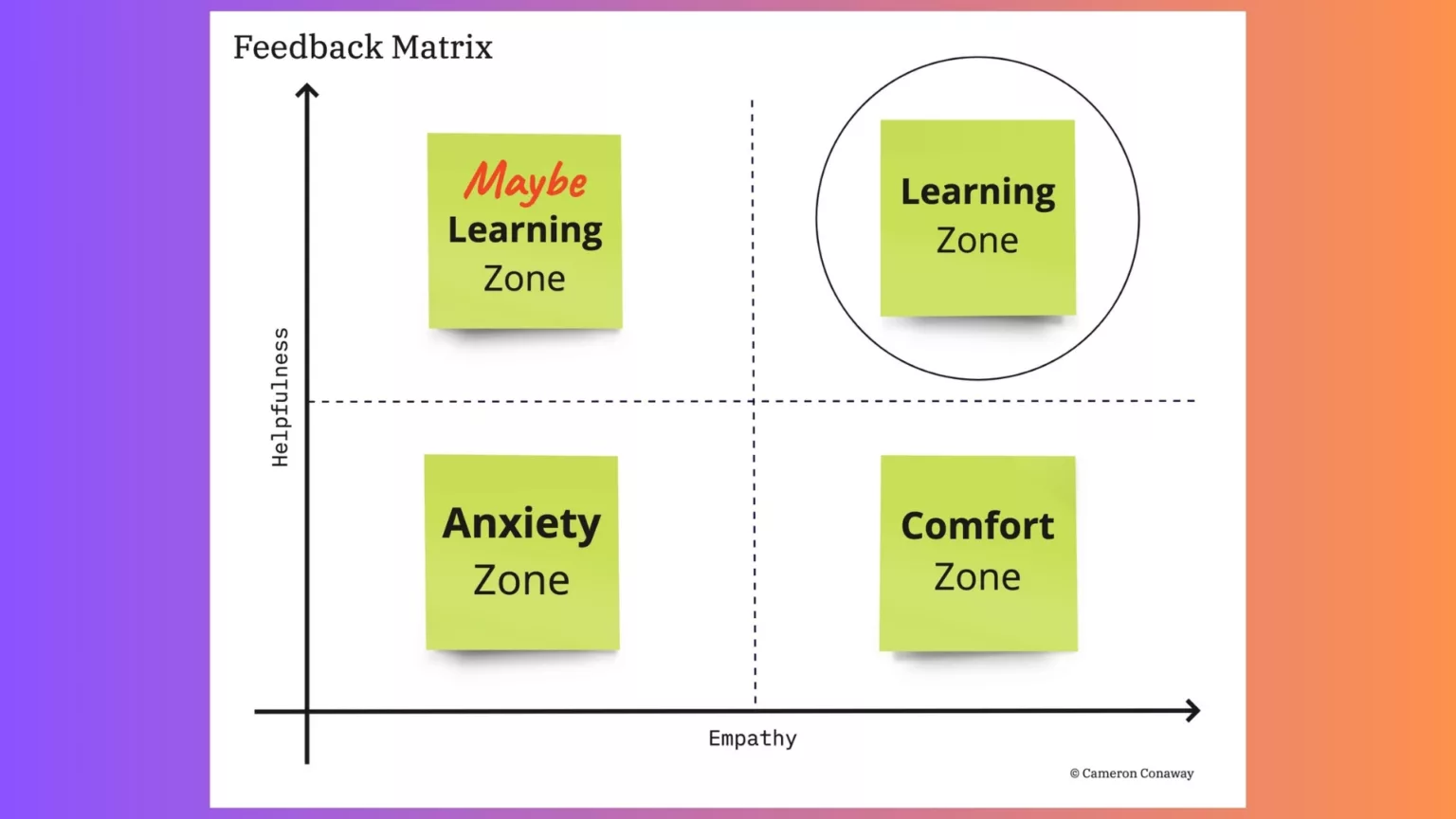
Feedback Matrix
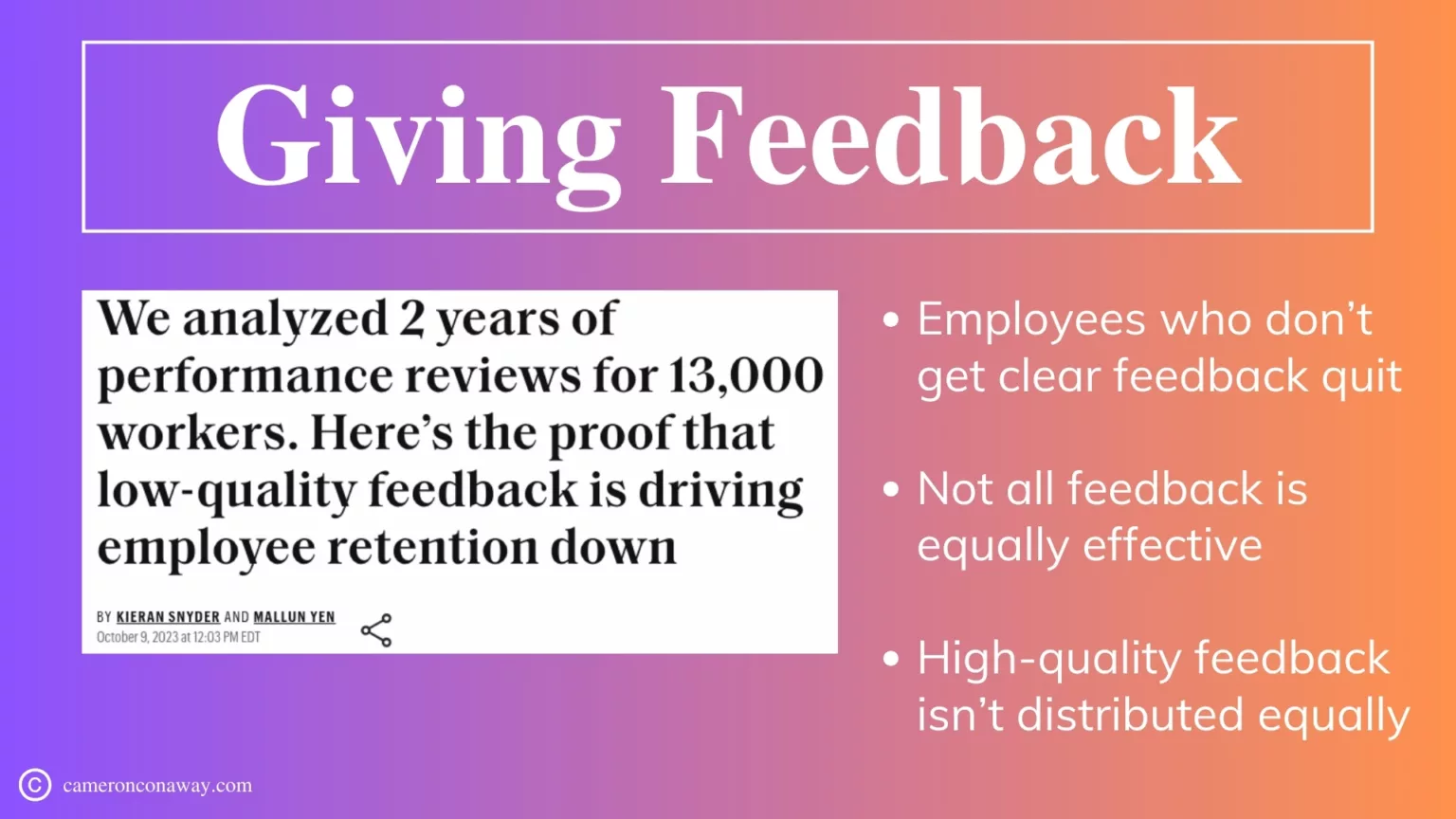
Fortune Study
In my life, feedback has been 0/4
“Feedback is not merely a transaction of words; it can be the mirror through which we view our potential. To master it is to commit to a lifelong excavation of the self—wringing wisdom from every experience until growth becomes inevitable.”
See More Feedback Quotes →How to Receive Feedback
I’ve had a very nonlinear career journey — ranging from being a mixed martial artist paid to get into a cage to fight another human, to being a poet and investigative journalist covering human rights issues.
Entering these different fields has allowed me to see feedback from all sorts of angles, and I’ve come to realize that receiving feedback is how I’ve improved in every element of my life. In mixed martial arts, feedback could be a literal punch in the face. In poetry, feedback could be somebody writing in red pen all over a poem I just put my heart and soul into.
Despite all of the research I’ve done and the experiences I’ve had, I still feel my heart racing with anxiety when I need to step into a quarterly performance review.
“There is a substantial literature on how to deliver feedback to change performance. However, to date no research has been conducted on teaching employees how to effectively receive feedback.”
Journal of Organizational Behavior Management, 2020
How to Receive Feedback Effectively
Hi there and welcome to Module One in our Constructive Feedback course.
Let’s now work through How to Receive Feedback Effectively. I want to start this module by acknowledging that many of us feedback receivers have received some pretty condescending advice in this regard, mostly through the many popular articles out there telling us, essentially, that receiving feedback is mostly about smiling, saying thank you, and making eye contact.
If you’re lucky, you may have found an article talking about active listening. In essence, these articles put the feedback giver on a pedestal and speak down to us feedback receivers. They make it appear as though being perceived as receiving feedback is more important than actually receiving feedback. Unfortunately, this power dynamic also plays out across much of the academic literature about feedback.
Consider this quote from a paper in 2020: “There is a substantial literature on how to deliver feedback to change performance, however to date, no research has been conducted on teaching employees how to effectively receive feedback.” Now, to be fair, there is research out there about receiving feedback – particularly in helping students do so – but the authors of this paper highlight a significant gap in the literature and I wanted you to be aware of it.
So if you’ve received such condescending advice or otherwise just haven’t found practical insights to help you receive feedback, welcome. We’re going to take a far different approach here. Now I know we’ve talked a lot about the perils of making assumptions in this course. But I am going to assume that, generally, you know how to interact with other human beings. With that assumption made known, let’s now explore how to receive the feedback we need to improve as professionals.
In my experience, effectively receiving feedback and being able to sustain our ability to do so over a long period of time comes down to two parts. The first is the ability to consciously cultivate curiosity and a growth mindset. There are several elements worth exploring here. First, let’s look at consciously cultivates. Team, this is about intentionally making an effort to do the inner work it takes to change your mind’s habits. As such, it means developing self-awareness. You can do this through various means, including journaling, meditation, and even therapy, but you may find it quite difficult to begin to develop an inner world that better serves you if you aren’t first taking the time to explore how it’s serving you right now.
Let’s now look at curiosity. Earlier in this course, we mentioned Tim Grover, Michael Jordan’s long-time trainer. Tim has a quote that has stuck with me for some time now. He said, “Interested people watch obsessed people change the world.” I’ll say that again. “Interested people watch obsessed people change the world.” Now, as with all quotes, this may not apply to every situation, but in my experience there’s a truth in there as it relates to receiving feedback. For example, how is it that the greatest artists and musicans and mathematicians and scientists and writers and athletes… how is it that the folks who have reached greatness in their field keep working on their craft day in and day out – which is often what it takes to be great? One might say, as Tim’s quote does, that they are obsessed. But what’s behind that obsession? If you peel that layer back, you’ll find a lot of things, I mean a lot of things, but very often one of them is relentless curiosity. It’s this curiosity that allows us to care about the small details. Yes, one might say to sweat the details, rather than only look at the larger pictures. In this sense, those considered the great of their domain – whether it’s a sushi chef or a fashion designer – tend to see their craft as a mosaic in which they are fascinated and curious by every piece that goes into it.
So, as feedback receivers, we can build a similar mindset. We can set out on this path. Wee might ask: “What is it that I want to improve in?” And then a follow-up question would be: “If what we want to improve in we’re a mosaic, how many of the pieces that go into it are we aware of? And of those pieces we know, how are we working to improve in them?” Lastly, let’s look at growth mindset. As I covered in a video on the Five Feedback Myths, many variables come into play when we receive feedback – and one of them has to do with whether we are more inclined to have a growth mindset or a fixed mindset.
We know from the work of Professor Carol Dweck, you’ll find a link to her book titled, Mindset: The New Psychology of Success, in the description, that those of us with a fixed mindset – that is those of us who are inclined to believe that our intelligence and abilities are fixed – tend to experience receiving feedback as if we failed a critical test. After all, if we believe our qualities are fixed we will likely work hard to portray them as perfect, and feedback rattles this sense of perfection, often causing us feedback receivers to become defensive, even ignore great feedback, and generally feel pretty terrible. Those with a growth mindset, that is, those who are inclined to see their intelligence and abilities as qualities that by their nature can be improved through effort, tend to experience receiving feedback as a valuable and even an exciting opportunity to grow. Billie Jean King’s quote from earlier in the course about how she sees every mistake as feedback is a great example of a growth mindset. As with curiosity, for many of us it takes work to shift our mind into this new way of being.
The second part to effectively receiving feedback is about applying these qualities to serve a continuous pursuit of personal and professional development. We can spend all the time in the world shifting our mind’s habits to better serve us, and this indeed can have a host of benefits, but we also need to bring these mindset shifts out into the world and into our relationships. For the late Lakers superstar Kobe Bryant, this meant going to what he called “GOAT Mountain,” with GOAT standing for Greatest Of All Time. Kobe approached six all-time great basketball players and sought feedback about how to improve. He picked their brain about every minute detail of the game, from their mindset to what they ate. In other words, Kobe had cultivated a growth mindset and then put a disciplined plan in place for how to use this mindset to go around collecting the most constructive feedback he could find.
So if we were to label these two parts of receiving feedback, it might look like this, with the first part being about Mindset and the second about Action. The next point I want to highlight here has to do with where feedback comes from. Too often, I see folks who are early in their journey of taking feedback seriously seem to think it only comes from their manager. With this lens, it’s easy to become a passive feedback receiver, which is exactly the opposite of what we want.
So, first up, you could receive feedback from yourself. You may have noticed your mind can be incessant about calling attention to areas where you aren’t good enough or don’t stack up to others. Again, through cultivating self-awareness and mindfulness, you can begin to leverage this self-feedback for your benefit rather than letting it spiral out of control into harsh and unhelpful looping criticism. Additionally, you can receive feedback from your body. We tend to think the mind is the only place wisdom can arise, but our body is a teacher. In one obvious example: it’s not our mind that tells us there’s something off about how we are sitting at work. It’s our body, often through an ache in the neck or back. We’ll explore the body in a bit more detail later in the course. And second, you can receive feedback from others. But I want you to expand your sense of what others means here. Others can be your manager, but it can also be any of your colleagues, or your friends and family members, or automated systems and bots. Others simply means from anyone or anything outside of yourself. And keep in mind that others doesn’t necessarily mean someone says something to you. You can seek feedback from others through what’s called “Indirect Feedback Seeking,” which simply means observing some qualities in others, comparing that to your own, and using that comparison as a point of feedback for how you might be able to improve.
So now that you have a sense of the Mindset and the need for Action as a feedback receiver, and where feedback comes from, let’s ensure you are looking out for the right things – in other words, let’s ensure you have a sense of what Effective Feedback typically looks like. At a high level, feedback is most effective when it takes place within a relationship that feels psychologically safe. Psychological safety comes from the work of Amy Edmonson, and in a team environment it essentially means all members of the team have a shared sense that it’s safe to ask questions, bring up concerns, disagree, put forth ideas, and even admit mistakes. In other words, these important forms of communication have not just a place but a valued place and they aren’t met with negative consequences. It takes a lot of work to build such an environment for feedback, and we’ll cover some of that in Module 6. Feedback is also typically effective when the mindsets of the feedback giver and the feedback receiver are positive and aligned. As in: both parties are stepping into the relationship with respect and empathy for each other, with a pure intention, and with the goal of development.
As you can likely guess, effective feedback is specific and constructive – not just a call out. As one article in Harvard Business Review puts it: “Telling people they are missing the mark is not the same as helping them hit the mark.” What you’re looking for in effective feedback is not overly vague statements like great work, or even “You need to improve your project management skills,” but the next level that come after these statements, something like: “Here are a few things I loved about your latest effort” or “The latest projects you’ve been working on missed our deadlines. Is there anything I can do to help? How would you recommend we improve in this regard?” And as we will cover in future modules, feedback is most effective when the receiver has time to process and integrate it into their life or workflow.
Here’s a way, inspired by Edmondson’s work, to visualize when feedback coming your way might be the most effective kind. We have helpfulness on one axis and empathy on the other. Typically the best feedback is upper right. It’s very helpful and it’s delivered by a person who can truly understand what the receiver needs and is sensitive to how the receiver may need feedback to be delivered. As you can see from the Maybe Learning Zone, learning can still happen with feedback that isn’t delivered from that place of empathy but it can just as likely be disregarded due to the poor delivery or lack of trust that may arise based on how it was delivered. A related point to note here: a 2017 study showed that leaders who scored higher on empathy tests were better at giving constructive feedback but, get this, a 2022 study showed that their own performance was less effective after delivering feedback because doing so took an emotional tool on them. You’ll also notice here that feedback that isn’t very helpful and isn’t delivered with empathy is more likely to cause anxiety than any kind of professional development. And that feedback that is pure empathy without much helpfulness, as can often be the case with feedback givers who are conflict-averse, isn’t likely to achieve anything great as it will mostly be keeping things comfortable and as they are.
Okay, let’s switch gears a bit and think about being in the moment of receiving constructive feedback. What can you do? How can you best handle that moment? Should you smile and say thank you and all that? Well, here’s how I see it. The first thing you should do is bring attention to your breath. Receiving feedback can stir emotions. Coming back to our breath before, during, and after receiving feedback can help us receive it with grace and feel grateful for the gift – even if it’s a gift we may choose not to use. The second thing you can do is feel into your best self. You know who that person is. Bring them out. Don’t worry about smiling or performing certain acts, just consciously bring your best self to the experience and you will know what to do. You’ll likely leave the conversation feeling far better about how you showed up.
Lastly, and sort of a bonus tip here: When feedback comes out of nowhere it can be helpful to have what I call a Feedback Fallback Phrase. This is a phrase you can use after you’ve received feedback you need time to process. If you receive feedback about fixing a typo, for example, you don’t really need a feedback fallback phrase. A simple: “Thank you for catching that. I’ll make the edit as soon as possible will suffice.” But for feedback that feels challenging, perhaps because it brought forth your defensiveness or because you aren’t sure you agree with it, it can be helpful to have a phrase that quickly acknowledges receipt of the feedback, grants you space to process, and doesn’t immediately agree or disagree with the feedback. Something I’ve used in the past is: “Got it. I hear what you’re saying and I’ll get back to you on that.” As you approach your journey of receiving feedback, it can be helpful to use what I call The Four A’s of Receiving Feedback. The first A is for Aspire. This is a reminder to keep aspiring by centering your development through curiosity and a growth mindset. If you feel yourself starting to stagnate or otherwise get complacent, come back to this one. The next A is for active. This is about pairing your receiver’s mindset work with action, and it’s also about practicing active listening in the moment when you are receiving feedback. If something isn’t clear to you, ask questions about it. One type of active listening you can practice is called reflective mirroring, where you restate in your own words what you think the feedback giver means. By active listening, you are taking a proactive role in ensuring you fully understand the feedback you just received. The third a, because it’s that important, is Ask. This is a reminder to be a constant feedback seeker, to go get what you need. Ask for clarity. Ask for what you think you need. And put yourself in a position to get what you don’t yet know you need. And lastly we have Accept. Consider this a reminder to eventually accept what you received so you can move on. To accept doesn’t necessarily mean to adopt the feedback, it just means you’ve reached what seems like a final level of clarity and you are now ready to move it to the processing phase, which we will cover in the next module.
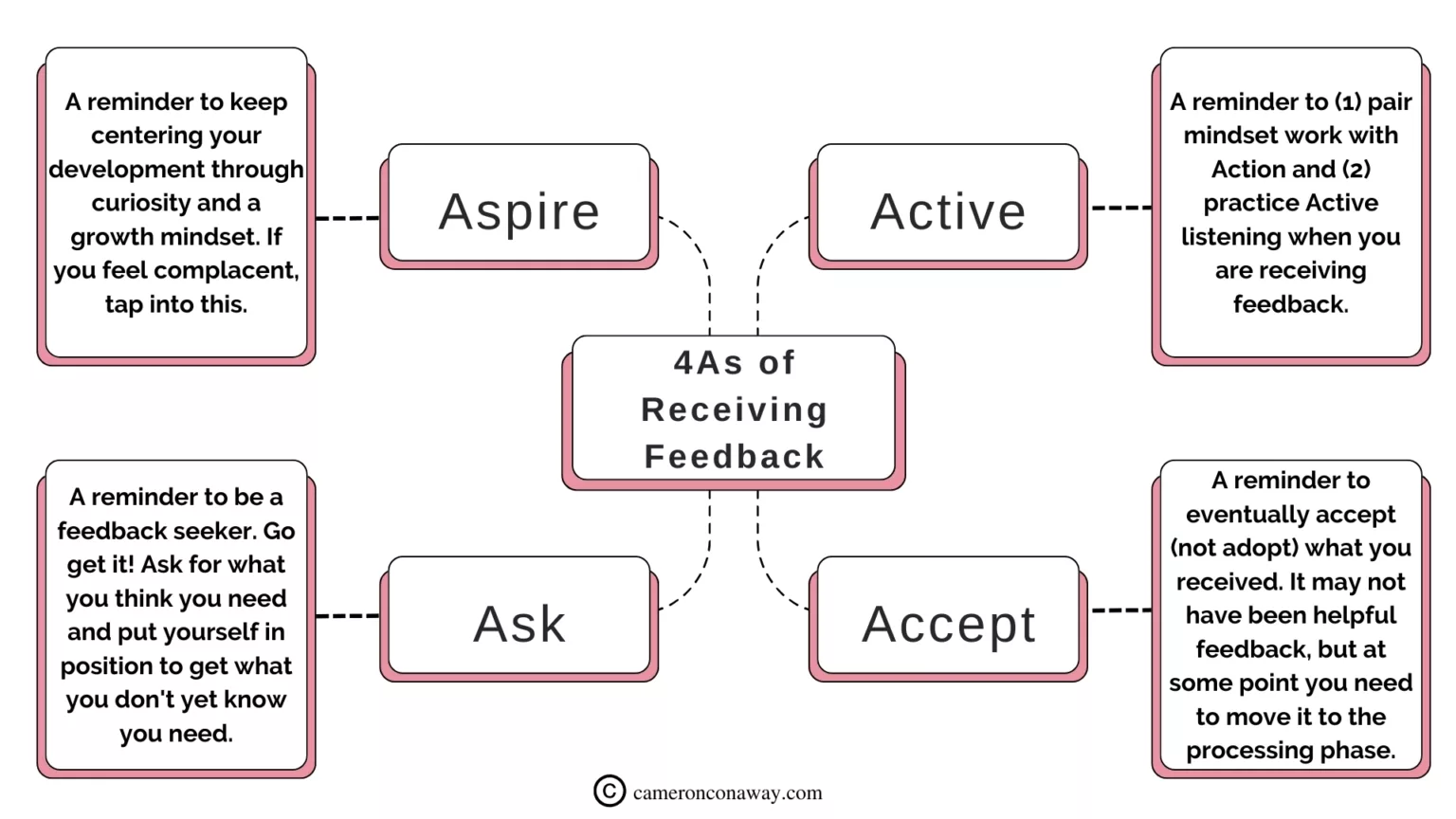
Figure 5.1: The 4 A’s of Receiving Feedback
How to Process Feedback

How to Process Feedback — The Six Ps
Hi there and welcome to Module Two in our Constructive Feedback course.
Processing feedback happens as we receive feedback and is the period after where we determine what to do with it.
If you’ve received challenging feedback, this processing step is especially important.
In this module, we will explore and expand upon my article at Harvard Business Review titled The Right Way to Process Feedback.
While I’m not sure of the editorial choice of referring to the way I’ve come up with as “the right way,” you might think of “right” as meaning “appropriate,” as in the right tool for the job.
The article resonated with thousands of leaders from seemingly every sector from fighter pilots and yoga instructors to senior business executives and academics.
And since the article’s publication I’ve seen many folks now speak to the three elements of feedback: giving, receiving, and now processing.
Before we dive in, and to keep centering our theme of understanding the why behind feedback, why did an article on processing feedback resonate with so many people from so many different industries?
I think this is partly because the article brought to the main stage a third and critical layer to our understanding of feedback.
As we’ve covered, there’s no shortage of content out there about how to give feedback and receive feedback, but mentions of processing feedback rarely get any attention – let alone featured in this way.
Additionally, despite my searching, major business Publications like Harvard Business Review haven’t highlighted a process for processing feedback until this piece.
This is all the more important because, as Angela Duckworth said, the active processing is as essential as its immediacy.
In other words, it’s just as important to be able to process feedback as it is to receive feedback in a timely manner.
As I shared in this video, my thinking about processing feedback arose not from some intellectual exercise but because I was really struggling with feedback I had received from my former manager.
Long story short, it was stressing me out beyond belief – to the point where I couldn’t sleep and felt sick to my stomach.
As I wrestled with this feedback, and allowed it to surface during my meditation practice, I was able to bring awareness to the parts of my thinking that were allowing me to gain some insight into it.
And this eventually became The Six Ps of Processing Feedback, which I wrote about in the article.
So let’s explore each of those a bit.
The first is Poise.
So Poise is about holding the feedback you received with neutrality and grace – both in the moment you receive it and thereafter.
For anybody who has received constructive feedback that maybe touched on a sore spot, this is easier said than done.
Many of us tie some of our personal identity to our work, our performance, and so getting constructive feedback – even if it’s delivered well – can feel like a personal attack and make us want to react.
But here neutrality and grace work in tandem to protect you.
What does this mean in practice?
Step into a feedback session with neutrality – neither enthusiastically agreeing with the feedback nor forcefully rejecting it.
You might recall our feedback fallback phrase from the previous module.
What this phrase did was allow us to respond to the feedback but do so without either emphatically agreeing or disagreeing with it.
In other words, with the neutrality we are talking about here.
This approach, in my experience, allows me to be a better listener instead of simply trying to hear the other person with an intent to respond.
Keep in mind that if adopting the feedback is the way, proceeding to adopt it all at once might not be the best way.
For example, let’s say the feedback you received and chose to implement involves being more assertive in meetings.
Let’s say you’ve got six meetings lined up for the day.
Rather than going all in and showcasing this new assertive side of yourself, I’d recommend the drip approach, perhaps practicing being more assertive during one meeting that day which is on a topic where you have a clear and informed opinion.
You can then journal or otherwise take time to reflect on how they went and proceed from there.
Think of Proceed as your opportunity to practice developing expertise of a new skill.
And forming a habit is more likely to happen with consistent practice over a long period rather than jamming six practice sessions into one day.
The slower approach can be especially helpful when the feedback you received was constructive but didn’t necessarily come with a guide for how to incorporate it.
And our final P is Perspective.
Perspective can be about asking those who you respect and who have seen your new post-feedback performance what they think of it to ensure there isn’t a mismatch between how we perceive our performance and how it’s landing for others.
If the colleague you ask doesn’t know it’s something you’ve been working on, you can frame the question like: “I’ve been working on X. Have you noticed any performance changes in this regard?” If the person does know, you might ask something like: “As you know, I’m working on X. Can you let me know if and when you see improvements in this regard?” Regarding Perspective, I’d also recommend journaling your experiences so that you understand how it’s landing with others and how it feels to you.
Earlier I mentioned practicing during one of your six meetings for the day. In this example, I want to highlight again how helpful it can be to reflect on how that practice went.
If your attempt to be more assertive was exhausting because you’re an introvert, capture that in your journal.
Over time, you may start to notice patterns and gain a better perspective on how to improve in the ways you want while protecting your energy to stay motivated for the long haul.
Lastly, with Perspective, I recommend casting your gaze wide so you are observing others who seem to be doing great in the area you are trying to improve in.
When we commit to improving in something, whatever that something is, it can be helpful to see what a future state might look like.
Although I prefer to use the order outlined here: Poise, Process, Positionality, Percolate, Proceed, and Perspective – it’s also possible to pursue the six Ps in a different order.
You may, for example, already have a sense of the change you want to make.
In this case, you could begin directly at Percolate or even Proceed and progress from there.
Lastly, have some fun with this!
Not all professional development must be paired with a formula, but I found it can be a joy to take something like implementing received feedback and looking back over time at how you’ve practiced, how the practice went, and what new perspectives you’ve gathered along the way.
So that’s a wrap on Module Two, team. I’ll see you over at Module 3.
Processing feedback is the often-overlooked middle stage. We talk constantly about how to give feedback and receive it, but the critical work happens in between: what do you actually do with it once you have it?
The Six Ps offer a framework born from personal experience. Each P represents a distinct stage of engagement with feedback you’ve received — from the immediate moment of receipt all the way to the long view of tracking your growth over time.
Angela Duckworth has noted that the active processing is as essential as its immediacy. In other words, it’s just as important to be able to process feedback as it is to receive feedback in a timely manner.
The 6 P’s of Processing Feedback
Click or tap a card to reveal its strategy
Hold the feedback with neutrality and grace. Avoid immediately reacting, agreeing, or disagreeing. Use a fallback phrase to buy time.
Metabolize the feedback. Let it run through your body and mind. Feel the emotions without judgment before taking action.
Consider the giver’s motives, power dynamics, and social identities. Does their feedback reflect your needs or their values?
Use a decision tree. Do you trust the giver? Does it align with your goals? Decide what to keep and what to discard.
Adopt the “drip approach.” Don’t change everything at once. Practice the new skill in small, low-stakes environments first.
Check in with trusted colleagues. Ask if they’ve noticed your improvements. Journal your progress to see the long view.
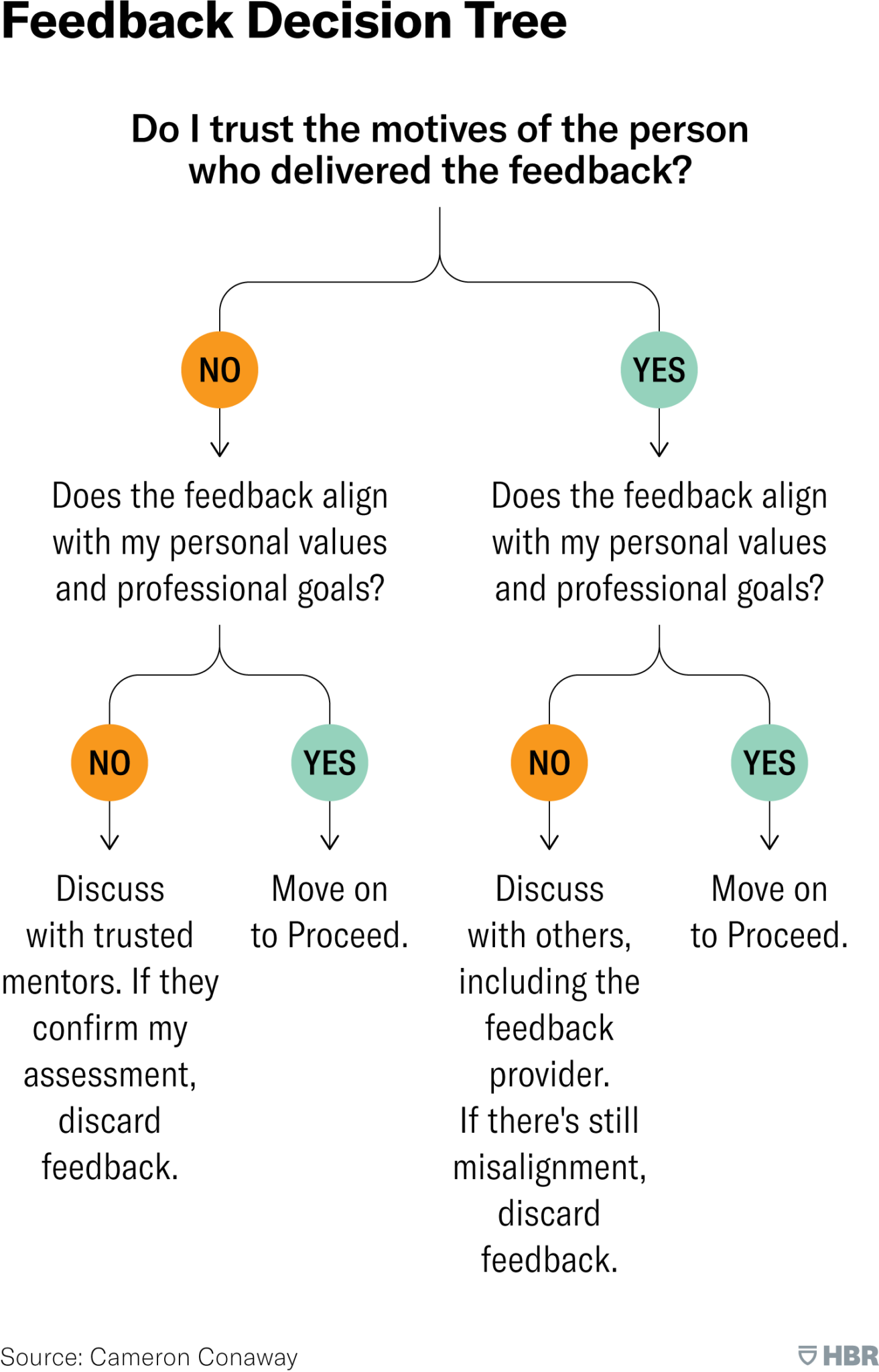
How to Use Feedback

How to Use Feedback — The G.R.O.W.T.H. Model
Hi there and welcome to Module 3 in our Constructive Feedback course.
Now that we’ve received and processed our feedback, it’s time to think about how we use it. At this point in the course we’ve developed an understanding of what feedback is and why it’s important, and we’ve also discussed a few of the challenges that can arise and how to mitigate some of those challenges.
From there, we started to build the pieces of a kind of constructive feedback assembly line. We learned how to receive constructive feedback, including feedback that may be especially challenging to us. But it was here where we realized that receiving feedback does not necessarily mean making a decision about it. We split out the receiving of feedback from our next step, processing it.
So let’s say we’ve used some of the tools in Module 2 to effectively process that feedback and in leveraging the six Ps and the feedback decision tree. Let’s say we’ve now decided that we are going to adopt the feedback – that is, we’ve decided that we can grow professionally if we adopt it. It’s now time to integrate it into our work life.
But as with all parts of this course, it’s worth being strategic here. As feedback researchers have made clear: feedback is perhaps the most powerful lever for our professional growth, but the results can vary due to its complexity. Fortunately, the work you’ve done up to this point by receiving and processing has served as a kind of filtering mechanism, and you may find that in some ways actually using the feedback is the easiest part. As such, this module will be a little shorter than the others as we’ll walk through a framework to help us use the feedback.
So our GROWTH model begins with G with G standing for Game Plan. Just as you’ve carefully and mindfully received and processed the feedback, now it’s time to do the same with using it. Creating a Game Plan has several meanings. First, it’s about building out a strategy for how you’re going to adopt this feedback. You might set a SMART goal here with SMART standing for Specific, Measurable, Achievable, Relevant, and Time-bound.
Next, we move to R with R standing for Reflect. As you progress, it will be important to Reflect on how you’re progressing. You may have days when you feel you made leaps and bounds of progress whereas other days may feel like two steps back. Over time, through reflection, whether through journaling or some other means, you’ll begin to see patterns that can both help ensure you are staying on a path to growth and inspire you by showing you how even the small moments of progress all add up.
From there, we can move to O with O standing for Ownership. Throughout the process of adopting challenging constructive feedback, it’s important for you to keep in mind that this journey is yours to own. Yes, the feedback may have come from someone else but you are not necessarily adopting it for them. This is for you. You own it. You own the journey of it. Seeing yourself as the owner can allow you to tend to your growth with more care and more consistency.
We then move to W with W standing for Wonder. If the Game of Game Plan didn’t resonate with you, here’s to Wonder serving that purpose. At every step along the way, try to to see your path to improvement with a beginner’s mind, with a sense of wonder. Wonder is what allows some of the world’s greatest to remain fascinated by the details of their craft, details that many others may overlook, details that, if developed, can catapult growth.
Our next letter is T with T standing for Test. At various points along the way, it can be helpful to test your progress, perhaps in new environments. To continue with our public speaking example, let’s say your confidence is growing at Toastmasters. A new test for you might be to ask your manager if there might be any internal speaking opportunities in the coming weeks, or if she might be supportive of you applying to speak at an upcoming industry event.
And lastly we have H with H standing for Habit. Learning about all the public speaking skills in the world won’t necessarily lead to you becoming a better public speaker. However, turning a few critical skills into a habit could create some remarkable results. As James Clear, author of Atomic Habits writes, “All big things come from small beginnings. The seed of every habit is a single, tiny decision. But as that decision is repeated, a habit sprouts and grows stronger.”
So team, that’s the GROWTH model for using feedback. Similar to the quote from Billie Jean King we talked about earlier in the course, you might think of feedback equaling growth as a way to remember both the importance of feedback and our model here.
Feedback without action stays trapped as insight. The GROWTH model offers a strategic framework for turning the feedback you’ve processed into lasting professional development.
As feedback researchers have made clear: feedback is perhaps the most powerful lever for professional growth, but results can vary due to its complexity. The strategic work you’ve done in receiving and processing has served as a filtering mechanism — you may find that actually using the feedback is the most rewarding step.
The G.R.O.W.T.H. Model
Click or tap a card to reveal its strategy
Build a strategy. Set SMART goals (Specific, Measurable, Achievable, Relevant, Time-bound). Treat it like a game — bring joy and curiosity to the challenge.
Journal your progress. Some days will feel like leaps forward, others like steps back. Reflection helps you see the patterns and stay inspired.
This journey is yours. You aren’t just doing it for them — you are doing it for your own growth. Own the process and seek feedback on your progress.
Adopt a beginner’s mind. Be fascinated by the details of your craft. Wonder allows you to see nuances others overlook.
Put your new skills to the test in new environments. Ask for opportunities to practice your improved performance in real scenarios.
Turn the skill into a habit. Once it becomes second nature — something you no longer have to think about — you are ready to tackle the next challenge.
Feedback Shorts

What is Feedback?

Dunning-Kruger & Feedback

Women Get 20% Less Feedback

37% of Managers Avoid Giving Feedback

19 Words to Improve Feedback

The COIN Feedback Framework

Should You Use the Feedback Sandwich?

Recency Bias in Feedback

Feedback & Psychological Safety

The Science of Negative Feedback

17% of Employees Quit Due to Feedback

Feedback as Directive vs. Guide
How to Ask for Feedback

How to Ask for Feedback — 6 Strategies
Hi there and welcome to Module 5 where we will cover why asking for feedback is so important and how to go about doing it.
Asking for feedback is perhaps the most effective way to get the feedback you need. As we covered in Module 3 as it relates to using feedback, asking for feedback is an act of ownership – it’s you intentionally breaking what is in many places a business world norm of passively waiting for feedback – and going after it to get what you need.
We’ve mentioned Kobe Bryant throughout this course. Kobe had Phil Jackson as a coach, one of the greatest basketball coaches in history. Kobe certainly could have been a passive recipient of Coach Jackson’s feedback. Indeed, I’m sure many who have played for Coach Jackson did just that. But Kobe went to the next level. He received feedback from Coach Jackson, but as we covered, it didn’t end there. He also sought feedback from what he called GOAT Mountain, a group of six of the greatest living players.
In the academic literature on feedback, this type of behavior is referred to as “Feedback-Seeking-Behavior,” abbreviated as FSB. You can think of feedback-seeking behavior as referring to how individuals seek feedback either by reading the actions of others to infer what it means – in other words, to get feedback purely through observation, or by explicitly asking others for feedback. This concept came to prominence thanks to this classic paper in 1983 by Susan Ashford and LL Cummings. This paper, to my understanding, was the first to really go deep in an exploration of what it means for feedback recipients in the workplace to play a major and proactive role, to truly be owners of their professional development.
This all leads to what they write here, that FSB is “proposed as an important component of the feedback process.” Earlier in the paper, the researchers first set the scene for why feedback is important. They write: “The positive effect of feedback on performance has been an accepted psychological principle since at least the early 1950s.” Among the paper’s many insights on the importance of asking for feedback, and the paper does suggest that feedback receivers should ask for feedback more often, I want to bring our attention to a few particularly compelling passages.
The authors state that these arguments “suggest that it may benefit both individual and organizations to not only give subordinates more feedback” and recall here some of the research we covered in the giving feedback module about how many managers completely avoid giving constructive feedback at all “as the current literature suggests, but also to improve the use of inquiry as a FSB strategy.” In other words, to promote the use of asking for feedback as a strategic tool in the workplace.
They go on to say that such a promotion can best be achieved by attempting to reduce some of the risk and effort costs involved in this strategy. In other words, the culture matters. If there’s psychological safety it will be far easier for everybody in the organization to engage in feedback seeking behavior because the team or department or even the entire organization will see it as a proactive act of growth. Managers, they say, can play a major role in manipulating the shared meaning of this act. Rather than a sign of weakness and uncertainty, asking for feedback could come to represent a confident desire to understand one’s strengths and weaknesses.
Note how the authors specifically call out strengths here. We’ve covered it throughout this course, but I can’t reiterate it enough. Knowing your strengths is often just as and sometimes more important than understanding your weaknesses. A great ballet dancer, for example, could not have become great if they spent most of their time trying to shore up their weakness in geometry. Or, to get even more specific, they wouldn’t have been able to carve out their unique and differentiated strengths as a ballet dancer – perhaps their incredible ability to maintain posture and balance during dynamic pirouettes – if they spent most of their time trying to leap further. If you’re interested in learning more about the importance of strengths, you might check out a book called Strengths-Based Leadership. I’ll link to it in the description.
The authors of our paper on FSB here conclude with “opening up this channel of feedback will allow employees to obtain more accurate appraisals of their work at the times when such appraisals are most valuable.” Lastly, let’s look at one other passage from this paper. “The perspective presented here is also beneficial in that it more accurately reflects how individuals actually acquire and respond to feedback in their organizational lives. In situations where no verbal feedback is being given, our perspective argues that the individual is processing environmental cues and is deriving feedback information from them.” In other words, even in environments where nobody is providing feedback, feedback still remains.
They continue with “second, it is probably accurate to conceive of the individual as having several goals in his or her organizational life beyond present performance, and that each of these goals may serve as the organizing function of FSB.” In other words, as a feedback receiver you would do well to ask for feedback on a range of topics – from specific feedback directly tied to the task you are currently working on to perhaps more general feedback around how you may need to develop to move within your company from a director to a Vice President.
Even if we move out of the 1980s and into the modern era, we still find research highlighting the powerful role of asking for feedback. Consider this quote from a paper in 2022 titled Learning Leadership and Feedback Seeking Behavior: Leadership That Spurs Feedback Seeking. “Lifelong learning is crucial for professionals to continuously develop and update their knowledge and skills, and for organizations to create and sustain competitive advantage. In this regard, feedback-seeking is a powerful vehicle to gain new knowledge and insights in one’s development and performance.” Okay, so let’s jump out of the research and into how to go about asking for feedback.
First, come at this with a pure intention. What do I mean by that? Well, you may have experienced someone who seeks your feedback not necessarily to learn but to quickly get your approval so they can move forward with a project. That’s not really asking for feedback. Or, similarly, some seek feedback as a way to appease someone or to perform humility. In other words, it’s more about the performance of being perceived as a humble feedback seeker than it is about gaining new knowledge and insights. So, to the extent possible, try to seek feedback genuinely and not with hidden motives.
Number two: ask your manager. This seems simple enough but it doesn’t happen as often as it should. And remember that you don’t need to wait until a quarterly performance review to do this, you might even start next week by saying to your manager “Hey. I’ve been watching a course on feedback and since we’ve been working together for insert time period, I’d like to get your feedback on how I’m doing, maybe what you see as my strengths and areas for growth.” Number three, and this is especially true if you are a people manager, you should be regularly asking your team either via a survey, directly going individual by individual, or even going to the group after a project – if the latter you can pull everybody together after a project and ask how they think it went, what worked, and where you might have been able to do a better job as their leader. When this works, and it often does, you will both be receiving great feedback and also modeling for your team what feedback-seeking behavior looks like.
Number four is about indirect feedback seeking. Study those in your field or beyond who inspire you. Maybe you see those folks shining on LinkedIn or you saw them wow an audience at an industry conference or you’ve been reading their blog for years. Rather than merely be inspired, see them as a case study worth really digging into. What qualities do they bring to the table that you admire? What are their strengths? And is there anything about their strengths that you may be able to learn from to improve your own strengths or weaknesses?
Number five is about establishing peer-to-peer relationships, either within your organization or beyond. The research on peer-to-peer feedback is vast and it suggests that we can learn as much or more from meeting with a few peers than we can from meeting with with our manager. If you’re a digital marketer in a large organization, for example, you might reach out to another digital marketer at your same level who works on a completely different part of the business – perhaps you set up a monthly one-to-one conversation to share insights with each other. You might also join an organization in your skill domain. This will connect you with a variety of peers who likely have a similar skill set but have learned to apply it across different sectors. Again, this could be a great opportunity to get feedback.
And, lastly, although there are plenty of other ways, ask for feedback after you interview somewhere. Although some on interview panels aren’t allowed to share their feedback, many are willing if you really push for it. This type of feedback can be especially helpful because this interviewer likely knows the type of talent they need and has perhaps already interviewed many other folks. Their feedback can help you see how you stack up in your field. I’ve personally provided feedback to a few folks who I had great interviews with but who for various reasons didn’t fit what I was looking for. On several occasions, these folks sent me a response about how my feedback meant the world to them and will help both with their development and in their future interviews.
Okay team, that concludes Module 5: Asking for Feedback. I’ll see you over at our final module.
Asking for feedback is an act of ownership. It is you intentionally breaking the business norm of passively waiting for feedback and going after what you need.
We’ve touched on Feedback-Seeking Behavior (FSB) in previous chapters, but here we’ll go deeper. Asking for feedback matters because it sets you up to receive insights others might be too afraid to share, and it builds collaboration into a habit.
When you bring a wholesome intention to seeking feedback, you generally ask the right people at the right time.
The Feedback Vault: Power Questions
6 Strategies for Seeking Feedback
Click or tap a card to reveal its strategy
Don’t seek feedback just to appease someone or perform humility. Come at this with a genuine desire to learn, not just to get approval.
Don’t wait for the quarterly review. Ask next week. “I’d like to get your feedback on how I’m doing, specifically regarding my strengths.”
If you lead people, ask them how a project went and how you could have led better. This models healthy behavior for the whole group.
Study the greats in your field. Treat them as case studies. What strengths do they have that you can reverse engineer?
Research suggests we learn as much from peers as managers. Find someone at your level in a different department and swap insights.
Push for feedback after job interviews. They know the talent market best and can tell you exactly where you stack up.
Building a Feedback Culture
Building a Feedback Culture — Final Module
Hi there and welcome to Module 6, the final module in our course on Constructive Feedback.
The topic here, building a feedback culture, is a big one worthy of an entire book, but I’ll work to address as many points as I can without repeating too much from earlier in the course. For those, who may have stumbled on this video rather than the course, I’ll pause here just to say that while I think you’ll find value in Module 6 here, if you are serious about improving your feedback culture at work, I’d highly recommend starting at the beginning of the course this module is part of as you’ll build some foundational knowledge that will make everything we’re about to cover here make sense on a much deeper level.
Okay, so we’re going to break this module down into five parts. Part one will be to look at a Feedback Relationship Model so we have a visual way to understand how the many dimensions of feedback we’ve covered in this course relate to each other. From there, we’ll move to an in-depth exploration of feedback literacy, a concept we’ve mentioned a few times throughout the course but haven’t unpacked. If some part of your role involves building a feedback culture, and I’d argue that everyones is, then a large part of what you will be doing is working to improve the feedback literacy of yourself and others. As such, it makes sense that we understand what feedback literacy is.
In part three, we’ll keep working with feedback literacy, this time exploring some practical ways we can develop in each of its three foundational areas. In part four, we’ll dive into feedback culture – including an exploration of the ways in which we can categorize the various feedback types that exist within a culture. This will take some of the information we covered throughout the course and give you a new way to look at it so you’re able to think about feedback at the organizational level. And in part five, our last part and a fitting close to the course since we opened with a mention of how Slack made feedback the epicenter of its effort to grow into a $1 billion company, we will cast our gaze beyond the constructive feedback that occurs between individuals at work and towards organizational feedback systems – the ways in which organizations as a whole can be strategic in how they receive and process customer feedback and market feedback.
After all, for constructive feedback between employees to continue having the ability to even exist, the larger organization must be effective at leveraging feedback so it can stay alive and competitive as a business.
Okay, so let’s begin with exploring the feedback relationship model. At the core, we begin with feedback literacy. If you recall, this is your capacity to effectively give, receive, ask for, process, and use feedback – all of the things. Think of it as the collection of all the pieces we’ve covered in this course, whether you are having a challenging conversation with a direct report whose performance is pulling your team down, or are learning from audience survey results that the presentation you spent months preparing didn’t land well, or are preparing to ask a colleague in your field if she might be open to serving as your mentor, or are working diligently to integrate the audience’s feedback you received into your next performance. All of these are part of the feedback relationship and are actually opportunities, what you’ll hear me referring to as experiences, that can allow us to improve our feedback literacy by putting the reps in.
So before we move forward here, I want to call attention to the openings and the lines of this model, the dots that you see here. This represents each element of the feedback relationship holding its own space, with the dotted lines representing fluidity as each element can influence and be influenced by the other. Also notice that there are three levels to this porous nature. In our initial view here, this would mean that what we are describing as the total set of our feedback literacy can leak out to impact other areas. Likewise, those other areas can leak into our feedback literacy. So here is how it works, starting from the inside out. Feedback literacy is at the core because it contains everything and, although developing it takes being in relationship with others, it is an individual capacity we can develop.
Extending from this core individual capacity are the specific feedback skills we’ve covered in our time together. So you’ll see in the next level here we have giving, receiving, processing, and generally experiencing feedback. Let experiencing here be a reminder to get into the arena. As we said earlier, we can intellectualize and read about feedback all day long and yet still not make much progress toward the development of our overall feedback literacy. All of these parts then extend into the enclosed outer layer of the feedback culture. While elements outside of the feedback culture can impact the culture, and while the feedback culture you are primarily part of can leak out to positively or negatively influence other cultures, we enclose it here so we can focus our thinking on it.
In my experience of feedback at work, while we are part of multiple feedback cultures, there’s usually one that we typically inhabit and influence most. As we progress here, you might think about which culture that is for you. Perhaps your direct team or the team you work closest with or, depending on your environment, the primary feedback culture may simply be the relationship you have with a colleague or two. If you are leading some feedback training for your team or organization you may find, as I do, that this visualization makes it far easier to discuss feedback in general and each part in particular. It also helps to break down some of the boundaries we have with feedback – where we put certain folks into certain camps. This visual shows that we’re all working towards improving the same core even if as individuals we have differences in terms of how our time is spread across the different feedback parts.
One last point about culture here: it is both an expression of and a contributor to a group’s feedback literacy. When managers receive advice to build a healthy feedback culture, they can now see this means recognizing existing elements of the culture that may not be as developed and modeling and otherwise helping their team develop the skills that feed into feedback literacy. For example, a manager may find on their team that folks are excellent at receiving feedback, but upon thinking it through further it could just be that their team basically says yes to all feedback as soon as they get it. This can often be the case on teams with very early in career colleagues. If this is the case, you might highlight their openness to receiving feedback as a strength while also letting them know you also want their thoughts about it before they move to adopt it. You might also find other areas where they can develop it. For example, perhaps they can be more proactive by asking for feedback rather than only waiting for it, or perhaps they can begin to flex their muscle to give feedback to you or in peer-to-peer relationships where they can share feedback with others in areas most closely aligned to their greatest skill. For example, you might have an early in career but incredible copywriter on your team provide feedback to others who aren’t as strong in writing. These types of lighter touch feedback relationships can help early in career colleagues begin to build feedback confidence.
Well team, you just completed what is perhaps the most in-depth course available on constructive feedback. Congratulations on not only prioritizing this important topic but focusing on your growth! Now what? Here are some recommended next steps. First, this was an epic achievement. By sharing it with others on social media or elsewhere you will create a ripple that will help others see and prioritize the importance of taking feedback seriously. The world needs it. Second, share the course with your teammates. Building feedback literacy takes all of us acting as a collective. As your teammates level up their skills, you’ll level up yours. If you’re bold enough, you might even incorporate this course into your organization’s professional development plan so that all employees level up together. Third, use what you learned at work, at home, wherever. Keeping everything trapped in your mind won’t be all that helpful for you or humanity.
Fourth, keep learning about feedback. I’ve been at this for a while and I still feel like I’m barely scratching the surface. There are many ways to keep learning, including by reading many of the books I’ve recommended, but an additional way is to sign up for my newsletter on CameronConaway.com. This will ensure you are the first to know about my Feedback Facilitator Certificate Program, an in-depth course that will build on what you learned here and prepare you to be a confident feedback trainer at your organization and beyond – a leader capable of delivering comprehensive feedback training to all employee. We’ll get to work together directly, and I’ll be keeping the cohorts very small to ensure you leave the program feeling fully prepared. Spots in the program will be offered based on the order you sign up, so if you have any interest at all I’d go ahead and get on the list. Congratulations again on your achievement here! May you and those you love be well.
This final chapter brings everything together. A feedback culture isn’t a destination — it’s a continuous practice. The frameworks covered in this course are tools for that practice, not rules to follow once and set aside.
Feedback literacy creates a common language and a common ground for all employees to recognize that feedback is multi-dimensional and an ongoing developmental path that everybody is on — dismantling the invisible walls that too often separate givers and receivers.
When managers receive advice to build a healthy feedback culture, they can now see this means recognizing existing elements of the culture that may not be as developed, and modeling and otherwise helping their team develop the skills that feed into feedback literacy.
The Models
Switch views to explore the relationship between feedback literacy and workplace culture.
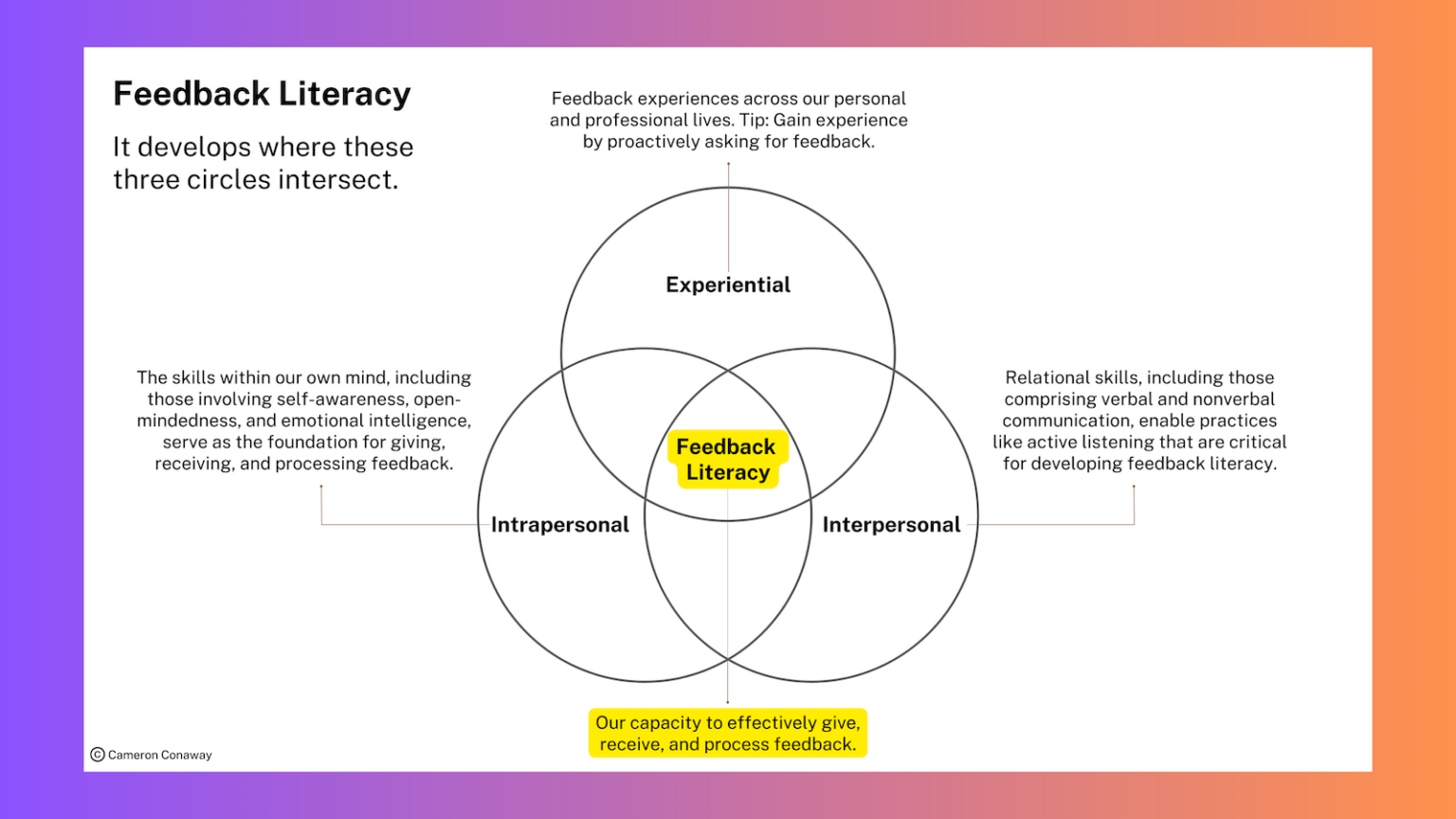
-
IntrapersonalSkills within your own mind. Self-awareness, open-mindedness, and emotional intelligence.
-
InterpersonalRelational skills. Verbal and non-verbal communication, active listening, and empathy.
-
ExperientialThe reps. The feedback experiences we have across our personal and professional lives.
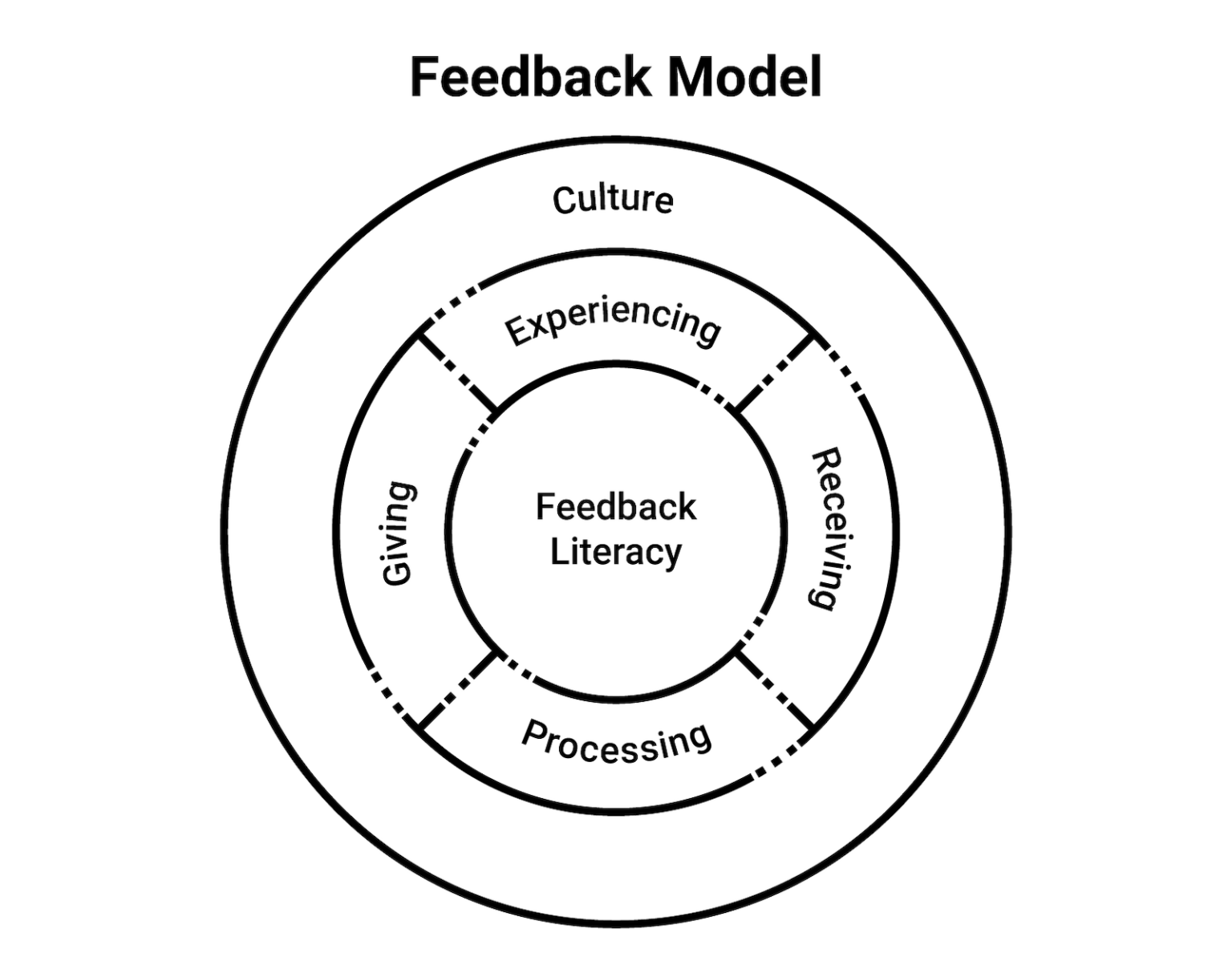
-
The CoreFeedback literacy is central. It is the engine that drives the system.
-
The Porous LinesDotted lines highlight the interplay. Giving, receiving, and processing all bleed into one another.
-
The CultureThe outer circle. A team’s culture is both the result of and the container for these interactions.
The Feedback Deck.
50 cards. 5 suits. One tool designed to build feedback literacy in individuals and teams — from seeking to giving, and every dimension in between.
Feedback Refresher
How often should feedback be given?
For in-depth formal feedback, many leaders schedule quarterly individual sessions with their direct reports. Informal feedback, however, should be given as close to the event being commented on as possible.
How should I prepare for giving constructive feedback?
Use the SEEN acronym: Scene (understand the full context), Empathy (for the receiver), Example (avoid vague generalities), Next opportunity (a future moment where the feedback might apply).
How should I prepare for receiving feedback?
Have a feedback fallback phrase ready: “Thank you, I’ll process that and get back to you.” Always set an intention to bring your best self. Practice active listening and be prepared to take notes.
What is the main purpose of constructive feedback?
To help an individual or group adjust a behavior or activity to become more effective. In the workplace, it serves as a mirror to help employees see their strengths and address areas for development.
What makes feedback constructive?
Feedback is constructive when it is specific, actionable, delivered with care, and focused on helping the person grow rather than simply judging them.
Why do people avoid giving feedback?
People often avoid giving feedback because they fear conflict, don’t know how to phrase it constructively, or have had negative experiences in the past.
What’s the role of psychological safety in feedback?
Psychological safety enables people to give and receive feedback honestly. Without it, people may withhold insights or become defensive.
What’s the best time to give feedback?
The best time is soon after the relevant event — while details are fresh — but only when both parties are in the right mindset to engage productively.
What’s the difference between criticism and feedback?
Criticism often points out flaws without support. Feedback highlights behaviors and provides insight that can help someone improve.
Should feedback be anonymous?
Anonymous feedback can surface hidden truths but risks being less constructive. It’s best used carefully, alongside a culture of open dialogue.
How do you process difficult feedback?
Pause, breathe, reflect. Don’t rush to accept or reject it. Seek context, talk to trusted peers, and revisit it with a growth mindset.
Can feedback be given nonverbally?
Absolutely. Written feedback is vital, and nonverbal gestures (like yawning audience members) provide important cues.
How do I respond to harmful feedback?
Manage your emotional state before and during receiving feedback. Take steady breaths. If the behavior of the feedback giver is abusive, it may be best not to engage and leave the situation.
What is feedback literacy?
Feedback literacy refers to an individual’s understanding of and capacity to effectively give, receive, ask for, process, and use feedback.
What is feedback orientation?
Feedback orientation refers to an individual’s overall receptivity to feedback, including comfort with feedback, tendency to seek feedback and process it mindfully, and the likelihood of acting on it to guide behavior change.
Is feedback communication always biased?
No, but it is often influenced by cognitive biases. Systemic biases within an organization can also influence how feedback is given and received. Structured feedback templates and training can help mitigate some bias.
How is feedback different from coaching?
Coaching is a type of feedback. Not all feedback includes coaching, but all coaching is a form of feedback.
Are there downsides to feedback?
Yes. Bad feedback, poorly delivered feedback, or great feedback given at the wrong time or place can demotivate an employee and even set them up for failure.
What is a feedback loop?
A feedback loop is a continuous and iterative process where an individual or team receives feedback, learns, and improves performance.
My manager doesn’t give feedback. What should I do?
Ask for their feedback directly and be specific. Propose regular check-ins. Remember that you can also seek feedback from peers and industry leaders.
Looking for something specific?
Search Cameron’s entire feedback library.