Feedback Literacy
for All.
Changing how the world gives, receives, and grows from feedback.
I was a cage fighter before I was a business school professor. A journalist covering a genocide before I led global marketing teams. A poet before a contributor to Harvard Business Review. And across every one of those lives, the same thing separated the people who got better from the people who remained stuck: their relationship with feedback.
In the ring, the best fighters weren’t usually those with the most natural skill but those who listened and observed the most. Of all the journalists I’ve worked with, those who grew weren’t the ones who defended every draft — they were the ones who sat with an editor’s critique long enough to understand what it was really saying. At Cisco, the most innovative teams weren’t those with some lone creative genius but those who excelled at seeking and using feedback.
But when I looked for the language to describe this capacity — this ability to seek feedback, be with it, learn from it, decide what to do with it, and offer it well — I found that it barely existed outside of academic journals about the teacher-student relationship. The workplace had no framework for it. Nor did humanity in general. Most people had never been taught these key skills.
Because feedback, done well, changes the way people relate to each other. It’s how a manager earns trust. How a parent stays connected to their teenager. How a team moves from polite silence to real collaboration. How a person stops flinching at hard truths (or jabs) and starts learning from them.
I’ve come to see feedback as the secret to improving in everything. That belief is now my life’s work — through my teaching at Penn State, my research, my writing in Harvard Business Review, and the tools I’m building to make feedback literacy accessible to everyone.
Everything is feedback.
The question is whether we have the literacy to learn from it.
“A workplace feedback expert.”

“A warrior poet.”

“A writer who moves gracefully between liberal arts and martial arts.”

“One of the best professors I’ve had across several universities.”

The Path

A former mixed martial artist (2-1 professional record) as detailed in Caged: Memoirs of a Cage-Fighting Poet, Cameron lived in Thailand for three years, where he held a Muay Thai kickboxing fellowship, taught Shakespeare online for various colleges, and wrote about the horrors of sex trafficking—helping spark broader conversations about how this crime impacts boys. During this time, he also received an arts grant from the Wellcome Trust to write Malaria, Poems (Michigan State University Press), which NPR named one of the best books of the year. Shortly after returning back to the U.S., Cameron created Skillshare’s most popular poetry writing class.

Cameron was an investigative journalist and Daniel Pearl Investigative Journalism Fellow—an honor given to one journalist each year—which took him to Myanmar to report on the Rohingya genocide. He also received a grant from the Pulitzer Center on Crisis Reporting to cover the environmental challenges facing the Ganges River. His work has appeared in Harvard Business Review, Stanford Social Innovation Review, The Washington Post, Newsweek, The Guardian, and Forbes, among others.
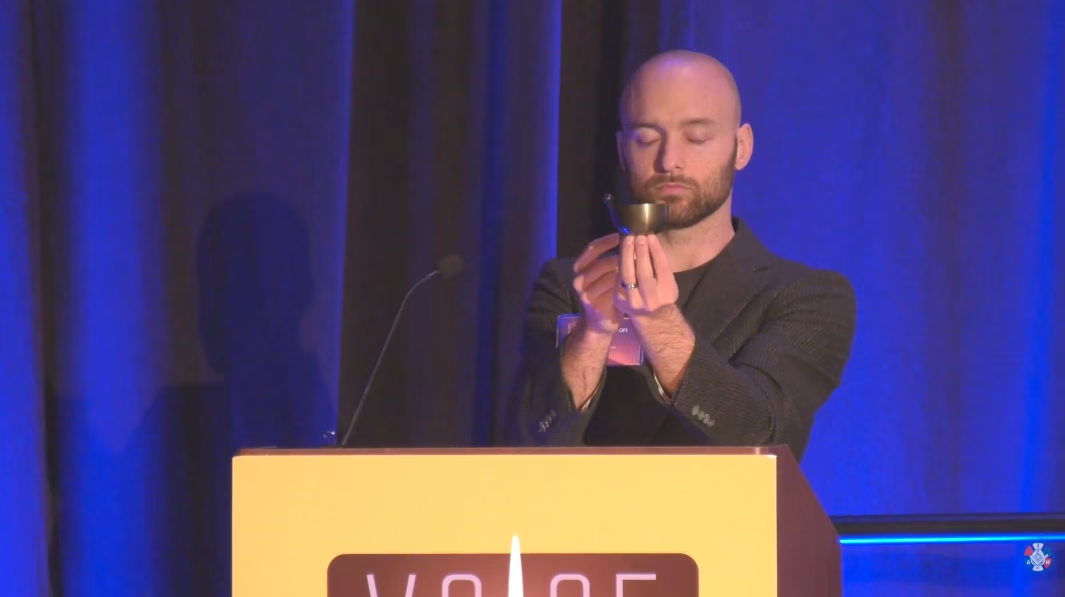
A pivotal 2013 meditation retreat with Zen Master Thich Nhat Hanh set him on a new path of healing from childhood trauma and made mindfulness practice a quiet throughline in his life and teaching ever since.
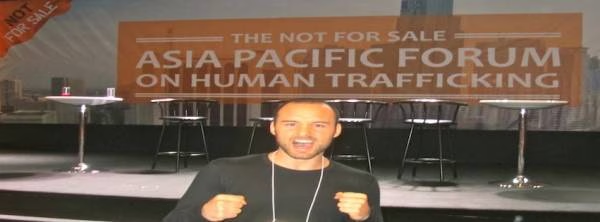
Today, Cameron is a management professor at the Penn State Smeal College of Business, where he teaches undergraduate and MBA courses on ethical leadership and social responsibility. Before Penn State, as a professor at the University of San Francisco, he built and taught the management department’s first MBA-level course on Strategic Talent Management. He has also led marketing for startups and Fortune 100s in Silicon Valley, most recently with Cisco Networking Academy, the world’s largest and longest-running corporate social responsibility education program.
He helps people around the world build feedback literacy through content like his webinar with Harvard Business School (attended by more than 2,000 higher education professionals) and his feedback guide.
The Feedback Definition Guide.
Get the complete breakdown of feedback definitions, types, and examples in one easy-to-navigate PDF. Perfect for printing, sharing with your team, or keeping as a quick reference.
↓ Download the PDF